
Last updated: 4 May 2026
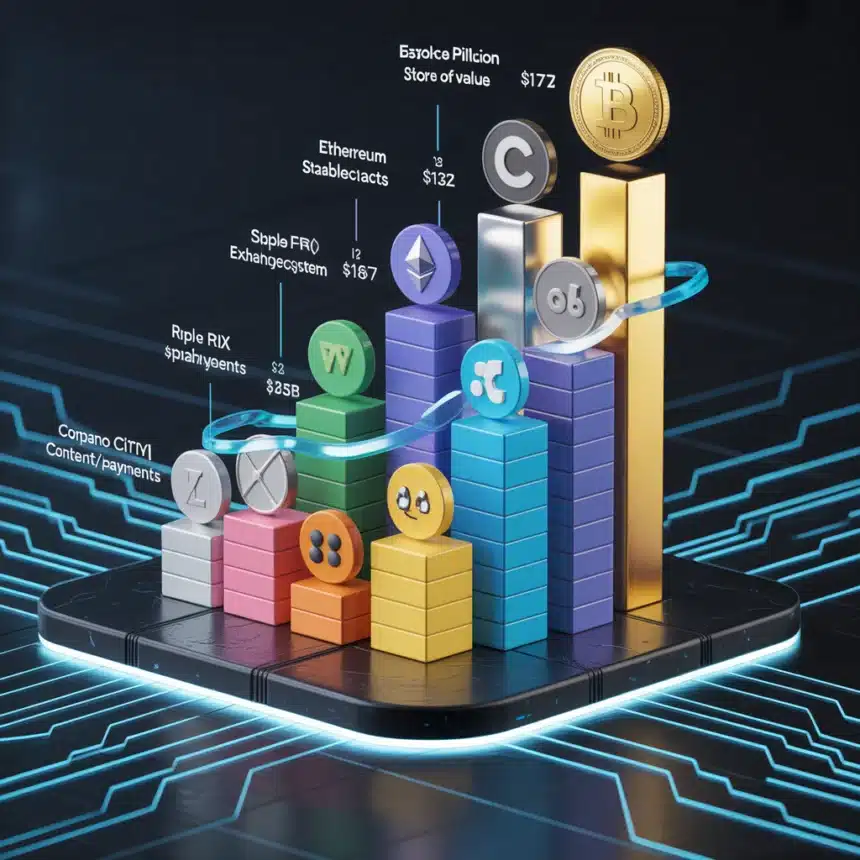
The following is the cryptocurrency ranking as per the data of early 2026
| Rank | Name | Symbol | Category | Market Cap (Approx) |
| 1 | Bitcoin | BTC | Store of Value | $1.78 Trillion |
| 2 | Ethereum | ETH | Smart Contracts | $367 Billion |
| 3 | Tether | USDT | Stable coin | $187 Billion |
| 4 | BNB | BNB | Exchange/Ecosystem | $119 Billion |
| 5 | Ripple | XRP | Payments | $115 Billion |
| 6 | USDC | USDC | Stablecoin | $75 Billion |
| 7 | Solana | SOL | Smart Contracts | $72 Billion |
| 8 | TRON | TRX | Content/Payments | $27 Billion |
| 9 | Dogecoin | DOGE | Meme/Payments | $22 Billion |
| 10 | Cardano | ADA | Smart Contracts | $13 Billion |
| 11 | Bitcoin Cash | BCH | Payments | $11.9 Billion |
| 12 | Chainlink | LINK | Oracle | $9.2 Billion |
| 13 | UNUS SED LEO | LEO | Utility | $8.8 Billion |
| 14 | Hyperliquid | HYPE | Decentralized Exchange | $8.3 Billion |
| 15 | Zcash | ZEC | Privacy | $8.0 Billion |
| 16 | Monero | XMR | Privacy | $7.6 Billion |
| 17 | Stellar | XLM | Payments | $6.8 Billion |
| 18 | Ethena USDe | USDe | Synthetic Stablecoin | $6.3 Billion |
| 19 | Litecoin | LTC | Payments | $6.1 Billion |
| 20 | Sui | SUI | Smart Contracts | $5.7 Billion |
| 21 | Avalanche | AVAX | Smart Contracts | $5.7 Billion |
| 22 | Canton | CC | Interoperability | $5.6 Billion |
| 23 | Dai | DAI | Stablecoin | $5.3 Billion |
| 24 | Hedera | HBAR | Enterprise Ledger | $5.1 Billion |
| 25 | Shiba Inu | SHIB | Meme/Ecosystem | $4.5 Billion |
How the 2026 Rankings Compare to Previous Years
The top of the 2026 rankings reflects remarkable stability. Bitcoin and Ethereum have held their first and second positions continuously since 2017. Tether’s rise to third place is the most significant structural change: a stablecoin now commands a larger market cap than all but two cryptocurrencies, reflecting how much of the ecosystem’s activity runs through dollar pegged assets rather than volatile tokens.
XRP’s return to the top five follows years of legal uncertainty after the SEC filed its lawsuit against Ripple in December 2020. The case’s resolution in 2024, which found that programmatic XRP sales did not constitute securities transactions, cleared the path for US exchanges to relist the token and for institutional buyers to re engage. The rebound in XRP’s market cap is as much a legal story as a technology story.
Solana’s position at seventh place underscores how much the network recovered from its association with FTX. Sam Bankman Fried’s collapse in November 2022 wiped out a significant portion of Solana’s institutional backing overnight. The network’s technical resilience and developer activity kept it alive during the bear market, and the return of retail interest in Solana based memecoins and DeFi in 2024 and 2025 rebuilt its market cap from under $10 billion to over $72 billion.
What the Rankings Do Not Show
Market cap rankings measure stored value, not activity. Ethereum processes far more transaction volume and total value settled than its market cap rank suggests relative to Bitcoin. Stablecoins like USDT and USDC collectively process trillions of dollars in annual transfers, dwarfing the on chain volume of every non stablecoin in the top ten. The rankings are a useful snapshot of where capital is parked, but they are a poor guide to where the ecosystem’s actual economic activity is happening.
Layer 2 networks do not appear in these rankings at all. Arbitrum, Base, Optimism, and Polygon process hundreds of millions of dollars in daily volume but hold their value denominated in ETH or bridged assets. As rollup adoption grows, the relationship between Layer 1 market cap and actual network usage will continue to diverge, making traditional rankings increasingly incomplete as a measure of blockchain health.
What to Watch in the Rankings Through the Rest of 2026
Several projects are positioned to move significantly before year end. Hyperliquid’s entry at 14th place is the most interesting newcomer. It is the first decentralized perpetuals exchange to generate enough fee revenue and user activity to compete with centralized alternatives at a market cap level. If derivatives volume continues migrating on chain, its ranking could climb materially.
Cardano’s $13 billion market cap at 10th place reflects years of slow but deliberate development. The Alonzo smart contract upgrade brought DeFi capabilities, and the Chang hard fork in 2024 advanced on chain governance. Whether Cardano converts its technical progress into meaningful DeFi usage will be the defining question for its ranking trajectory in the second half of 2026.
Privacy coins Monero and Zcash face a different challenge: regulatory pressure. Several major exchanges have delisted both tokens in response to anti money laundering compliance requirements. Their market caps have held because a core user base values financial privacy above exchange accessibility. But continued delistings could structurally limit their growth and push them further down future rankings regardless of the underlying technology.
Get the Daily Briefing
Crypto, AI, and Web3 intelligence. Free, every day.