
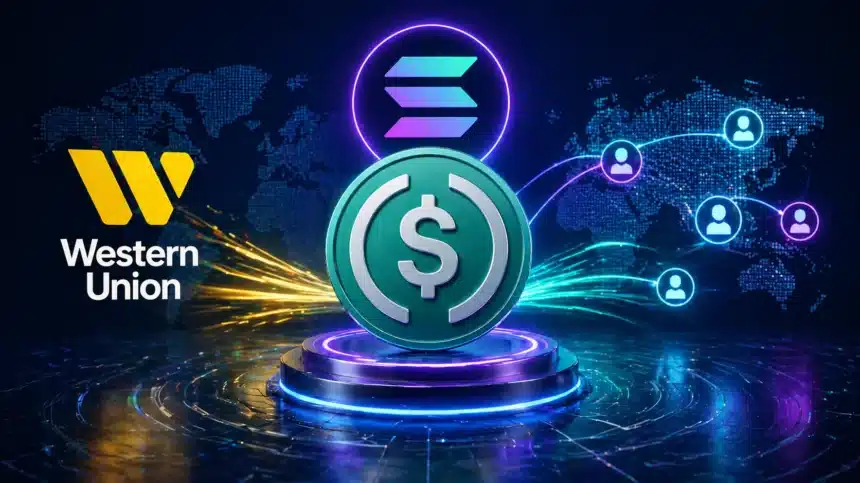
Western Union CEO Devin McGranahan announced on April 27, 2026 that the company’s US Dollar Payment Token, called USDPT, will launch on the Solana blockchain in May 2026. The stablecoin is designed to enable instant cross border settlements and aims to provide unbanked populations in developing markets access to dollar stability without requiring a traditional bank account. Western Union is positioning USDPT as infrastructure for a global digital dollar network built on Solana’s low fee, high throughput architecture.
Key Highlights
- Western Union CEO Devin McGranahan confirmed USDPT launches on Solana in May 2026, making it one of the largest traditional financial institutions to issue a stablecoin on a public blockchain
- USDPT is a fully dollar backed stablecoin pegged 1:1 to the US dollar, issued under Western Union’s payment license framework
- The token targets Western Union’s 500 million customer base in over 200 countries, with a specific focus on unbanked populations in Southeast Asia, Africa, and Latin America who hold dollar savings outside the banking system
- Solana was selected over Ethereum mainnet and other chains for its sub second finality, sub $0.001 average transaction fees, and existing stablecoin liquidity from USDC and PayPal’s PYUSD
- Remittance via USDPT is projected to settle in under 5 seconds compared to the 1 to 3 business days typical of Western Union’s legacy wire transfer network
- The CLARITY Act’s proposed ban on yield bearing stablecoins does not affect USDPT, which is designed as a pure payment token without an embedded yield mechanism
What USDPT is and what it is not
USDPT is a payment stablecoin. It is not a yield bearing product. Each USDPT token represents one US dollar held in reserve by Western Union’s custodial infrastructure. Users can send USDPT across borders in seconds, hold it as a dollar denominated savings instrument, and spend it at merchants or convert it back to local currency through Western Union’s existing agent network of over 500,000 locations worldwide.
The distinction from yield bearing stablecoins matters for two reasons. First, regulatory. The CLARITY Act currently moving through Congress includes provisions that would ban stablecoin issuers from offering yield or rewards on stablecoin balances. USDPT is explicitly structured as a payment instrument, which places it outside the proposed yield ban and positions Western Union to launch without regulatory ambiguity. Second, user experience. The target customer for USDPT is not a DeFi yield seeker. It is a migrant worker in Malaysia sending money to family in the Philippines, or a small business in Nigeria holding dollar reserves against local currency depreciation. Those users need stability and instant access, not yield optimization.
Western Union is not entering DeFi. It is digitizing its existing remittance network. The Solana blockchain provides the settlement rail. Western Union provides the compliance framework, the fiat on and off ramps, and the 500,000 agent locations where customers can convert between USDPT and local cash. The stablecoin regulation debate in Congress has clarified the compliance requirements enough that a company like Western Union can now design a product that fits within the expected legal framework before the law formally passes.
Why Solana and not Ethereum or Base
Solana’s technical architecture makes it the logical choice for a remittance stablecoin targeting high volume, low value transactions. A migrant worker sending $50 to family overseas cannot absorb a $2 to $5 Ethereum mainnet transaction fee. On Solana, the same transaction costs less than $0.001. At that fee level, a $50 remittance carries a fee of effectively zero, compared to Western Union’s traditional wire transfer fees that average 6% to 7% of the transferred amount.
Sub second finality matters for the user experience Western Union needs to compete with mobile money platforms like MPesa in Africa and GCash in the Philippines. Those platforms settle in seconds within their own networks. A blockchain solution that takes minutes or requires waiting for multiple confirmations is not competitive with what unbanked populations in those markets already have. Solana’s architecture delivers the speed that the remittance use case requires without the fee burden that would make the product uneconomical at low transaction values.
Solana already has deep USDC liquidity from Circle and PYUSD from PayPal on the network. The Solana ecosystem in 2026 includes established stablecoin infrastructure, decentralized exchange liquidity, and a developer tooling stack that Western Union does not need to build from scratch. The network effect of existing dollar liquidity on Solana reduces the bootstrap problem for USDPT, because users who already hold USDC or PYUSD on Solana can convert to USDPT at minimal cost through existing decentralized exchanges.
The remittance market Western Union is defending
The global remittance market moved approximately $860 billion in 2025, according to World Bank estimates. Western Union processed a portion of that flow through its traditional agent network, but has been losing share to digital competitors including Wise, Remitly, and a growing number of crypto native services. The average global remittance fee was 6.2% in 2025. Western Union’s average fee sits above that benchmark. USDPT, if it succeeds, would allow Western Union to offer near zero fee international transfers while generating revenue through currency conversion spreads and the float on USDPT reserves held before conversion back to local currency.
The business model resembles PayPal’s early digital payments playbook: build a trusted brand, digitize a slow transaction type, charge a spread on the conversion rather than a flat fee, and capture network effects as more merchants and agents accept the digital instrument. Institutional capital has been flowing into Solana ecosystem projects throughout Q1 and Q2 2026, and a Western Union USDPT launch adds a major legacy institution to that momentum.
What the unbanked actually need and whether USDPT delivers it
The 1.4 billion people globally without bank accounts are not uniformly technologically excluded. Many have smartphones and mobile data access. What they lack is access to dollar savings instruments that are stable, accessible, and do not require a bank account to open or maintain. USDPT addresses the stability and accessibility requirements directly. A user with a smartphone and a Western Union digital wallet can hold dollars, receive international transfers, and convert to local currency at an agent location. No bank account required.
The remaining challenge is the last mile. In markets like rural Indonesia or sub Saharan Africa, smartphone penetration is growing but not universal, and mobile data connectivity is inconsistent. Western Union’s 500,000 agent locations solve part of this problem by providing physical cash in and cash out points. The digital stablecoin layer handles the settlement. The agent network handles the physical money distribution. That combination gives USDPT a distribution infrastructure that purely digital crypto competitors cannot match.
The TCB View
Western Union launching USDPT on Solana in May 2026 is the most significant legacy financial institution entry into the stablecoin market since PayPal launched PYUSD in 2023. The difference is scale and specificity. PayPal launched PYUSD primarily for its existing US user base. Western Union is targeting a global remittance network with 500 million customers in over 200 countries, most of them in markets where dollar stability is a survival tool rather than a financial optimization choice. Solana was the right technical choice. The fee structure is the right product choice. The timing is right because the regulatory framework is clarifying. What Western Union has to execute on is the behavioral change: getting customers who have used the same wire transfer process for years to trust a stablecoin wallet instead. That is a distribution and trust problem, not a technology problem. Western Union has the brand, the agent network, and now the blockchain infrastructure to solve it. Whether it does will define whether legacy finance can genuinely compete in the crypto native financial system that is being built around it.
Free Daily Briefing
Get the Daily Briefing
Crypto, AI, and Web3 intelligence. Free, every day.
The Daily Brief by TCB
Crypto, AI & finance intelligence in 5 minutes. Every weekday morning. Free.