
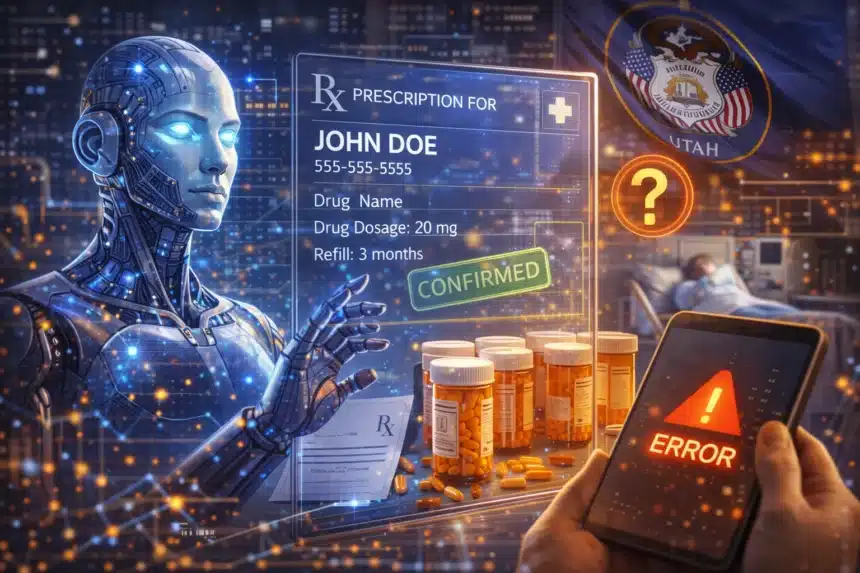
Utah became the first US state to grant AI systems legal authority to autonomously renew drug prescriptions in April 2026. No doctor needs to sign off. No pharmacist needs to review the decision. An AI system evaluates the patient record and issues the renewal. This is a meaningful efficiency gain for a healthcare system under enormous workforce pressure. It is also the first time a US government has formally transferred a clinical decision from a human to an algorithm with no mandatory human override. The accountability question has not been answered.
Key Highlights
- Utah signed legislation in April 2026 making it the first US state to grant AI autonomous authority over prescription renewals
- The law applies to renewal of existing prescriptions, not new prescriptions, and excludes controlled substances initially
- AI tools that assist mental health therapists with documentation are also entering the market rapidly, raising separate safety debates
- The legislation does not specify a liability framework for AI prescription errors: who is legally responsible is undefined
- The American Medical Association has not yet issued a formal position on autonomous AI prescribing authority
The Efficiency Case Is Real
The US is facing a serious physician shortage. The Association of American Medical Colleges projects a shortfall of up to 86,000 doctors by 2036. Prescription renewals for stable, chronic conditions like hypertension, diabetes management, and thyroid disorders consume a disproportionate share of physician time relative to the clinical complexity involved.
For patients who are stable on a medication they have taken for years, an AI system that reviews their latest lab results, checks for drug interactions, verifies there are no new contraindications in their chart, and issues a renewal is faster, cheaper, and probably as safe as a physician rubber-stamping the same renewal after a 90-second chart review. The efficiency argument is strongest in exactly these cases.
The Cases Where It Gets Complicated
The edge cases are where autonomous AI prescribing becomes dangerous. A prescription that was appropriate six months ago may not be appropriate today if the patient started a new supplement, developed a new condition, or experienced a life change that is not reflected in their medical record. AI systems review records. They cannot notice that a patient lost 40 pounds, stopped drinking, or started a new job with different stress levels.
Mental health is a particularly fraught domain. AI tools that assist therapists with documentation are entering the market rapidly, with some moving beyond note-taking into clinical assessment support. The NPR investigation published April 7, 2026, documented cases where AI-assisted documentation tools mischaracterized session content, creating record inaccuracies that persisted into clinical decision-making downstream.
The Accountability Gap
When a doctor renews a prescription incorrectly and a patient is harmed, the accountability pathway is clear. The physician has a license, malpractice insurance, and a professional duty of care. The legal framework for resolving harm is established.
When an AI system renews a prescription incorrectly, the accountability pathway is undefined. Utah’s legislation does not specify whether the AI vendor, the healthcare provider that deployed the system, the pharmacy that filled the prescription, or the patient bears responsibility for harm. This is not a hypothetical gap. It is a legal vacuum that will be filled by the first major AI prescription error lawsuit, and the outcome of that case will define AI healthcare accountability for a generation.
Also read:
Google Just Quietly Launched an Offline AI Dictation App. No Announcement. No Press Release. Just Shipped. | Decentralized AI Is the Most Searched Crypto Narrative of 2026. Here Is Whether It Deserves the Attention.
Microsoft Just Made Its Largest AI Investment in Asia. $10 Billion. Japan. No Competitors Are Close. | Meta Launched a New AI Model After Spending $14 Billion on Alexandr Wang. Here Is What It Actually Does.
AI Funding in 2026: The $242 Billion Surge That Changed Everything | AI Agent Wallets Are Coming. Here Is What Autonomous Onchain Finance Actually Looks Like
The TCB View
Giving AI systems autonomous authority over healthcare decisions is not inherently wrong. It is probably right for a narrow category of stable, low-risk prescription renewals. The problem is that “narrow” categories expand under institutional and economic pressure. Once autonomous AI prescribing is normalized for renewals, the argument for extending it to initial prescriptions, to higher-risk medications, to mental health treatment plans, follows naturally. Utah has drawn a line. That line will be tested. The state has an obligation to define who is accountable before the first serious harm, not after it.
Free Daily Briefing
Get the Daily Briefing
Crypto, AI, and Web3 intelligence. Free, every day.
The Daily Brief by TCB
Crypto, AI & finance intelligence in 5 minutes. Every weekday morning. Free.