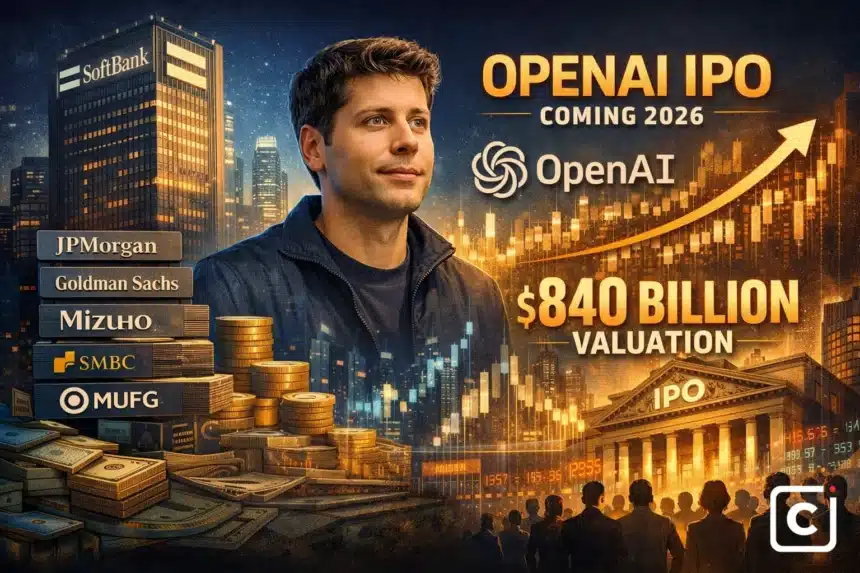
SoftBank has secured a $40 billion unsecured loan from a consortium led by JPMorgan and Goldman Sachs to fund its $30 billion commitment to OpenAI’s record $110 billion funding round. The loan, which carries a 12 month term, is the largest unsecured corporate credit facility arranged for a single investment. Its structure tells you what the banks believe is coming next: an OpenAI IPO before the end of 2026.
Key Highlights
- SoftBank secured $40 billion in unsecured credit from JPMorgan, Goldman Sachs, Mizuho, SMBC, and MUFG
- The loan covers SoftBank’s $30 billion commitment to OpenAI’s $110 billion funding round
- OpenAI’s post money valuation stands at $840 billion
- OpenAI crossed $25 billion in annualised revenue at the end of February 2026, up from $21.4 billion at year end 2025
- ChatGPT now serves 900 million weekly active users with 9 million paying business customers
- The 12 month unsecured loan term suggests lenders expect an IPO exit within that window
Why the Loan Structure Matters
A $40 billion unsecured loan is not normal corporate finance. Banks do not extend that kind of credit without a clear thesis on how they get repaid. The 12 month term is the signal. SoftBank does not plan to service this debt from operating cash flow. It plans to repay it from the proceeds of an OpenAI liquidity event, most likely an IPO.
The consortium behind the loan, JPMorgan, Goldman Sachs, Mizuho, SMBC, and MUFG, represents the top tier of global investment banking. These institutions have access to OpenAI’s financial data, growth trajectory, and strategic plans. They would not have approved this facility without confidence that an exit event is imminent.
OpenAI’s Revenue Trajectory
OpenAI crossed $25 billion in annualised revenue at the end of February 2026, up from $21.4 billion at year end 2025. That represents roughly 17% growth in two months, a pace that, if sustained, would put OpenAI above $30 billion in annualised revenue by mid year.
The growth is being driven by enterprise adoption. ChatGPT now serves 900 million weekly active users, but the commercial engine is the 9 million paying business customers. Enterprise contracts are larger, more predictable, and carry higher margins than consumer subscriptions. This is the revenue mix that makes an IPO viable.
The $840 Billion Valuation Question
OpenAI’s post money valuation of $840 billion places it among the most valuable private companies in history. At $25 billion in annualised revenue, that represents a price to revenue ratio of roughly 34x. For comparison, Microsoft trades at approximately 13x revenue. Nvidia trades at roughly 25x.
The valuation is not absurd by growth stage technology standards, but it does require OpenAI to maintain its current growth rate for several years. Any significant deceleration in revenue growth, whether from increased competition, compute cost pressure, or enterprise adoption plateauing, would compress that multiple rapidly.
The Sora shutdown earlier this month illustrates the risk. Products that consume enormous compute resources but fail to generate proportional revenue can burn through capital quickly. OpenAI’s core business, ChatGPT and the API, is performing well. The question for IPO investors is whether the company can maintain discipline about which products to fund and which to cut.
What an IPO Means for the AI Industry
An OpenAI IPO in 2026 would be the largest technology IPO by valuation in history. It would establish a public market benchmark for how to value frontier AI companies. It would also provide the first transparent look at OpenAI’s financials, including compute costs, margins, customer concentration, and the actual economics of running large language models at scale.
For the broader AI industry, a successful OpenAI IPO would validate the business model and unlock a wave of follow on public offerings from AI companies that are currently private. For competitors like Anthropic, Google, and Meta, it would establish the valuation ceiling against which their own AI investments are measured.
The TCB View
Follow the banks. A $40 billion unsecured 12 month loan from five of the world’s largest financial institutions is not a bet on maybe. It is a bet on a specific outcome within a specific timeframe. The IPO is coming. The only remaining questions are when in 2026 it happens and at what valuation the public market is willing to set the opening price.
For investors, the signal is clear. For the rest of the AI industry, an OpenAI IPO creates both opportunity and pressure. Opportunity because it validates the market. Pressure because it establishes a benchmark that every other AI company will be measured against, including those whose economics may not survive that comparison.
The Daily Brief by TCB
Crypto, AI & finance intelligence in 5 minutes. Every weekday morning. Free.