
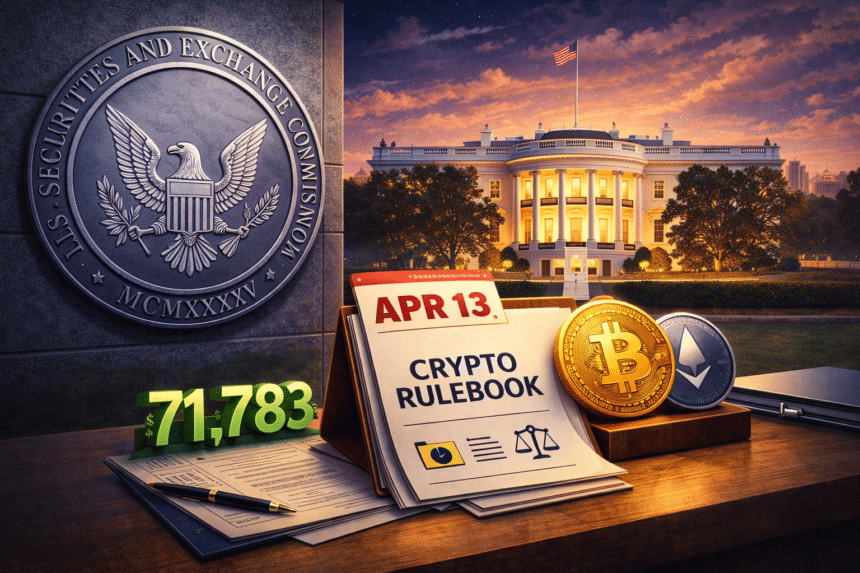
SEC Chair Paul Atkins confirmed that the commission’s “Reg Crypto” proposal has been submitted to the White House Office of Information and Regulatory Affairs, the regulatory gateway that all major federal rules must pass through before public publication. Separately, the Senate Banking Committee has scheduled a markup of the Crypto Clarity Act for April 13, two days from now. The convergence of executive and legislative action in a single two week window is the most concentrated moment of US crypto regulatory activity since the spot ETF approvals in January 2024.
- SEC Reg Crypto proposal submitted to White House OIRA as of early April 2026
- OIRA submission is the final step before a proposed rule is published for public comment
- Reg Crypto focuses on startup exemptions and crypto fundraising under the Securities Act of 1933
- SEC and CFTC signed a Memorandum of Understanding on March 11, 2026 and issued a joint interpretation on March 17
- Senate Banking Committee markup of the Crypto Clarity Act scheduled for April 13, 2026
- Senator Bill Hagerty has confirmed a Senate floor vote is possible by end of April 2026
What Reg Crypto Actually Proposes
Reg Crypto is the SEC’s attempt to create a regulatory pathway for crypto projects that are not straightforwardly securities under existing law. The focus is on the Securities Act of 1933, specifically the exemption framework that allows startups to raise capital from accredited investors without full SEC registration. The proposal would define which types of token issuances qualify for those exemptions and which require full securities registration.
This matters because the current state of crypto fundraising in the United States is a legal gray zone. Projects raise capital through token sales. The SEC has argued in multiple enforcement actions that many of these sales constitute unregistered securities offerings. Reg Crypto would establish, for the first time, a set of affirmative safe harbors that allow token projects to raise capital legally without registration, provided they meet specific disclosure and decentralization criteria.
The OIRA Process and What It Signals
Submission to the Office of Information and Regulatory Affairs signals that the SEC considers Reg Crypto a significant regulatory action ready for interagency review. OIRA reviews major rules from all federal agencies for consistency with executive orders and presidential priorities before they are published in the Federal Register. The review typically takes 90 days, though it can be expedited for priority rules.
Under the current administration, crypto regulation has been designated a priority area. An expedited OIRA review could result in publication of the proposed rule within 30 to 60 days, opening a public comment period that would draw extensive industry participation. The comment period would likely run 60 to 90 days, placing final rule adoption in late 2026 at the earliest. But publication itself would represent the first comprehensive SEC rulemaking specifically designed for the crypto industry.
The SEC CFTC Joint Framework
The Memorandum of Understanding signed on March 11, 2026 between the SEC and CFTC resolved one of the most persistent structural problems in US crypto regulation: which agency has jurisdiction over which assets. The joint interpretation issued on March 17 established that assets with proof of stake consensus mechanisms and active governance token structures are more likely to fall under SEC jurisdiction, while proof of work assets like Bitcoin remain primarily CFTC jurisdiction.
This matters because dual jurisdiction has been a significant compliance burden for crypto exchanges and custodians operating in the US. An exchange listing both Bitcoin and Ethereum effectively faced oversight from two different agencies with different rules. The joint framework creates clearer lines and reduces the compliance cost of operating a diversified crypto platform in the United States.
The April 13 Markup: What to Watch
The Senate Banking Committee markup of the Crypto Clarity Act on April 13 is the next critical inflection point. A markup session is where committee members vote to advance the bill to the full Senate floor, potentially with amendments. The yield ban provision on stablecoins is the most contested element of the bill and is the amendment most likely to be debated.
Industry observers are watching for three possible outcomes: the yield ban survives intact, which would galvanize DeFi opposition; the yield ban is modified with carve outs for decentralised protocols, which would be broadly welcomed; or the markup advances the bill without resolving the yield issue, leaving it for floor debate. Senator Hagerty’s confidence that a floor vote is possible by end of April 2026 suggests he believes sufficient committee votes exist to advance the bill.
Why This Window Matters for the Industry
The combination of Reg Crypto publication and Crypto Clarity Act passage would represent the first comprehensive legal framework for digital assets in the United States. Every project raising capital through token sales, every exchange operating a derivatives business, and every stablecoin issuer currently operates under enforcement risk because the rules are not clear. A clear rule set, even one that imposes costs, is better for institutional adoption than continued uncertainty.
Major institutional investors including sovereign wealth funds and pension funds have cited regulatory uncertainty as their primary reason for not allocating to crypto. That constraint does not disappear immediately when rules are passed, but it begins to dissolve. Compliance teams at large institutions need 12 to 18 months to adapt to new frameworks. The regulatory window that opens in April 2026 starts that clock.
The TCB View
The US crypto regulatory window of April 2026 is the one that the industry has been building toward since the first enforcement actions against ICOs in 2017. The critical variable now is not whether rules will be passed but whether those rules will be drafted by people who understand what they are regulating. Reg Crypto’s focus on the 1933 Act exemptions suggests the SEC is working from first principles rather than retrofitting existing securities law. The outcome of the April 13 markup will indicate whether Congress is doing the same. A yield ban carve out for decentralised protocols would be a strong signal that legislators understand the difference between a bank deposit and a smart contract liquidity pool. The absence of that carve out would be an equally strong signal that they do not.
Free Daily Briefing
Get the Daily Briefing
Crypto, AI, and Web3 intelligence. Free, every day.
The Daily Brief by TCB
Crypto, AI & finance intelligence in 5 minutes. Every weekday morning. Free.