
Last updated: 8 April 2026
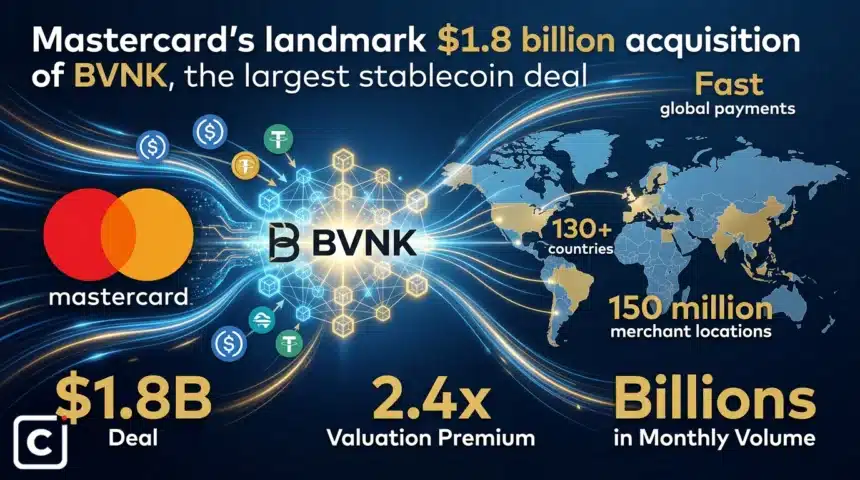
Mastercard agreed on March 17, 2026, to acquire BVNK for up to $1.8 billion. The London based stablecoin infrastructure company will give the world’s second largest card network a direct bridge into blockchain payments across 130 plus countries. It is the largest acquisition of a stablecoin firm on record.
Key Highlights
- Mastercard is paying up to $1.8 billion for BVNK, including $300 million in performance contingent payments
- BVNK was valued at approximately $750 million in its last funding round: Mastercard paid a 2.4x premium
- The deal ended rival talks between BVNK and Coinbase, which had been negotiating an acquisition before Mastercard entered with a higher offer
- Once integrated, Mastercard’s 150 million merchant locations will gain a direct path to stablecoin settlement across all major blockchain networks
What BVNK Actually Does
BVNK, founded in 2021, is not a consumer product. Most people have never heard of it. It is infrastructure: the company enables businesses to send, receive, store, and convert stablecoins across more than 130 countries, running on all major blockchain networks.
Its clients include crypto exchanges, fintech platforms, and traditional businesses that need to move large sums across borders without the delays and fees of correspondent banking. BVNK does not issue stablecoins itself. It builds and operates the rails that let other businesses use them.
At the time of the deal, BVNK processed billions of dollars in monthly stablecoin volume. Its compliance stack covers VASP licensing across multiple jurisdictions, which is one of the most time consuming and expensive assets any payment infrastructure company can hold.
Why Mastercard Paid 2.4x the Previous Valuation
Stablecoin transaction volume crossed $30 trillion in 2025, exceeding the combined annual volume of Mastercard and Visa, according to data from Visa Crypto and The Block. That is not a projection. It happened.
In markets like Latin America, Southeast Asia, and Sub Saharan Africa, stablecoin transfers have already replaced wire transfers and currency exchange for large segments of the population. These are Mastercard’s high growth regions. Watching stablecoin volume grow there without having the infrastructure to capture it is not a viable long term position.
Building from scratch would take three to five years at minimum: compliance layer, wallet integrations, multicurrency conversion, blockchain node operations, and live testing at scale. BVNK has all of it running today. The $1.8 billion is the cost of not starting from zero in 2026.
The Deal That Almost Went to Coinbase
The Mastercard deal ended talks that BVNK had been holding with Coinbase. Coinbase had been in acquisition discussions with BVNK before Mastercard entered with a higher offer, according to reporting from Fortune and CNBC.
The failed Coinbase bid adds context to the price. When two of the most strategically motivated buyers in the stablecoin space compete for the same asset, the winning bid reflects genuine strategic value rather than a speculative premium.
For Coinbase, the outcome means one of the clearest paths to institutional business to business stablecoin infrastructure is now inside Mastercard instead of its own product stack.
What Changes for Businesses
The most immediate change is reach. Mastercard’s network spans 150 million merchant locations globally. Once the BVNK integration is complete, any of those merchants will be able to accept stablecoin payment from a counterparty anywhere in the world and have it settled to a local bank account in their domestic currency through a single Mastercard connection.
For a business in Colombia receiving payment from a supplier in Vietnam, that path currently runs through correspondent banking, sometimes spanning three to five days and costing 3 to 7% in fees. A stablecoin settlement layer cuts that to minutes and a fraction of a percent.
The deal is subject to regulatory approval in the UK, the EU, and the United States. Mastercard expects it to close by the end of 2026.
The Pattern Every Payment Incumbent Should Study
Mastercard’s move is not isolated. Stripe acquired stablecoin startup Bridge for $1.1 billion in 2024. Visa Crypto Labs launched a tool in March 2026 allowing AI agents to make card payments autonomously. PayPal has been expanding its PYUSD stablecoin since 2024 across Solana.
Each major payment network has reached the same conclusion independently: stablecoins will be a core settlement layer for the next decade. The question is no longer whether to build on that thesis. It is how fast and at what cost.
At $1.8 billion, the BVNK deal is the highest price paid for stablecoin infrastructure to date. It will not hold that record for long.
Free Daily Briefing
Get the Daily Briefing
Crypto, AI, and Web3 intelligence. Free, every day.
The Daily Brief by TCB
Crypto, AI & finance intelligence in 5 minutes. Every weekday morning. Free.