Key Takeaways
- Big Money: Google is putting up $5 billion to help Anthropic build a home for its AI.
- Huge Power: The center will start at 500 megawatts (MW) and aims to reach 7.7 gigawatts (GW).
- Texas Location: Texas was chosen because it has a lot of land and its own way of handling electricity.
- The Shift: The “AI war” is no longer just about who has the best math; it is about who has the biggest “engine” to run that math.
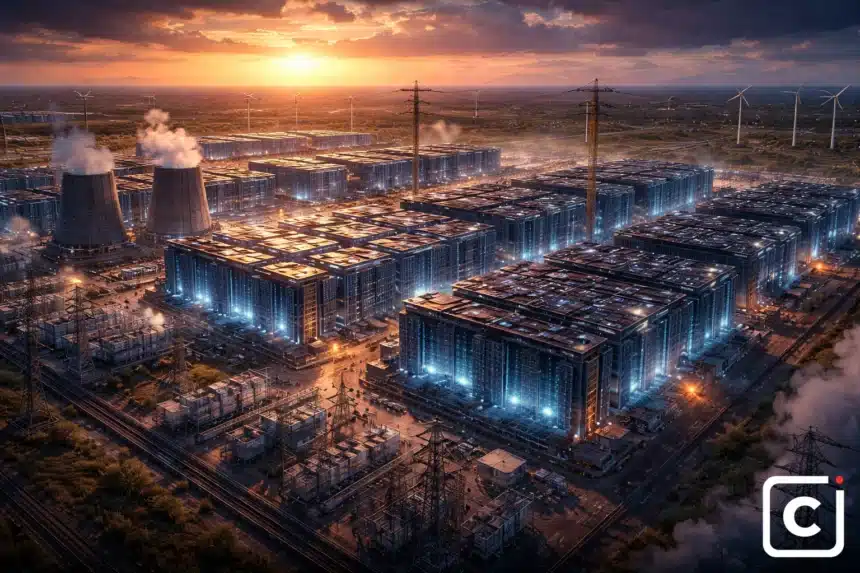
Google is currently finishing a deal to provide $5 billion in funding for a giant computer center in Texas built for the AI company Anthropic. This project is starting with enough power to run a large city and has a plan to grow into one of the largest power consumers on Earth, proving that winning at AI is now about who has the most electricity and hardware.
What is Happening in Texas?
To understand this deal, think of a computer center as a giant library. In the old days, a library just needed enough light for people to read. But an AI computer center is more like a giant factory that never sleeps. It needs thousands of special computer chips that get very hot and eat up a lot of electricity.
Google and Anthropic have picked Texas for a new “super” library. While many companies build small centers, this one is being built on a scale we haven’t seen before. They are starting with a size that uses 500 units of power (megawatts). To give you an idea of how much that is, one megawatt can power about 200 to 900 homes depending on the time of year. So, right at the start, this building will use as much power as a small city.
But that is just the beginning. The “roadmap” or the future plan for this site is to reach 7.7 gigawatts. This is a number that is hard to wrap your head around. One gigawatt is 1,000 megawatts. So, they want to grow this project until it is over 15 times its starting size.
Why Is Google Spending $5 Billion?
You might wonder why Google is giving so much money to another company like Anthropic. Anthropic is the creator of “Claude,” which is a direct competitor to Google’s own AI and ChatGPT.
The reason is simple: Google wants to be the “landlord” of the AI world. By providing the money and the technology to build these centers, Google ensures that the most powerful AI in the world runs on Google’s systems. It is like owning the tracks that every train must run on. If Anthropic becomes the most popular AI, Google still wins because they provided the “house” where that AI lives.
From Algorithms to Atoms: The New AI Race
For the last few years, the talk about AI was all about “algorithms.” An algorithm is just a fancy word for a set of instructions or a recipe that a computer follows. People thought the company with the best recipe would win.
However, the world has realized that even the best recipe doesn’t matter if you don’t have a big enough oven. In this case, the “oven” is the data center.
The Shift in Focus:
- Old Way: Writing better code and hiring the smartest math experts.
- New Way: Securing thousands of acres of land, building giant power stations, and buying millions of computer chips.
This is why people are calling it a shift from “bits” (computer code) to “atoms” (physical buildings and wires). If you don’t have the physical space and the electricity, you cannot build a smarter AI.
Understanding the Power Numbers: 500MW to 7.7GW
To really see how big this is, we need to look at the concrete numbers.
| Stage | Power Amount | Equivalent Comparison |
| Initial Phase | 500 Megawatts | Enough to power roughly 250,000 to 400,000 homes. |
| Final Goal | 7.7 Gigawatts | More power than several nuclear power plants combined. |
If this project actually reaches 7.7 gigawatts, it would likely be the single largest consumer of electricity in the United States. To put that in perspective, the state of New York uses about 18 to 20 gigawatts on an average day. This one project in Texas would represent a massive chunk of a whole state’s power needs.
Why Texas?
Texas is a very specific choice for a project this big. Most of the United States shares electricity across state lines. If one state runs low, another can help. But Texas has its own separate power grid.
Texas also has:
- Lots of Space: You need miles of land to build something this big.
- Fast Building Rules: It is often easier and faster to get permission to build big things in Texas than in places like California or New York.
- Energy Variety: Texas produces a lot of wind and solar power, which tech companies like Google want to use to show they are being “green” or eco-friendly.
However, there is a risk. The Texas power grid has struggled during very cold winters or very hot summers. Adding a giant “power hog” like a 7.7GW data center will put a lot of pressure on the local wires.
Who is Anthropic?
If you haven’t heard of Anthropic, they are a group of researchers who used to work at OpenAI (the people who made ChatGPT). They left because they wanted to focus more on making AI “safe” and “helpful.”
Their AI, Claude, is known for being very good at writing and following complex instructions without making as many mistakes. Because Claude is becoming very popular with big businesses, it needs a lot more “brain space” to work. That is why they need this $5 billion deal. They are moving from being a small group of researchers to a giant company that needs its own massive infrastructure.
The Cost of Being Smart
Building a “smart” AI is becoming incredibly expensive. It isn’t just about the $5 billion for the building. Companies also have to pay for:
- Chips: The special computer parts (often made by a company called Nvidia) cost tens of thousands of dollars each. A center this size will need hundreds of thousands of them.
- Cooling: When you run that many computers, they get hot enough to melt. You have to spend millions of dollars on water and giant fans to keep them cool.
- People: You need thousands of construction workers to build it and hundreds of engineers to keep it running 24 hours a day.
How Does This Affect You?
You might think a big building in Texas doesn’t matter to someone living somewhere else, but it does.
First, it affects the tools you use. When you ask an AI to write an email or explain a math problem, the answer comes from one of these centers. The bigger the center, the faster and more “human” those answers become.
Second, it affects prices. All this spending on electricity and chips can change the price of energy or the cost of the devices we buy.
Third, it marks a change in the economy. We are moving into a time where “computation” (the ability to process information) is becoming a commodity, just like oil or gold. The countries and companies that own the most “compute” will likely be the ones that hold the most power in the future.
The Competition: Microsoft and Amazon
Google isn’t the only one doing this. Microsoft has a similar deal with OpenAI, and they are rumored to be working on a project called “Stargate” that could cost $100 billion. Amazon is also buying land next to nuclear power plants to build its own centers.
This $5 billion deal between Google and Anthropic is Google’s way of saying they won’t be left behind. They are putting their money into the ground literally to make sure they have a seat at the table.
What Could Go Wrong?
A project this big has a lot of hurdles.
- The Grid: Can the Texas power grid actually handle 7.7 gigawatts? If not, the project might never reach its full size.
- The Money: $5 billion is a lot of money, even for Google. If AI doesn’t start making a lot of profit soon, investors might get nervous about these giant spending habits.
- Environment: Even if they use wind and solar, a building using this much power has a big impact on the environment. People are starting to ask if “smart” software is worth the “heavy” physical cost.
Looking Ahead: What’s Next?
The next few months will be about finalizing the paperwork and starting the construction. You will likely see more news about Google buying energy from Texas wind farms or solar fields to power this giant.
We should also watch for Anthropic releasing new versions of their AI. Each time they get a new “room” in this Texas data center, their AI gets a little more room to “think.”
FAQ:
1. What is a data center?
It is a large building filled with thousands of computers that store and process information for the internet and AI.
2. Why does AI need so much electricity?
To “think,” AI has to do trillions of math problems every second. This makes the computer chips work very hard, which uses a lot of power and creates a lot of heat.
3. Is 7.7 gigawatts a lot?
Yes. It is enough to power millions of homes. It is an almost unheard-of amount of power for a single business project.
4. Will this make my electricity bill go up?
It depends on where you live. In Texas, there is a debate about whether these big centers help the grid by paying for new power plants or hurt it by using up all the available energy.
5. Is Google buying Anthropic?
No. Google is a big investor and a partner, but Anthropic is still its own company. This deal is more like Google building a customized office building for Anthropic to rent.
6. When will the Texas center be finished?
The first part (500MW) will likely be ready in the next year or two, but the full 7.7GW plan could take a decade to finish.
7. Why is it called an “arms race”?
Because tech companies feel like they have to build these centers just to keep up with each other. If one company gets a bigger “brain” for their AI, the others feel they must do the same or they will lose their users.
Editor’s view
The deal between Google and Anthropic is a clear signal that the world of technology has changed. We are no longer just talking about apps on a phone or websites on a screen. We are talking about massive physical infrastructure that rivals the biggest power plants and factories ever built.
As this $5 billion project moves forward in Texas, it will serve as a test. Can we build the physical world fast enough to keep up with how fast our AI “brains” are growing? Only time will tell, but for now, the race is on, and it is being run with concrete, steel, and billions of watts of electricity.
Follow The Central Bulletin on X for daily AI and crypto coverage.
The Daily Brief by TCB
Crypto, AI & finance intelligence in 5 minutes. Every weekday morning. Free.