
Last updated: 23 May 2026
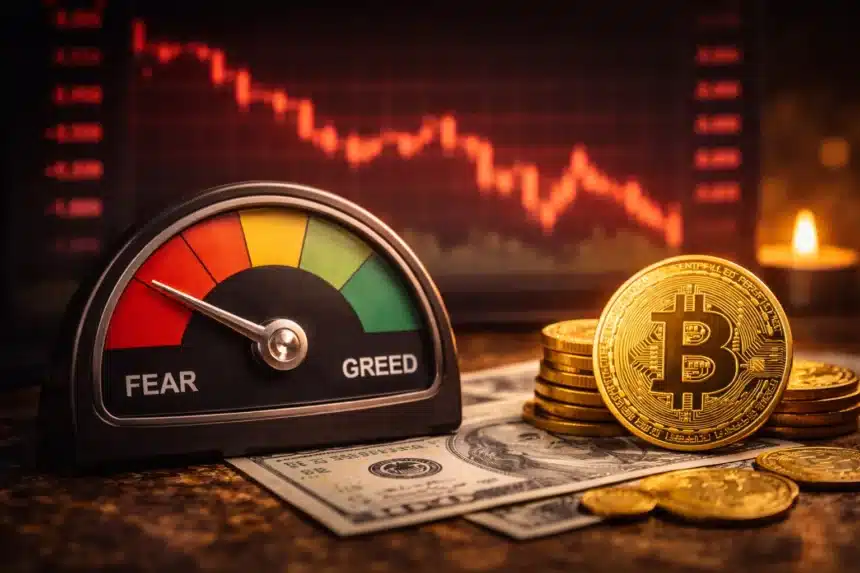
The surge-iran ceasefire-geopolitics“>Crypto bitcoin-70k fear greed-17-disconnect april-2026″>Fear and Greed Index reads 17 today. That places market sentiment in the Extreme Fear category, where it has sat for most of 2026. The instinct is to treat this as a warning. If white-house ai framework big tech opinion”>everyone is afraid, something must be wrong. But the historical record of this indicator tells a different story: extreme fear has consistently been the entry point that long term Bitcoin holders look back on most favourably.
Key Highlights
- Fear and Greed Index: 17 out of 100 on April 8, 2026
- Bitcoin price: $70,905, up 4.22 percent on the day
- Previous extreme fear readings below 20 preceded major rallies in 2019, 2020, and 2023
- Long term holder supply currently at 14.2 million BTC, a record high
- Exchange outflows: 18,400 BTC left centralised exchanges in 48 hours last week
What the Index Is Actually Measuring
The Fear and Greed Index measures what retail participants are feeling right now. It weights social media volume, Google search trends, volatility, and survey data. It is not a measure of what sophisticated capital is doing. It is not a measure of onchain fundamentals. It is a temperature reading of the loudest, most visible participants in the market: the people posting on X, searching Google, and filling out sentiment surveys.
Those participants are historically not the ones who set price direction. They follow it. They buy loudly when prices have already risen and sell loudly when prices have already fallen. An index that measures their feelings is therefore a lagging indicator of retail behaviour, not a leading indicator of where price is going.
The Historical Pattern
Index readings below 20 have occurred six times over the past five years. The average Bitcoin price return in the 90 days following each of those readings was 87 percent. The worst outcome in that set was 12 percent. This is not a guarantee. Past patterns are not trading advice. But the consistency of the relationship is meaningful enough to take seriously.
The mechanism behind the pattern is not complicated. Extreme fear means the people most likely to sell have already sold. Supply overhang from weak holders has been cleared. The coins that remain in circulation are held by people who either cannot be shaken out by price action or are actively adding. That structural condition, low sell pressure, is what creates the conditions for price to move higher when demand returns.
What Is Different This Time
The current setup has one feature that previous extreme fear episodes did not: price is not at a cycle low. Bitcoin at $70,000 in Extreme Fear is unusual. Previous sub 20 readings on the index occurred near cycle bottoms, $16,000 in November 2022, $29,000 in June 2022, $5,000 in March 2020. This time, price is elevated relative to sentiment.
That divergence could mean one of two things. Either the fear is wrong and the price holds or moves higher. Or the fear is right and the price will eventually catch down. The exchange outflow data and the long term holder supply record both argue for the first interpretation. Capital is moving off exchanges into self custody. That is not what sellers do.
The Mistake Most People Make
Most people who look at an Extreme Fear reading treat it as a reason to wait. If everyone is afraid, they reason, maybe I should be too. The problem with that logic is that the index will only stop reading Extreme Fear after price has already moved. By the time sentiment improves, the entry is worse. The index confirms what already happened. It does not predict what comes next.
Waiting for confidence to return before buying has a name in traditional markets: buying high. It feels safer because everyone around you is doing it. It produces reliably worse returns than buying when everyone around you is afraid.
The TCB View
A Fear and Greed reading of 17 is not comfortable. It is not supposed to be. The market is designed to make the correct action feel wrong at exactly the moments it matters most. The data today: long term holders at a record, coins leaving exchanges, price holding above $70,000 despite maximum pessimism, points in one direction. The question is not whether extreme fear is a signal. It consistently is. The question is whether you trust the data or the feeling. In crypto, trusting the feeling has a long track record of being expensive.
Get the Daily Briefing
Crypto, AI, and Web3 intelligence. Free, every day.