
Last updated: 11 April 2026
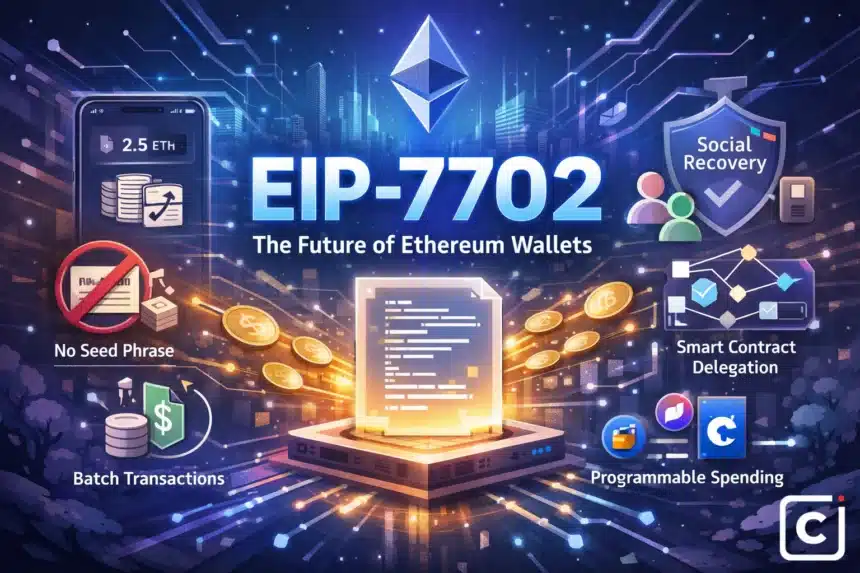
EIP-7702 went live on Ethereum mainnet with the Pectra upgrade in May 2025. It is the most important change to how Ethereum wallets function since the network launched. It allows any regular Ethereum address to temporarily behave like a smart contract. In practice, that means: no more seed phrases required for recovery, no more manually managing ETH for gas, the ability to batch multiple transactions into one, and programmable spending rules on any wallet. Most users do not know it exists. That is about to change.
Key Highlights
- EIP-7702 activated on Ethereum mainnet with Pectra upgrade, May 7, 2025
- Allows any regular wallet address to delegate behavior to a smart contract
- Enables transaction batching, gasless transactions sponsored by apps, and social recovery
- Does not require users to migrate funds or change wallet addresses
- MetaMask, Rainbow, and Coinbase Wallet are already integrating EIP-7702 features
- Sets the stage for mainstream Ethereum wallets that work like normal apps
The Problem EIP-7702 Solves
Before EIP-7702, Ethereum had two types of accounts. An externally owned account (EOA) was a regular wallet controlled by a private key. A smart contract account was code deployed on chain, capable of complex logic but requiring a separate EOA to trigger it. The two could not overlap.
This created the classic Ethereum UX problem. Every action required ETH for gas. Every transaction was separate. Recovering a lost wallet meant having the seed phrase, with no alternatives. Approving a token for use in a DeFi protocol was a separate transaction from actually using it. None of this makes sense to someone who has never used crypto before.
EIP-7702 dissolves the boundary between EOAs and smart contracts. With one signed authorization, a regular wallet can point its behavior to any smart contract code, temporarily inheriting all the logic in that contract without moving funds or changing its address.
How It Works: The Technical Explanation Without the Jargon
When you sign an EIP-7702 authorization, you are telling the Ethereum network: for the purposes of this interaction, let my wallet address execute code from this smart contract. The authorization is a signed message, not a transaction, meaning it can be included in another transaction rather than requiring its own gas payment.
The wallet address remains yours. Nothing moves. But for the duration of that authorization, your wallet can do things that only smart contracts could do before. Batch five DeFi steps into a single transaction. Pay gas in USDC instead of ETH. Set a spending limit that resets daily. Grant a trusted contact the ability to recover your wallet if you lose access.
The authorization is revocable. You can withdraw it at any time by signing a new message that removes the smart contract delegation. Your wallet returns to standard EOA behavior instantly.
What This Looks Like for Real Users
Consider the experience of using a DeFi lending protocol before EIP-7702. You needed ETH for gas. You approved the token, one transaction, one gas fee. You deposited the token, a second transaction, a second gas fee. You waited for both to confirm.
After EIP-7702, an app can sponsor your gas entirely, batch the approval and deposit into a single operation, and present it to you as a single confirm button, the way a bank app confirms a transfer. The complexity still exists on chain. You no longer see it.
For wallet recovery, the change is even more significant. With wallets built on EIP-7702, you can designate recovery addresses including your partner’s wallet, a hardware wallet, or a trusted service that can restore access if your primary device is lost. This eliminates the single biggest source of permanent crypto loss: the missing seed phrase.
Which Wallets Support It Now
MetaMask, Rainbow, and Coinbase Wallet have all announced EIP-7702 integration roadmaps. MetaMask’s Smart Transactions feature, already in beta, uses EIP-7702 to batch operations. Coinbase Wallet has integrated gasless transaction sponsorship for apps built on Base.
The full consumer facing experience, where regular users never think about gas or seed phrases, is 12 to 18 months away. The infrastructure is live. The wallet UX needs to catch up.
What EIP-7702 Does Not Do
EIP-7702 is not full account abstraction. It does not allow smart contract accounts to initiate transactions independently without a triggering EOA. That requires ERC-4337 or a future native account abstraction EIP. EIP-7702 is a practical bridge: it gives existing EOA users smart contract capabilities without requiring a full ecosystem migration.
It also does not make wallets automatically safer. The delegated smart contract code must be audited and trusted. A poorly written delegation contract could expose a wallet to exploits. Users and wallet providers must vet the smart contracts they delegate to, just as they currently vet DeFi protocols.
The TCB View
EIP-7702 is the unglamorous infrastructure upgrade that makes everything else possible. The reason crypto has not reached a billion users is not price, regulation, or lack of awareness. It is UX. Seed phrases, gas management, and multi step transaction flows are not features. They are barriers. EIP-7702 gives wallet developers the tools to eliminate those barriers while keeping Ethereum’s security model intact. The wallets that ship the best experience powered by EIP-7702 in the next 12 months will onboard the next 50 million Ethereum users. This is the starting gun for that race.
Free Daily Briefing
Get the Daily Briefing
Crypto, AI, and Web3 intelligence. Free, every day.
The Daily Brief by TCB
Crypto, AI & finance intelligence in 5 minutes. Every weekday morning. Free.