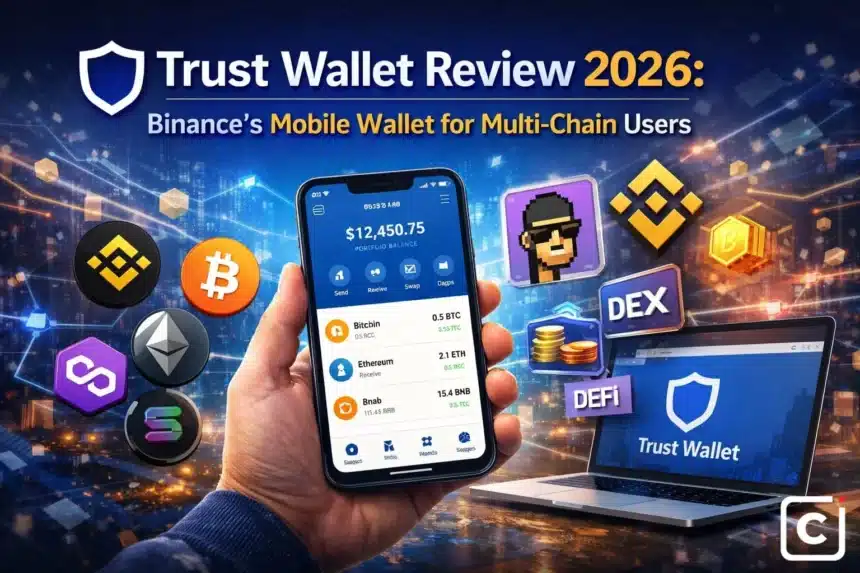
Trust Wallet is the best option for mobile users who want to interact with 100+ blockchains from a single app. With 100 million users and ownership by Binance, it has scale and resources behind it. It is non-custodial despite the Binance connection, and it is free to use. The main limitation: until recently, there was no desktop version, and it still lacks hardware wallet integration.
What Trust Wallet Is
Trust Wallet is a non-custodial mobile wallet owned by Binance. Binance acquired it in 2018, but the wallet operates independently — Binance does not hold your keys or control your funds. It is available on iOS and Android, with a browser extension added in 2024.
It supports over 100 blockchains including Ethereum, BNB Chain, Solana, Bitcoin, Polygon, Cosmos, TRON, Avalanche, and many more. This multi-chain breadth in a single mobile app is its core value proposition.
Core Features
- Support for 100+ blockchains and millions of tokens
- Built-in DEX and DApp browser for on-chain trading
- Native staking for 30+ cryptocurrencies directly in-app
- NFT display and management across multiple chains
- Buy crypto via fiat on-ramp integrations
- Multi-chain portfolio view
- Browser extension (launched 2024)
Security and Audits
Trust Wallet is non-custodial. Your seed phrase is generated and stored on your device. CertiK has audited the wallet’s smart contract integrations. The app code is partially open source on GitHub.
There is no hardware wallet integration — you cannot pair Trust Wallet with a Ledger or Trezor. For users storing significant value, this is a meaningful gap. A mobile software wallet, however well designed, carries more risk than a hardware wallet setup.
The Binance association raises questions for some users about data privacy. Trust Wallet has stated it does not share user data with Binance, but the relationship warrants awareness.
Fees
Trust Wallet is free to download and use. The wallet earns revenue through swap fee spreads when you use the built-in DEX — these fees are not shown as a separate line item, which is a transparency concern. Network gas fees apply as normal. Staking rewards are passed directly to users with no fee cut taken by Trust Wallet.
Multi-Chain Experience
The breadth of blockchain support is genuinely impressive. Managing Bitcoin, Ethereum, BNB Chain, and Solana assets in a single mobile app with a unified portfolio view is convenient. The DApp browser lets you access DeFi protocols on supported chains without leaving the app.
The depth of experience on any single chain is not as polished as a chain-specific wallet. Phantom is a better Solana experience. MetaMask is more deeply integrated with Ethereum DeFi. But for users who move across chains frequently, Trust Wallet’s coverage wins.
Who Should Use Trust Wallet
Mobile-first users who hold assets across multiple blockchains. Users who want staking and DeFi access without multiple apps. Users comfortable with software-only security who do not require hardware wallet support. Those new to crypto who want a single app that covers most of what they will encounter.
Final Verdict
Trust Wallet is the strongest multi-chain mobile wallet available. Its 100-blockchain coverage, built-in staking, and DApp browser make it the most versatile free wallet for mobile users. The lack of hardware wallet integration means it is not ideal for cold storage of large holdings. The Binance ownership is worth noting but has not translated into any documented privacy or security incidents. For multi-chain mobile access, it is the top pick.
The Daily Brief by TCB
Crypto, AI & finance intelligence in 5 minutes. Every weekday morning. Free.