
Last updated: 9 April 2026
Key Highlights
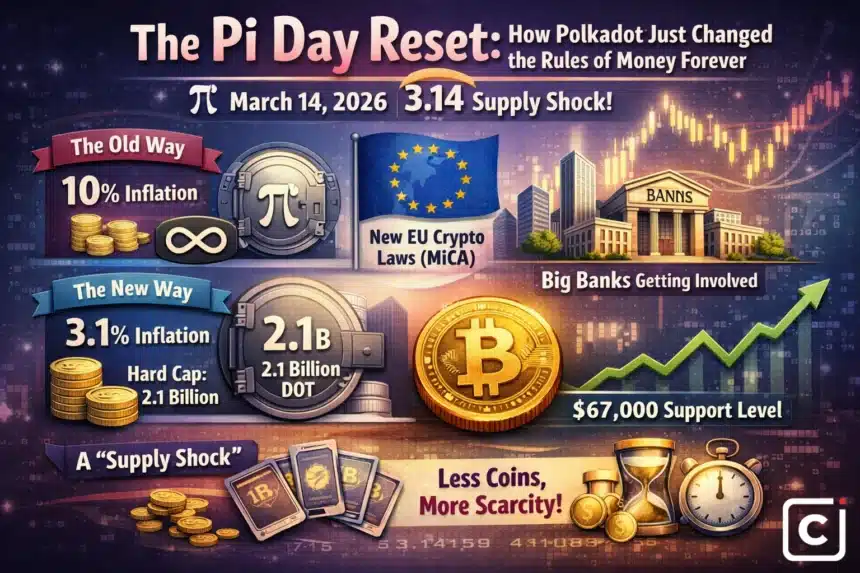
- Less Money Being Made: Polkadot (the DOT coin) used to grow its supply by 10% every year. Now, that has dropped to just 3.1%.
- The 2.1 Billion Limit: For the first time, there is a hard limit. Only 2.1 billion DOT coins will ever exist.
- Europe is Getting Involved: New laws in Europe (called MiCA) are making it safer for regular people and big banks to buy these coins.
- The $67,000 Support: This is all happening while Bitcoin is trying to stay above a “floor price” of $67,000. If Bitcoin stays strong, Polkadot’s new rules could help its price grow.
What is the “Pi Day” Supply Shock?
On March 14, 2026 a day often called Pi Day because of the math constant 3.14 the Polkadot digital currency system went through its biggest transformation ever.
In the world of digital money (often called crypto), things usually move fast. But this change is different. It wasn’t just a small update; it was a total rewrite of how the currency works. The network basically decided to stop “printing” so much new money.
In this guide, we will break down exactly what happened, why the number 3.1% is so important, and how new rules in Europe are making this a very big deal for the future.
What is a “Supply Shock”?
To understand why people are excited, we have to look at how money works. Imagine a brand of trading cards. If the company prints 1 million new cards every month, the cards you own aren’t very rare. If they suddenly announce, “Starting today, we will only print 300,000 cards a month,” your cards suddenly become much harder to get.
That is a Supply Shock.
From 10% to 3.1%
Before Pi Day, Polkadot was adding about 120 million new coins to the market every year. That’s a lot of new coins! This is called inflation. While it helped pay the people who kept the network running, it also meant the value of each coin could be watered down.
Now, that number has been slashed. Instead of 120 million new coins, only about 56 million will be made each year.
The Hard Cap
The most important part of this “shock” is the Hard Cap. In the past, Polkadot could theoretically keep growing forever. Now, the community has voted to set a final limit of 2.1 billion coins. Once the world hits that number, no more will ever be created. This makes it more like “Digital Gold,” similar to how Bitcoin works.
Why Does “Pi Day” Matter?
The developers of Polkadot love math. They chose March 14 (3/14) to launch this because the new growth rate of the currency is based on the number 3.14 (the math constant Pi).
But it’s more than just a fun date. This change makes the coin much “leaner.” When there is less new money entering the market, there is less “selling pressure.”
Simple Tip: Selling pressure happens when people who get new coins for free (as rewards) immediately sell them for cash. Since there are now 50% fewer “free” coins being given out, there is 50% less selling happening from those people.
Europe and the “MiCA” Rules
While the math is changing on the inside, the laws are changing on the outside. Europe has introduced a set of rules called MiCA (Markets in Crypto Assets).
For a long time, digital currency felt like the “Wild West”, there were no rules, and it was easy to get tricked. Europe decided to change that by making a strict rulebook for any company or project that wants to work there.
Why Polkadot Fits In
Polkadot is built to be transparent. It isn’t run by one boss in a secret office; it is run by thousands of people all over the world who vote on changes. Because it is so open, it fits perfectly into the new European rules.
- Big Banks are Watching: Because there are now clear laws (MiCA), big European banks are starting to feel safe enough to buy digital assets like DOT.
- Long Term Strategy: Europe is “playing the long game.” They want to be the world leader in safe, regulated digital money. Polkadot’s move to lower its inflation makes it look much more professional to these big investors.
The Market Context ($67k Bitcoin)
No coin lives in a bubble. Even though Polkadot has great news, it is still influenced by the “King of Crypto”: Bitcoin.
Right now, Bitcoin is hovering around $67,000. Traders call this a “support level.” Think of it like a floor. As long as Bitcoin stays above this floor, the rest of the market feels safe.
If Bitcoin stays steady or goes up, Polkadot’s “Supply Shock” could act like a rocket booster. If the supply is going down (less DOT available) and the demand is going up (because of the new rules and Bitcoin’s strength), the price has a better chance to rise.
Comparing the “Old” vs. “New” Polka dot
To make it even easier to see the difference, look at this table:
| Feature | The Old Way (Before 2026) | The New Way (After Pi Day) |
| New Coins Per Year | High (10%) | Low (3.1%) |
| Total Limit | None (Unlimited) | Locked at 2.1 Billion |
| Getting Your Money Out | It took 28 days to unlock | It takes 24 to 48 hours |
| Regulation | Uncertain | Fully compliant with EU laws |
A Big Change for Your Money
One of the best “humane” changes in this update is how fast you can get your money. In the old system, if you were earning rewards with your DOT, you had to wait 28 days to “unbond” (unlock) it so you could sell or move it.
That felt like a lifetime! Now, that wait time has been cut down to just one or two days. This makes it much easier for regular people to use their money when they need it.
How to Think About This as a Beginner
If you are new to this, don’t get distracted by the fancy charts or the “moon” emojis you see on social media. Focus on these three simple facts:
- Scarcity wins: Items that are hard to find usually hold their value better than items that are everywhere. Polkadot just became much harder to find.
- Rules are good: Even though “regulation” sounds boring, it means that your grandma or your local bank can eventually use this technology without being afraid of losing everything to a scam.
- The “Shock” takes time: A supply shock doesn’t always change the price in five minutes. It’s like a slow moving wave. As fewer new coins enter the market day after day, the effect starts to build up over months.
Summary: Is Polkadot Positioned for Success?
The “Pi Day” update is a sign that Polkadot is growing up. It has moved away from a model of “printing money to grow” and toward a model of “being valuable because it is rare.”
With the European Union creating a safe “net” for these assets to grow in, and the supply of new coins dropping by more than half, the stage is set for a very interesting year.
Whether the market stays above $67,000 or takes a dip, the fundamental “math” of Polkadot is now stronger than it has ever been. It is no longer just a tech project; it is a regulated, limited, and high speed digital asset.
FAQ:
Is this like Bitcoin Halving?
Sort of. The Bitcoin Halving happens every four years and cuts rewards in half. Polkadot’s “Pi Day” was a one time massive change that cut rewards by over 50% and added a permanent limit to how many coins can exist.
Why is it called Pi Day?
The developers chose March 14 (3/14) and built the new math of the system around the number 3.14159. It’s a bit of “math humor” from the creators.
Will the price go up immediately?
Not necessarily. In the short term, markets can be messy. However, in the long term, having a smaller supply and more demand from regulated European markets is generally seen as a positive sign.
Do I need to do anything with my DOT?
No. The update happened automatically on the network. Your coins are safe, and the new rules apply to everyone equally.
Free Daily Briefing
Get the Daily Briefing
Crypto, AI, and Web3 intelligence. Free, every day.
The Daily Brief by TCB
Crypto, AI & finance intelligence in 5 minutes. Every weekday morning. Free.