
Last updated: 21 July 2026
bounce april: Dune Analytics remains the most digital finance”>powerful publicly accessible onchain data platform in 2026. Its SQL based query engine, thousands of community built dashboards, and free tier make it an essential tool for any serious DeFi researcher or crypto analyst.
Key Highlights
- Key Highlight: Free tier provides full access to the query editor, community dashboards, and most blockchain data going back to genesis blocks.
- Key Highlight: Covers Ethereum, Solana, Bitcoin, Polygon, Arbitrum, Optimism, Base, and dozens of additional chains with decoded contract data.
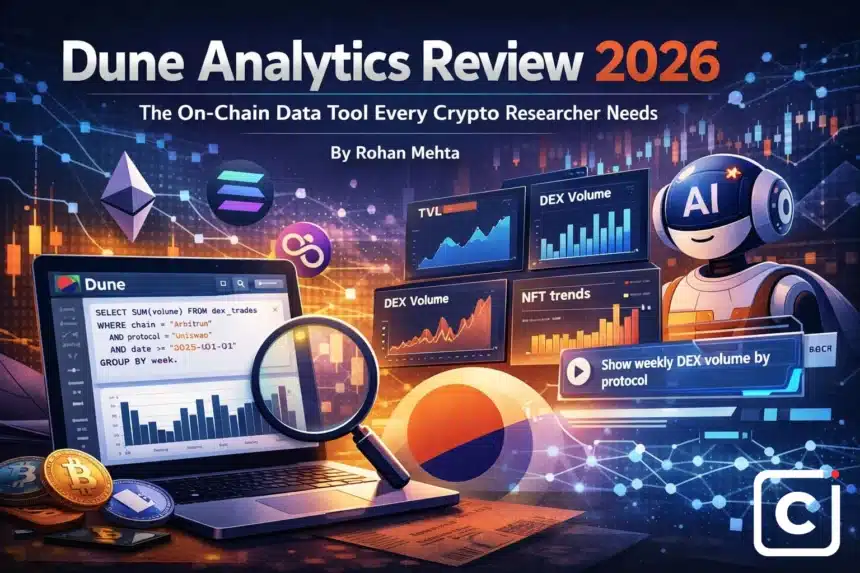
- Key Highlight: The community has published thousands of dashboards covering DEX volumes, protocol TVL, wallet activity, NFT trends, and stablecoin flows.
- Key Highlight: Decoded tables abstract raw transaction data into human readable format, making protocol specific queries accessible without deep Solidity knowledge.
- Key Highlight: Dune AI (beta) allows users to generate SQL queries using natural language prompts, lowering the barrier for nontechnical researchers.
Overview
Dune Analytics, founded in Oslo in 2018, was built on a simple premise: blockchain data is public, but querying it directly requires significant technical infrastructure. Dune provides that infrastructure as a platform, giving analysts access to indexed, decoded blockchain data through a standard SQL interface in the browser.
By 2026, Dune has become the de facto standard for onchain research. When a new DeFi protocol launches, when a whale makes an unusual transaction, when a governance vote is contested, the first place serious analysts go for data is Dune. The combination of deep data coverage and a large community of public dashboards makes it uniquely valuable.
Key Features for DeFi Research
The core of Dune is the query editor. Users write SQL queries against Dune’s indexed tables, which include raw transaction data, decoded protocol specific events, token transfers, DEX trades, and lending protocol data. For Ethereum, this means you can query every Uniswap v3 swap since the protocol launched, every Aave liquidation, every ENS registration, or every address that has interacted with a specific smart contract, all within the browser.
The decoded tables are particularly important. Raw Ethereum transaction data is encoded in bytes that require application level interpretation to understand. Dune decodes the input data of major protocol contracts automatically, so instead of working with hex strings, you query named columns like “token_bought_address,” “amount_usd,” and “block_time.” This makes writing DeFi specific queries accessible to analysts who know SQL but not Solidity.
Community dashboards represent one of Dune’s most valuable assets. The top dashboards for protocols like Uniswap, Lido, MakerDAO, and Aave have been built and refined by experienced analysts over years. Rather than building everything from scratch, researchers can fork existing dashboards and modify them for their specific use case. This dramatically reduces the time to insight for common research tasks.
The Dune AI feature, currently in beta, allows users to describe the data they want in plain English and receive a SQL query as output. “Show me the weekly DEX trading volume on Arbitrum broken down by protocol for the last 12 months” produces a working query that can be run and visualized immediately. For researchers who are comfortable with data concepts but less fluent in SQL, this feature significantly expands what is accessible on the platform.
Pricing
The free tier is genuinely comprehensive. It includes access to all community dashboards, the full query editor, and most chain data. Free tier queries run on shared compute and may take longer during peak hours, but for occasional research use, the free tier is fully functional.
The Plus plan at $349 per month provides faster query execution, private dashboards, higher API call limits, and access to premium datasets. The Premium plan at $1,499 per month adds the fastest execution, dedicated compute, and enterprise grade data refresh rates. For individual researchers and journalists, the free tier covers the majority of use cases. Teams building real time monitoring tools or running high frequency queries will need Plus or Premium.
Pros
- Free tier provides broad access to blockchain data across dozens of chains with no commitment required
- SQL interface is familiar to any analyst with data background and does not require blockchain specific skills
- Thousands of community dashboards covering major DeFi protocols, available to fork and customize
- Decoded contract data makes protocol specific analysis accessible without Solidity knowledge
- Dune AI natural language to SQL lowers the barrier for nontechnical researchers significantly
Cons
- Free tier queries can be slow during peak hours, making time sensitive research frustrating without a paid plan
- SQL knowledge is still required for custom analysis beyond community dashboards, which excludes nontechnical users
- Not all chains or protocols are decoded at the same depth, and newer or smaller chains may lack the rich decoded tables available for Ethereum
- The platform has a learning curve for users unfamiliar with relational databases and blockchain data structures
Who It Is For
Dune Analytics is essential for crypto researchers, DeFi analysts, protocol teams, journalists covering onchain activity, and investors who want to verify protocol claims with primary data. If you write about DeFi, track protocol TVL, research wallet behavior, or need to verify whether a project’s onchain metrics match its marketing claims, Dune gives you the tools to find the answer yourself rather than relying on aggregators.
It is not the right tool for users who need prebuilt reports with no learning investment. For that use case, platforms like Messari, Token Terminal, and DeFi Llama provide curated dashboards with less customization but lower technical barriers. Dune is for researchers who want to go deeper than the prebuilt options allow.
The TCB View
Onchain data is the most powerful information advantage available to crypto researchers in 2026, and Dune is the most accessible gateway to that data. The public nature of blockchain transactions is one of the defining characteristics of the crypto ecosystem, and Dune is what makes that public record actually queryable by humans. The community dashboard library is an underappreciated asset. Years of analytical work by hundreds of contributors is available for free, and the ability to fork, modify, and extend that work means a researcher with solid SQL skills can produce publication quality data analysis in hours rather than weeks. For The Central Bulletin’s onchain data reporting, Dune is the primary source for DeFi metrics, protocol comparisons, and trend analysis. It is not optional: it is infrastructure.