
Last updated: 8 April 2026
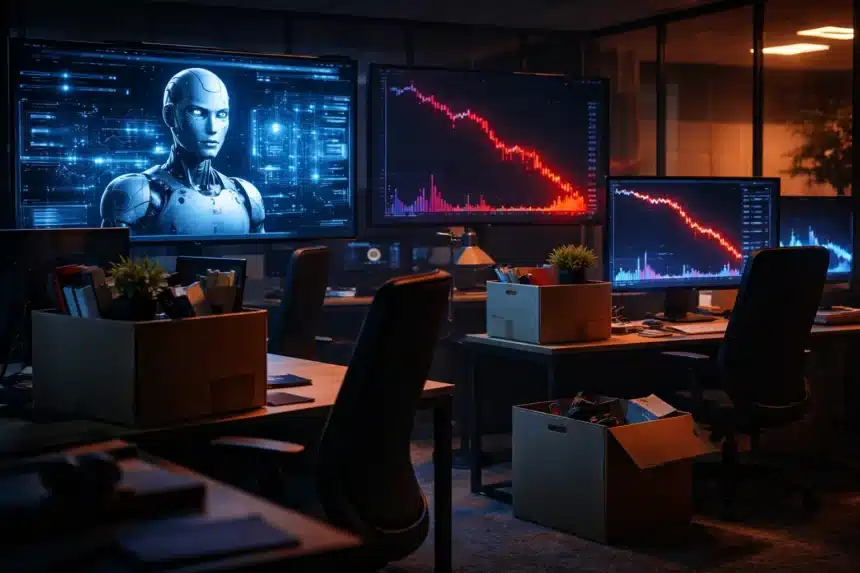
In the space of a few weeks in March 2026, a significant portion of the crypto industry’s headcount disappeared. Algorand, Gemini, Crypto.com, OP Labs, Messari, and PIP Labs all cut staff. Total disclosed cuts excluding Messari: approximately 450 jobs. Companies cited two reasons: weak markets and AI. One of those explanations is more accurate than the other.
Key Highlights
- Algorand (25% cut), Gemini (30%), Crypto.com (12%), OP Labs, Messari, PIP Labs all cut staff in weeks
- Roughly 450 jobs cut across these firms in March 2026, excluding Messari
- New crypto job postings running at 6.5 per day in January 2026, down 80% from a year earlier
- Crypto.com and Algorand cited AI. A leading crypto recruiter says there is no evidence AI is actually replacing workers at scale
- Two forces are running simultaneously and companies are conflating them deliberately
What Happened
Algorand cut 25% of its workforce, citing the uncertain global macro environment. Gemini eliminated roughly 200 positions in February, a number that grew to 30% of staff by mid March. Crypto.com trimmed 12%, approximately 180 roles, and said it was cutting positions that do not adapt in our new world. OP Labs cut 20 employees. Messari, which was once targeting 1,000 analysts, is now down to approximately 140 staff after three rounds of cuts since 2023. PIP Labs also reduced headcount without disclosing numbers.
The AI Explanation Does Not Fully Hold
Several of these firms were explicit about AI as a factor. Crypto.com’s framing was the most direct: roles that fail to adapt to an AI driven workflow are being eliminated. Block, Jack Dorsey’s payments company, cited similar reasoning.
Dan Escow, founder of crypto recruitment agency Up Top, pushed back. “I see no real indication that these layoffs have anything to do with AI workforce replacement at scale,” he said. New job postings across major crypto job boards ran at approximately 6.5 per day in January 2026, down around 80% from the same period a year earlier. If AI were creating net efficiency gains, you would expect some offsetting new hiring in AI adjacent roles. That is not what the data shows.
The more straightforward explanation: Bitcoin is trading at $69,000 against an $88,000 production cost, most altcoin treasuries are down significantly from 2024 peaks, and companies that over hired during the 2024 bull cycle are now correcting.
Where AI Is Genuinely Involved
The AI explanation is not entirely a cover story. It is accurate for a specific subset of roles. Content teams, research analysts producing templated reports, customer support functions, and basic compliance monitoring are all areas where AI tooling has materially reduced the headcount required to do the same work.
Messari’s trajectory is the clearest example: a company that built its model on human analysts producing research at scale is now operating at 14% of its peak target. That is not purely a market story. The economics of human produced crypto research changed when large language models became capable of drafting reports in seconds.
The honest framing is that two separate forces are running at the same time. Crypto firms are over indexed in headcount from the bull market and cutting to survive a downturn. Some functions within those firms are also being replaced by AI tools. Companies are conflating both into a single narrative because AI efficiency is a less damaging headline than we over hired and are now cutting to meet runway.
The TCB View
The 450 job cuts across these firms are not a signal that crypto is collapsing. They are a signal that the industry is compressing toward a leaner structure under bear market conditions, the same way it did in 2022. The AI narrative gives companies a more palatable story to tell investors and press, and in some cases it is partially true.
What matters more than the headline number is what gets built during this compression. The 2022 cuts preceded the infrastructure cycle that produced Base, Hyperliquid, and the staking ETF category. If this round of cuts sheds the overhead and leaves the builders, the next cycle starts from a stronger foundation. Watch the hiring patterns over the next two quarters. That will tell you which firms are actually restructuring around AI and which are just surviving.
Free Daily Briefing
Get the Daily Briefing
Crypto, AI, and Web3 intelligence. Free, every day.
The Daily Brief by TCB
Crypto, AI & finance intelligence in 5 minutes. Every weekday morning. Free.