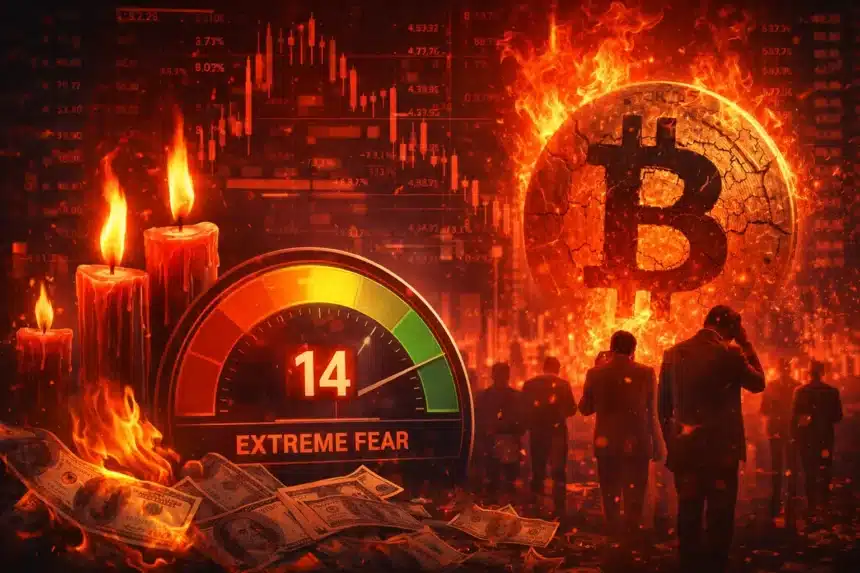
Bitcoin has traded in extreme fear territory for 46 consecutive days as of March 24, 2026. That is the longest unbroken streak since the post-FTX collapse in late 2022. The Fear and Greed Index sat at 14 on March 26, with BTC holding just below $70,000. The headline is scary. The data underneath it is more complicated.
Key Highlights
- Fear and Greed Index reached 14 on March 26, 2026, the lowest reading in over three years
- U.S. spot Bitcoin ETFs recorded $124M in net outflows on March 25, the fifth consecutive day of redemptions
- Whale wallets holding more than 100 BTC accumulated 270,000 BTC over the past 30 days, approximately 1.3% of total circulating supply and $23B in notional value
- BlackRock’s IBIT recorded $112M in single day inflows while Grayscale’s GBTC bled $58M in outflows on the same day
- Strategy executed a $1.57B single week BTC purchase of 22,337 BTC, a record for the firm
- Open interest declined 7% to $18.2B with funding rates flipping negative, a deleveraging signal
Who Is Actually Selling
ETF outflows get the headlines. But the picture inside those flows matters. On March 25, BlackRock’s iShares Bitcoin Trust recorded $112M in inflows on the same day that aggregate ETF flows showed a net outflow of $124M. That gap is almost entirely explained by Grayscale’s GBTC, which continued its steady bleed with $58M in outflows.
GBTC has been in persistent outflow since its conversion to a spot ETF in early 2024. The sellers are largely legacy holders rotating out of a high fee wrapper, not institutions abandoning Bitcoin. Year to date ETF flows remain positive at $2.1B.
Retail sentiment, measured by funding rates across major exchanges, has flipped negative at an average of minus 0.008%. That means short sellers are paying longs to hold their positions. Historically, this is a precondition for a short covering rally, not a confirmation of continued downside.
The Whale Signal Is Unusual
While retail investors have been selling, wallets holding more than 100 BTC have accumulated 270,000 BTC over the past 30 days. That is the largest whale accumulation event recorded since 2013, according to onchain data.
To put scale to that number: 270,000 BTC at current prices represents approximately $23B in notional value, moved into cold accumulation during one of the most fearful sentiment environments in Bitcoin’s history.
That divergence between retail sentiment and large holder behavior is not coincidental. It is a structural pattern. Large holders tend to accumulate during fear cycles and distribute during greed cycles. The data is consistent with that pattern.
What the Macro Backdrop Is Doing
The fear environment has a clear external cause. Rising oil prices pushed equity markets lower in the week ending March 26, triggering risk off flows that hit crypto alongside growth stocks. Bitcoin dropped from $73,000 to a low of $69,984 in five sessions.
The Federal Reserve’s communications added pressure. Fed commentary warning of persistent inflation kept rate cut expectations subdued, reducing the macro tailwind that drove Bitcoin’s rally through Q4 2025 and into early 2026.
Exchange netflows turned positive for the first time in 11 days on March 26, with 8,420 BTC deposited to exchanges. Deposits to exchanges are typically a precursor to selling. That reading bears watching over the next 48 to 72 hours.
What History Says About Extreme Fear Streaks
At 46 days, this fear streak is long but not unprecedented. Extreme fear readings that persist for more than 30 days have historically resolved in two ways: short covering rallies that recover 20% or more within two weeks in 40% of historical instances, or capitulation moves that establish multi month lows before recovery in 60% of historical instances.
The current technical setup leans toward compression before movement rather than directional confirmation either way. Open interest has fallen 7% and funding is negative. That combination typically precedes a volatility event rather than continued slow drift.
The TCB View
Forty-six days of extreme fear while whales buy $23B worth of Bitcoin is not a story about a broken market. It is a story about a market where retail is overwhelmed by macro noise and large holders are using that noise to accumulate quietly.
The ETF outflow narrative is real but incomplete. GBTC drag is not new institutional selling. BlackRock buying $112M on the same day aggregate flows turned negative is the more informative signal.
Bitcoin is not in a structural bear market. It is in a sentiment compression phase while macro conditions resolve. The onchain data suggests large holders agree. Whether that plays out as a sharp rally or a drawn out base depends on the next Fed move and whether oil prices stabilize. But the setup is not as bearish as the fear index suggests.
Frequently Asked Questions
What is Bitcoin’s Fear and Greed Index reading in March 2026?
Bitcoin’s Fear and Greed Index reached a reading of 14 on March 26, 2026, placing it firmly in “extreme fear” territory. This was the lowest reading in over three years and marked the 46th consecutive day the index has remained in extreme fear, the longest such streak since the collapse of FTX in late 2022.
Are Bitcoin ETFs seeing outflows in 2026?
U.S. spot Bitcoin ETFs recorded $124M in net outflows on March 25, 2026, the fifth consecutive day of net redemptions. However, the breakdown matters. BlackRock’s IBIT recorded $112M in single day inflows on the same date. The net outflow was driven almost entirely by Grayscale’s GBTC, which has been in persistent outflow since it converted to a spot ETF in early 2024. Year to date ETF flows remain positive at $2.1B.
Are Bitcoin whales buying or selling during the fear cycle?
Whale wallets holding more than 100 BTC accumulated 270,000 BTC over the 30 days ending March 26, 2026. That is approximately 1.3% of total circulating supply and $23B in notional value, making it the largest whale accumulation event recorded since 2013 according to onchain data. Large holders appear to be buying the extreme fear environment aggressively while retail sentiment remains deeply negative.
What typically happens after Bitcoin stays in extreme fear for 30 or more days?
Historically, extreme fear readings that persist for more than 30 days have resolved in two ways: a short covering rally recovering 20% or more within two weeks in about 40% of historical instances, or a capitulation move establishing a multi-month low before recovery in roughly 60% of cases. The current setup features negative funding rates and declining open interest, which typically precede a volatility event rather than continued slow drift.
The Daily Brief by TCB
Crypto, AI & finance intelligence in 5 minutes. Every weekday morning. Free.