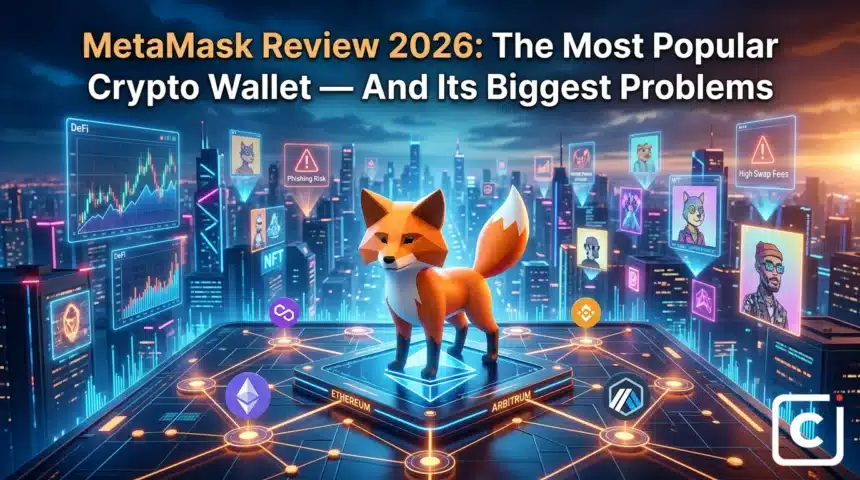
MetaMask is the most widely used crypto wallet in the world, with 30 million monthly active users. For Ethereum and EVM-compatible chain beginners, it remains the default choice. But its swap fees are steep, phishing attacks targeting MetaMask users are rampant, and power users will quickly find its limitations. Use it to get started — then evaluate whether it still makes sense for your needs.
What MetaMask Is
MetaMask is a software wallet available as a browser extension (Chrome, Firefox, Brave, Edge) and as a mobile app for iOS and Android. It is non-custodial — you hold your own private keys. Consensys, the Ethereum infrastructure company founded by Joseph Lubin, owns and develops MetaMask.
It supports Ethereum and every EVM-compatible chain: Polygon, BNB Chain, Arbitrum, Optimism, Avalanche, Base, and more. In 2024, MetaMask added a Solana beta, though that integration is still limited compared to dedicated Solana wallets.
Core Features
- Browser extension and mobile app with seamless DApp connectivity
- Multi-chain support across all major EVM networks
- Built-in token swap aggregator
- Hardware wallet support (Ledger, Trezor)
- NFT display in mobile app
- MetaMask Portfolio dashboard for tracking assets across chains
- Solana beta (limited functionality)
Where MetaMask Falls Short
The built-in swap feature charges a 0.875% service fee on top of network fees and price impact. For large trades, that adds up fast. Third party DEXes accessed directly through your browser will almost always be cheaper.
MetaMask has no native Bitcoin support. If you hold BTC, you need a separate wallet.
Phishing is a serious concern. MetaMask’s popularity makes it the primary target for fake extension scams, malicious DApp approvals, and seed phrase theft attempts. Users must be vigilant about what they connect to and what transactions they approve.
The closed source mobile app and partial open source status means security cannot be fully independently verified by the community — a contrast to fully open source alternatives like Trezor.
Fees
MetaMask itself is free. The 0.875% swap fee applies only when using the built-in swap tool. Network gas fees are paid separately to the blockchain. There is no subscription or account fee.
Security
MetaMask is non-custodial, so your seed phrase is stored locally on your device. It supports hardware wallet integration with Ledger and Trezor for added security. MetaMask also has a phishing detection system that flags known malicious sites, though it is not foolproof.
The biggest security risk is user error: approving malicious smart contract permissions or entering your seed phrase on a fake MetaMask site. This is a software wallet — for large holdings, pairing it with a hardware wallet is strongly recommended.
Who Should Use MetaMask
MetaMask is ideal for anyone starting out in Ethereum and DeFi. It connects to virtually every Ethereum-based DApp and is supported across every major platform. If you are using Uniswap, Aave, OpenSea, or any major Ethereum protocol, MetaMask works out of the box.
High volume traders and users who want cheaper swaps should look at alternatives or bypass the built-in swap entirely. Users who primarily hold Bitcoin need a different wallet. Security-focused users storing significant assets should pair MetaMask with a Ledger or Trezor.
Final Verdict
MetaMask earns its popularity as the gateway to Ethereum. It is the easiest way to get started with EVM chains, DeFi, and NFTs. The 0.875% swap fee is the clearest downside — avoid it by trading directly on DEXes. Phishing awareness is non-negotiable. For beginners, MetaMask is the right starting point. For power users, it is one tool among several.
The Daily Brief by TCB
Crypto, AI & finance intelligence in 5 minutes. Every weekday morning. Free.