Last updated: 9 April 2026
Key Highlights
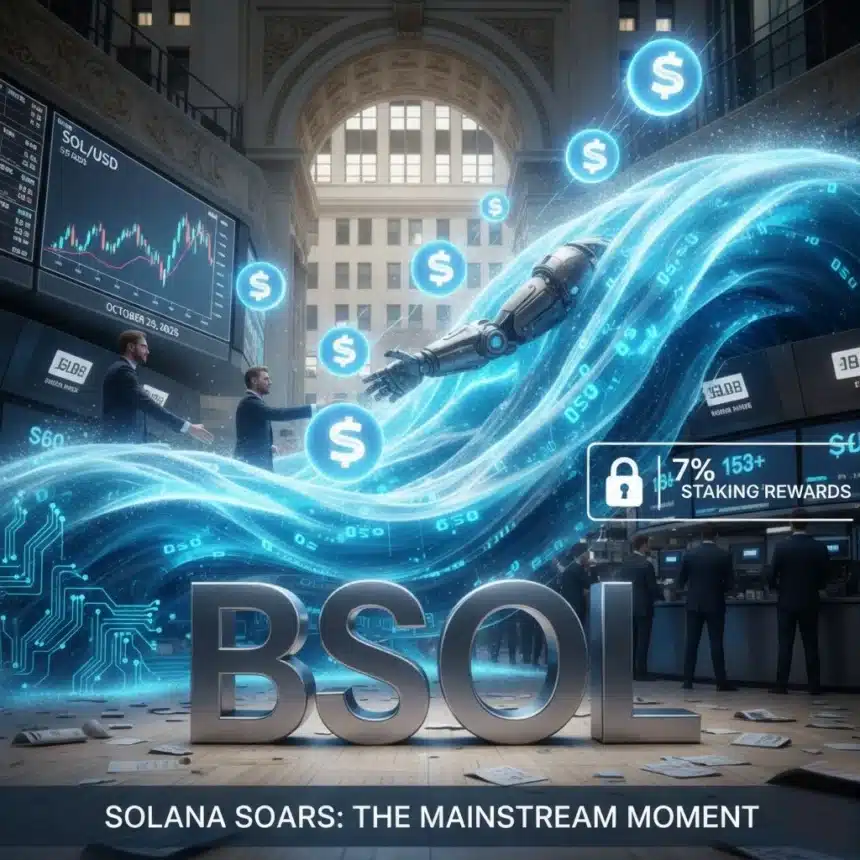
- The Bitwise Solana Staking ETF (BSOL) launched on the NYSE on October 28, 2025, marking the first US Solana ETP.
- A key attraction of BSOL is its unique, built in staking feature, which helps secure the Solana network and offers investors a simple way to earn rewards, historically averaging over 7%.
- The ETP launch is a “major turning point” expected to attract billions in new institutional capital from asset managers and financial advisors.
- Its scalability, near instant transaction settlement, and ultra low fees position it as a powerful platform for DeFi, gaming, and NFTs, making it a compelling long term hold for institutional grade.
A tidal wave of institutional money is set to hit the crypto markets after the first US Solana ETP debuted on the NYSE. The launch gives traditional investors easy access to the asset, causing $SOL’s price to jump. Market analysts are calling it a “major turning point,” projecting that the token’s value could easily exceed a 100% rally.
The Wall Street Handshake: Introducing BSOL
On October 28, 2025, a new chapter in crypto investing began as the Bitwise Solana Staking ETF (ticker: BSOL) started trading on the NYSE. This isn’t just a standard fund; it’s a groundbreaking product that gives investors 100% direct exposure to SOL while also offering a crucial feature: built in staking.
An ETP is essentially a security that trades on a regular stock exchange, making it accessible to anyone with a standard brokerage or retirement account. For Solana, the launch of BSOL is vital because it solves a huge problem: it allows traditional investors from large institutions to everyday people to invest in crypto without the technical complexities of wallets, private keys, or specialized exchanges. The fund’s unique staking feature, which aims to secure the network and earn rewards (historically over 7%), adds an extra layer of appeal by creating a simpler, lower cost way to participate in Solana’s growth.
The Price Target: Why $400+ Is On the Table
The market’s enthusiasm is undeniable, and the core of the excitement lies in the expectation of massive capital inflows from the traditional financial world. When an ETP launches, it becomes a regulated investment vehicle that can attract billions of dollars from asset managers, financial advisors, and large institutional funds that were previously restricted from buying SOL directly.
This sudden, huge wave of new demand, hitting Solana’s fixed supply, is the primary force behind the aggressive price predictions. Analysts are now suggesting that $SOL could rally over 100%, pushing its value well past the $400 mark.
The bullish outlook is supported by two main factors:
- Inflow Catalyst: As investors buy shares of the BSOL ETP, the fund manager must immediately purchase an equivalent amount of actual SOL tokens from the open market. This obligatory buying creates a persistent, powerful upward pressure on the price.
- Validation and Technical Momentum: The approval of a U.S.-listed ETP by a major exchange like the NYSE serves as a massive endorsement. It signals that Solana is a legitimate, core investment asset. This validation, coupled with the buying momentum, often leads to powerful upward movements in the token’s price, validating technical analysts’ bullish signals.
The Technology That Attracts Institutions
While the ETF provides easy access, the real investment thesis for Solana is its powerful technology. It stands out as one of the most scalable and rapid blockchain networks operating right now. Critical factors like transactions settling almost instantly in milliseconds and ultra low fees (around $0.001) give Solana a massive edge. This technical superiority allows it to handle the high volume demand of applications in DeFi, gaming, and NFTs, positioning it as a direct competitor to legacy financial tech. These impressive “onchain fundamentals,” confirmed by consistent network revenue, are exactly why institutional investors view Solana as a compelling long term hold.
The debut of the Solana ETP is more than just a momentary surge; it represents a fundamental step in making crypto a permanent, accessible part of the global financial system.
Free Daily Briefing
Get the Daily Briefing
Crypto, AI, and Web3 intelligence. Free, every day.
The Daily Brief by TCB
Crypto, AI & finance intelligence in 5 minutes. Every weekday morning. Free.