
Last updated: 9 April 2026
Key Highlights
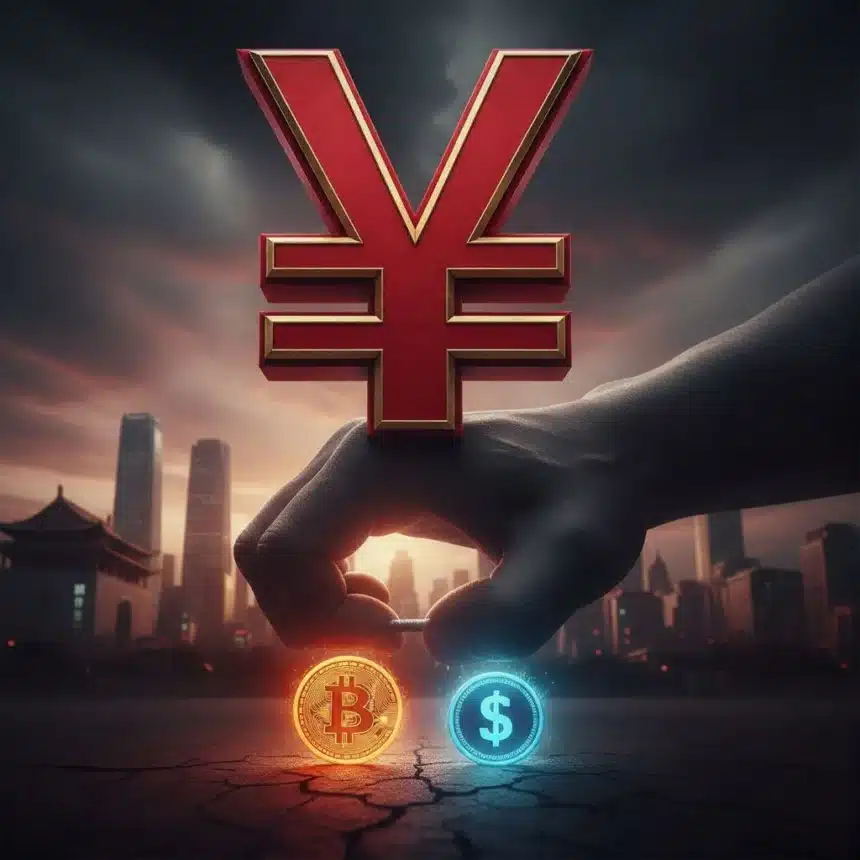
- China is severely intensifying its ban on all private digital money, aiming to completely stop its recent comeback.
- Digital tokens designed to hold a steady value (stablecoins) are the main target, as they enable money laundering and secret money transfers across borders.
- The government views these tokens as a serious threat, weakening its control over the national money system and causing financial risk.
- Enforcement is now global, targeting all related businesses, while China promotes its own state controlled digital Yuan as the only legal alternative.
China’s New Firepower
China’s financial watchdogs have issued their strongest warning yet, signaling a massive intensification of the fight against private digital currencies. For years, the government has worked to ban digital tokens like Bitcoin from its shores. Now, the crackdown is focused squarely on a specific, fast growing type of digital asset: digital tokens designed to hold a steady value (stablecoins).
The message from Beijing is clear: All forms of private digital money are considered illegal financial activity, and the nation’s top regulators, including the central bank, are preparing to use every tool available to stop them. This new push is not just about keeping a long standing ban in place; it’s about snuffing out a perceived threat to the stability and control of the entire Chinese economy.
The Ban Gets Tougher
China was one of the first major nations to completely outlaw trading and betting on the prices of digital currencies. This decision led to the mass exodus of digital currency businesses and miners from the country several years ago.
However, financial regulators recently held a high level meeting and warned that, despite the ban, they are seeing a “comeback” in risky trading and criminal activity linked to these digital tokens. This resurgence is creating new dangers, prompting the government to raise the stakes.
Officials reiterated a fundamental point: Digital tokens have no legal status. They are not official money, like the Yuan, and they cannot be used in the market as currency. From the perspective of the government, any business that involves virtual currency be it selling, promoting, or providing technical help is an illegal financial operation. The goal of this intensified effort is simply to safeguard the security of people’s property and maintain the firm order of the economic system.
Why The Steady Tokens Are Feared
While public discussion often focuses on highly volatile digital tokens like Bitcoin, the new wave of regulatory action takes aim at digital tokens that are designed to be steady.
To understand why, you first need to know what this steady token is. Imagine a digital token meant to always be worth a fixed amount, usually one US dollar. This fixed value is its main feature, making it useful for quickly moving money around the world without dealing with the constant ups and downs of other digital assets.
But this fixed value is exactly what scares China’s central bank. Regulators believe these steady tokens pose a unique and serious risk. They worry that these assets act like secret financial tunnels that weaken the country’s strong control over its own money system.
Why?
First, they make it too easy to move large amounts of money secretly across borders, avoiding the government’s official checks on cash leaving the country. This lack of control weakens China’s financial authority.
Second, these steady tokens often fail to meet the basic legal requirements that banks must follow, such as checking who the customer is and having safeguards against crime. Regulators specifically pointed out that this makes them a perfect tool for criminals who want to perform money cleaning (the act of hiding illegally gained cash) or commit various types of cheating.
In short, regulators view these steady tokens not as useful tools, but as an uncontrolled gateway for illegal money movement and a direct challenge to the nation’s financial safety.
Strict Watch and The Nation’s Digital Money
The government has vowed to strengthen its watch everywhere. This means the crackdown will target any organization offering services related to private digital money, even if those companies are operating from outside of China. Financial punishments will be severe.
Internet companies, mobile phone payment gateways, and other platforms have been given strict instructions. They must step up their monitoring to find and block any activity related to digital money trading. The government is essentially asking private companies to become its eyes and ears in the digital world to ensure the ban is fully effective.
This entire aggressive policy is driven by a larger, two part strategy. On one hand, the government is determined to completely remove unregulated, private digital assets. On the other, it is pushing hard to speed up the use of its own state controlled digital money, which is often called the digital Yuan.
Unlike private digital tokens, the digital Yuan is a completely centralized, official form of the nation’s money. It is issued by the central bank and follows every rule regarding customer checking and monitoring. By eliminating private competitors while promoting its own regulated alternative, China is ensuring that it retains full control over the future of money within its borders, protecting both its financial stability and its national rights.
Free Daily Briefing
Get the Daily Briefing
Crypto, AI, and Web3 intelligence. Free, every day.
The Daily Brief by TCB
Crypto, AI & finance intelligence in 5 minutes. Every weekday morning. Free.