
Last updated: 9 April 2026
Key Highlights
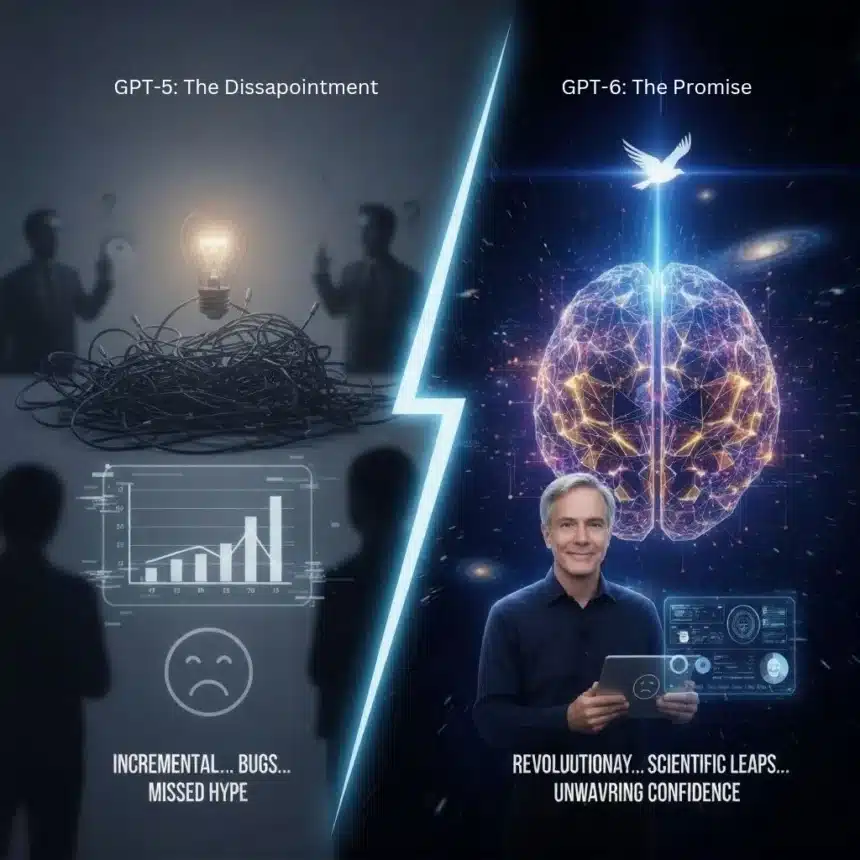
- GPT-5 Disappointed Hype: The model’s launch was met with negativity because its advancements felt incremental, failing to deliver the promised AGI or PhD level intelligence
- GPT-5’s true breakthroughs were in high level specialized tasks which regular users couldn’t easily appreciate
- Sam Altman admitted the GPT-5 launch and communication were poorly managed, learning critical lessons from the public reaction
- Altman confidently promises that GPT-6 and GPT-7 will deliver the significant, revolutionary leaps that GPT-5 was expected to bring
The Buzzkill: An Upgrade That Felt Like a Side Step
The August debut of OpenAI’s GPT-5 was supposed to be a monumental moment, but for many users, it was a damp squib. After months of intense anticipation, the new model, integrated into ChatGPT, failed to deliver the earth shattering intelligence leap everyone expected. Instead of a revolution, users perceived only subtle, incremental advancements, mostly in areas like speed and cost. The flagship language model felt less like a major breakthrough and more like a refined version of its predecessor. As CEO Sam Altman himself later admitted, the rollout had major issues: “I think we totally screwed up some things on the rollout.” This initial stumble, combined with technical glitches during the launch (like the AI generating inaccurate charts), set a definitively rocky tone.
The Hype Test Failure: What the Critics Said
The core problem was an inability to satisfy the intense public hype. Critics like New York University professor Gary Marcus, a leading voice in AI skepticism, didn’t mince words. He called GPT-5 the “most hyped AI system of all time” and declared it failed to deliver on its twin promises: achieving Artificial General Intelligence (AGI) AI that can match or exceed human performance and demonstrating PhD level cognition. For Marcus, the modest improvements suggested that OpenAI was hitting a scaling wall, meaning they couldn’t just throw more data and computing power at the problem and expect miraculous results anymore.
The Defense: Specialized Genius Over General Appeal
Despite the initial wave of negativity, OpenAI’s executives insist that the “vibes” have improved and that GPT-5 represents a true leap just not one visible to the average user. OpenAI President Greg Brockman pushed back on the idea that they only added more muscle, stating the gains came from sophisticated training techniques, specifically Reinforcement Learning based on Human Feedback (RLHF), which essentially gives the model a better education.
The most compelling defense came from Head of Research Mark Chen, who explained that GPT-5’s real power is optimized for specialized use cases like high level scientific research and complex coding. He pointed out a remarkable achievement: while the previous model ranked around the top 200 in the rigorous Math Olympiad, GPT-5 now ranks in the top five. These are the kinds of profound, high impact advancements that may not help you draft a better email but are essential for accelerating scientific discovery, a key goal, according to Altman.
Lessons Learned and the Unwavering Promise of the Future
While acknowledging the initial poor reception which Brockman attributed to “showing our hand” too early Sam Altman remains fiercely confident in OpenAI’s trajectory. He frames the GPT-5 experience as a difficult but necessary learning curve. And the lessons learned, he implies, will make the next generation truly spectacular. His parting shot is a powerful promise of exponential progress:
“What I can tell you with confidence is GPT-6 will be significantly better than GPT-5, and GPT-7 will be significantly better than GPT-6. And we have a pretty good track record on these.”
The message is clear: The initial frustration was a speed bump on the road to a far more revolutionary future.
Free Daily Briefing
Get the Daily Briefing
Crypto, AI, and Web3 intelligence. Free, every day.
The Daily Brief by TCB
Crypto, AI & finance intelligence in 5 minutes. Every weekday morning. Free.