



Key Highlights
- AI is Driving the Market
- A primary concern is the huge capital spending (capex) by tech giants (hyperscalers) required for AI infrastructure.
- Investors are wary of the interdependent financial ties between AI companies which create systemic risks. They also want this spending funded by cash flow, not new debt
- The market needs to see tangible revenue and productivity gains from AI
Artificial intelligence has become the driving force behind the recent surge in the U.S. stock market. Since the debut of ChatGPT in late 2022, AI has been the dominant story on Wall Street, fueling massive investor optimism about its potential for profit. This excitement has propelled the S&P 500 benchmark index and the tech-heavy Nasdaq Composite to impressive gains this year. In fact, strategists at Citigroup estimate that nearly half of the S&P 500’s enormous market value is exposed to the AI theme.
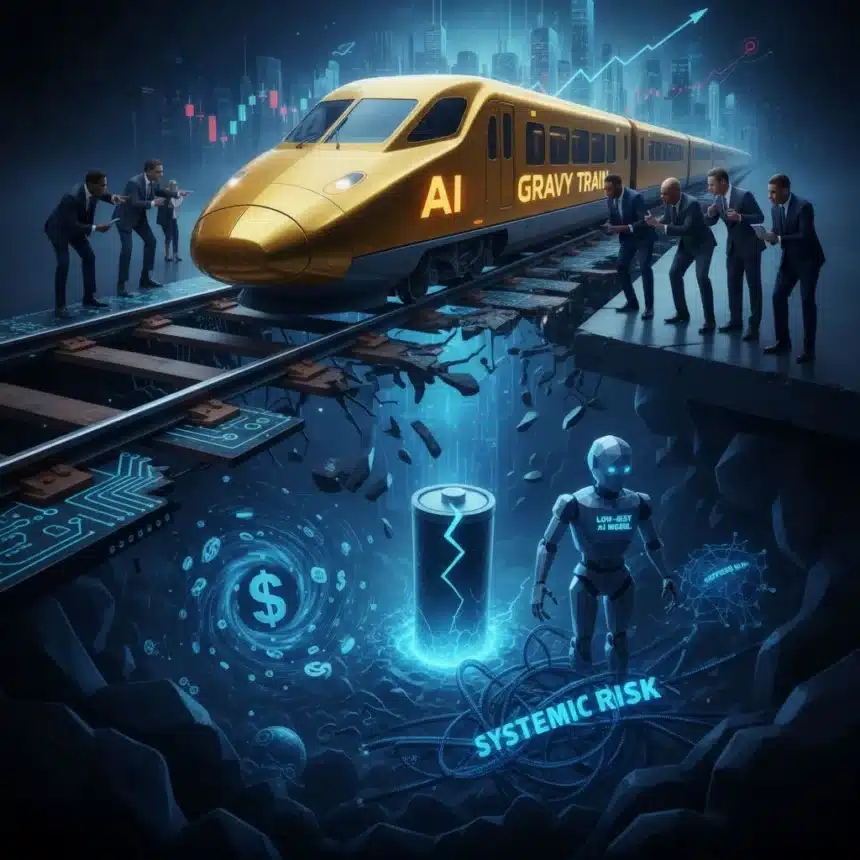
This AI-linked optimism is “holding up the markets,” as one chief investment strategist noted. However, this runaway success has investors actively looking for potential dangers that could slow down or “derail the AI gravy train.” While many still believe in the long-term success of AI, they are keenly watching for warning signs as major tech companies begin releasing their quarterly earnings.
The Steep Cost of the AI Race
The most immediate concern for investors is the sheer amount of money the massive capital expenditure (capex) required to build the infrastructure for AI. Think of the enormous data centers, specialized chips, and cooling systems needed. These outlays are required to support the AI expansion, but investors are focused on two things:
- The Spending Rate: Will these companies spend so fast that it hurts their profitability and eats into their available cash? Companies known as “hyperscalers,” like Microsoft, Amazon, Alphabet, Meta Platforms, and Oracle, are expected to roughly double their capex to \$500 billion annually by 2027. Investors need to see that this spending is not “faster than their growth rates,” as one expert put it.
- The Return on Investment (ROI): Is all this spending going to actually pay off? If it becomes questionable whether the massive investment will generate significant revenue and productivity gains, the AI trade will be “very at risk.” Currently, some strategists admit there haven’t been many tangible signs of major productivity gains yet, and a surprising slowdown in demand would be a “potential trigger” for market concern.
Interestingly, while some worry about overspending, others argue the “bigger risk is not investing enough right now” to keep pace in the AI arms race.
Systemic Risks and Financial Levers
Beyond the simple cost of building, other financial risks are making investors wary:
- Circular Deals and Interdependence: The AI ecosystem is becoming increasingly interconnected, which creates a new kind of risk. For example, when a major player like Nvidia announces it will invest in another key player like OpenAI, it raises questions. While these relationships aren’t necessarily malicious, the close financial and operational ties across the industry could create significant systemic risk meaning a problem for one company could quickly ripple through the entire sector.
- Funding the Spending Spree: The big tech companies have historically funded their expansions using their massive cash reserves. Investors prefer this. However, if they start relying more on debt (borrowing money) or issuing more equity (selling new shares) to fund their AI deals and infrastructure, it could be a “red flag.” Investors want the expansion to be “funded through cash flow, not debt or equity raises.”
The Power Problem and Unexpected Weak Spots
Investors have also flagged a less traditional, but critical, risk:
- The Energy Hurdle: The sheer amount of electricity needed to power and cool vast AI data centers is becoming a major constraint. One strategist called the “power issue” one of the most important factors to watch. If the energy infrastructure isn’t sufficient to support the massive build-out, it will bottleneck the entire expansion.
- The Low-Cost Threat: The AI market has already shown its sensitivity to competition. Earlier this year, the emergence of a Chinese low-cost AI model called Deepseek sent “shockwaves through tech stocks” and raised questions about whether massive capital spending could be quickly undercut by cheaper alternatives. While the market recovered, this suggests that competitive pressure and surprise innovations could quickly change the expected path to profitability.
In summary, while the excitement surrounding AI is real and has propelled the stock market to record levels, investors are no longer simply cheering. They are on high alert, seeking proof that the unprecedented spending will actually translate into robust profits, while also watching for systemic risks and practical roadblocks like energy constraints that could suddenly turn the AI boom into a bust.