
Last updated: 9 April 2026
Key Highlights
- Physical Protection: They act like a physical key for a digital locker, ensuring that your money cannot be moved unless you are holding the device in your hand and pressing its buttons.
- Offline Security: Because they stay disconnected from the internet, they are invisible to hackers and viruses that live on phones or computers, making it much harder for anyone to steal your funds remotely.
- Safe Transactions: The device acts as a “middleman” that approves transfers without ever sharing your secret password with the computer, keeping your most sensitive information hidden at all times.
- Safety Net Recovery: If the device is lost or broken, you can restore everything using a list of secret words written on paper, ensuring you never lose access to your money as long as you keep those words safe.
In the world of digital money, where everything exists on screens and in invisible networks, there is a physical object that brings back a sense of old fashioned security. It is called a hardware wallet. To understand what it is, you don’t need to know about complex code or mathematics. You only need to understand the difference between keeping your jewelry in a clear glass bowl on your front porch versus keeping it in a heavy, bolted safe hidden inside your home.
The Invisible Money and the Physical Key
First, it is helpful to clear up one common misunderstanding: a hardware wallet doesn’t actually “hold” your digital coins inside it like a leather wallet holds paper bills. Your digital money always stays on the giant, global record keeping system called the blockchain.
Think of your digital money like a high tech locker in a public park. Anyone can see the locker, and anyone can even walk up and look through its glass window to see what’s inside. However, only the person with the physical key can open that locker to move the items. A hardware wallet is that physical key. It is a small device, often looking like a thumb drive or a tiny calculator, that holds the “secret password” required to move your money.
Why Not Just Use a Phone or Computer?
Most of us are used to doing everything on our phones or laptops. We check our bank accounts, buy groceries, and chat with friends there. However, our phones and computers are almost always connected to the internet. Because they are “online,” they are like houses with many windows and doors. Even with good locks, a clever person far away might find a way to peek inside through a software flaw or a trick email.
A hardware wallet is different because it stays “offline.” It is a “cold” device, meaning it doesn’t have a constant connection to the digital world. It only talks to the internet for the few seconds it takes to authorize a transaction. For the other 99% of the time, your secret key is sitting in a piece of plastic and metal on your desk, completely invisible to anyone on the internet. A hacker in another country cannot “reach” into your desk drawer.
How It Works in Everyday Life
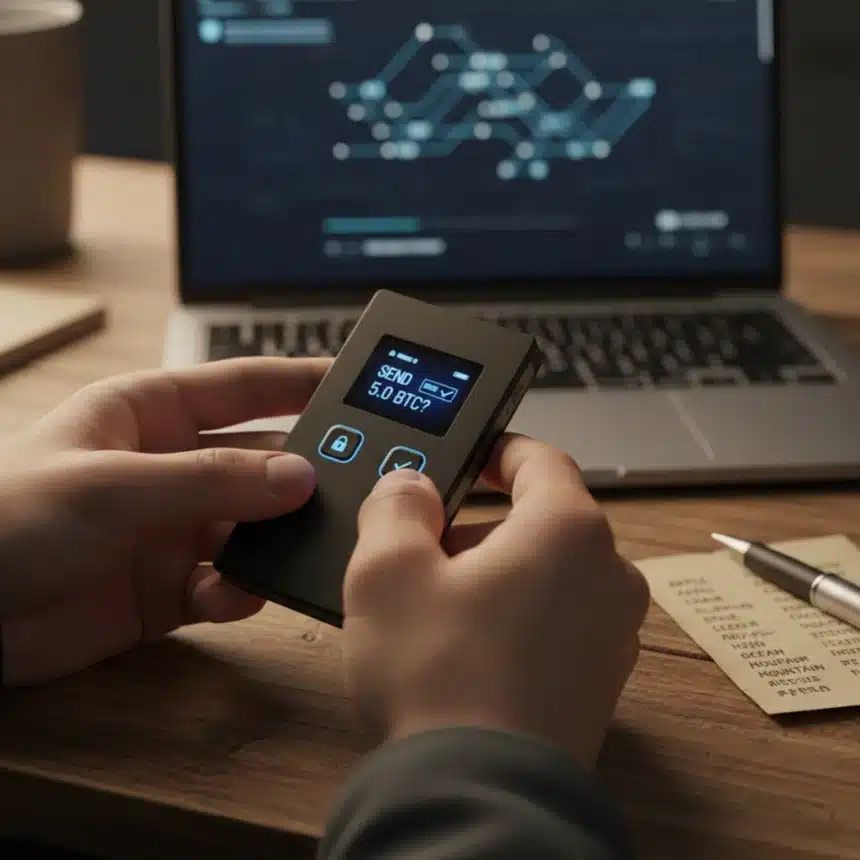
Using a hardware wallet feels very much like using a physical stamp to sign a letter. Imagine you want to send some digital money to a friend. You start the process on your computer, but before the money can move, the computer sends a request to your hardware wallet.
- The Request: The device wakes up and shows the details on its own tiny screen. It might say, “Send 5 coins to Sarah?”
- The Human Touch: You look at the device’s screen not your computer screen, which could be faked by a virus and you physically press a button on the device to say “Yes.”
- The Signature: The device “stamps” the transaction with your secret key inside its protected shell and sends the approval back to the computer.
The most important part of this process is that your secret key never leaves the device. The computer never sees it. The internet never sees it. Only the “approval” goes out.
The Ultimate Safety Net: The Magic Words
People often worry: “What if I lose this little device? What if I drop it in a lake or it gets crushed?” This is where the “Magic Words” come in. When you first set up a hardware wallet, it will give you a list of 12 to 24 simple words (like apple, chair, ocean, mountain).
These words are the DNA of your wallet. If your physical device is destroyed, you can buy a new one, type those words into it, and your “key” will be reborn. Because these words are so powerful, the most important rule of hardware wallets is to write them down on a physical piece of paper and hide them. Never take a photo of them or put them on a computer, because that would defeat the purpose of having an offline device.
Is It Worth the Effort?
A hardware wallet does add an extra step to your day. You have to find the device, plug it in, and press buttons. It isn’t as fast as a “tap to pay” app on your phone. However, for anyone who has saved a meaningful amount of digital money, that extra minute of effort provides a level of peace that a phone app simply cannot match.
In a digital age where we often feel vulnerable to invisible threats, the hardware wallet is a return to something we understand: a physical lock, a physical key, and a physical button. It puts the power back into your hands literally.
Free Daily Briefing
Get the Daily Briefing
Crypto, AI, and Web3 intelligence. Free, every day.
The Daily Brief by TCB
Crypto, AI & finance intelligence in 5 minutes. Every weekday morning. Free.