
Last updated: 9 April 2026
Key Highlights
- The “Infinite Money Glitch” Vanished: Strategy and BitMine grew massive treasuries (around $60 billion) by exploiting a trick: they issued new company shares at inflated prices, took the cash, and bought more digital assets. This cycle made their growth seem endless.
- The Market Wised Up: This easy money dried up when the financial market realized the shares were overpriced compared to the actual digital assets held. The profitable gap that fueled the operation disappeared, stopping the flow of cheap cash.
- Financial Structure is Exposed: Without the ability to continually raise new capital, their huge digital hoard is now fully vulnerable to market drops. The buffer of easy funding is gone.
- Forced into a Desperate Pivot: Strategy and BitMine must now abandon their accumulation strategy and urgently find a way to generate real, sustainable income and build a traditional business model to ensure their long term survival.
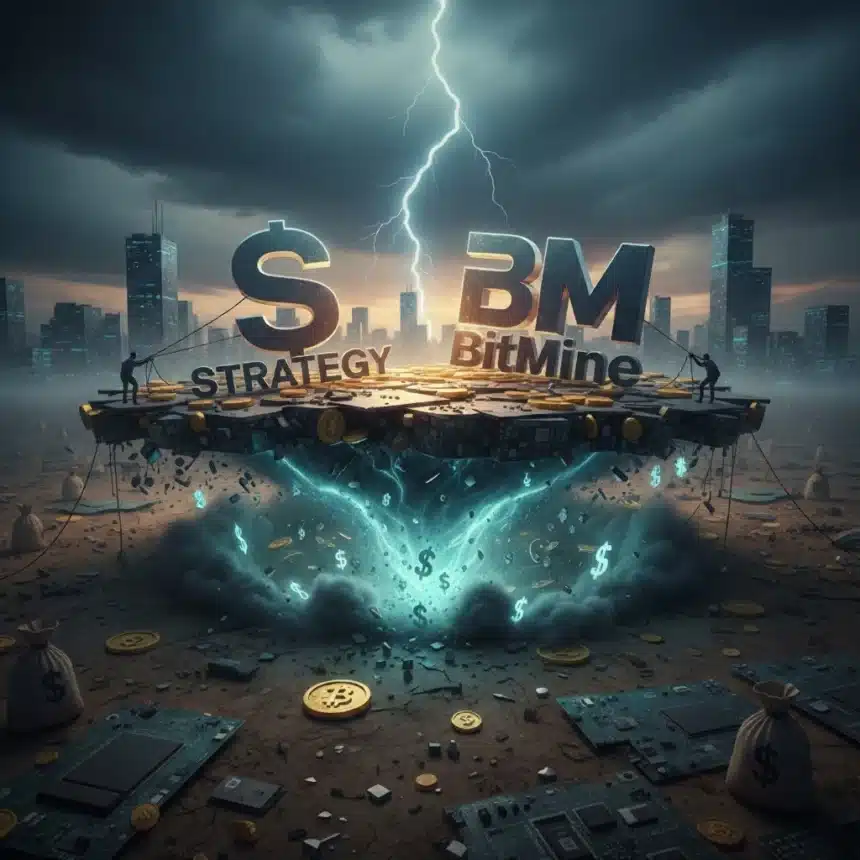
For a brief, dazzling period in the world of digital assets, two corporate giants, known as Strategy and BitMine, seemed to have stumbled upon the financial world’s equivalent of an “infinite money glitch.” This was not magic, but a clever, high stakes trade that allowed them to quickly build up immense digital treasuries, turning them into the biggest holders of assets like Bitcoin and Ethereum outside of actual currency creators. They were the king and queen of the digital hoard, sitting on a combined pile worth tens of billions of dollars.
But the party is over. The mechanism that fueled their incredible growth has ground to a halt. The easy money has evaporated, leaving both Strategy and BitMine facing a terrifying realization: their entire structure, built on this clever trick, is now exposed, forcing them into a desperate, high wire act just to survive.
The Magic Trick: Printing Tickets for Treasure
To understand this dramatic turn, you must first understand the “glitch” itself. It was brilliantly simple.
Imagine Strategy and BitMine were running a specialty shop that only sold one thing: ownership of their massive stash of digital money. When the excitement around Bitcoin and other digital assets was at its peak, investors desperately wanted a piece of the action. However, instead of buying the digital money directly, many chose to buy the companies’ shares the little tickets of ownership in Strategy and BitMine.
Crucially, the market valued these company shares at a much higher price than the actual digital money they held. It was like buying a ticket to a museum for a hundred dollars, when the ticket only entitled you to see a forty dollar painting. People were willing to pay the premium because they believed these companies were a safer, easier way to bet on the future of digital assets.
The “infinite money glitch” kicked in here. Strategy and BitMine could constantly issue new shares (print new tickets) and sell them at this inflated price. They would take the huge amount of cash they raised and immediately use it to buy more digital assets.
This created a beautiful, self sustaining loop:
- Issue Shares: Raise fresh cash at a premium price.
- Buy Assets: Use the cash to buy more digital assets.
- Company Value Rises: The company’s digital hoard grew, making its stock look even more valuable to eager investors.
- Repeat: They could then issue more shares, raising more money, and buying more assets.
As long as the stock price stayed high and investors remained hungry, the cycle kept spinning, making the growth seem endless. It felt like they had discovered a cheat code for business success.
The Wake Up Call: The Market Gets Wise
The problem with all “glitches” is that eventually, the game developers (in this case, the financial markets) find the bug and fix it. That is exactly what happened to Strategy and BitMine.
The window of opportunity slammed shut when the broader market realized the premium they were paying for the companies’ shares was simply too high. Investors started asking: Why pay $100 for a company that only holds $40 worth of digital assets?
When that realization dawned, the enthusiasm faded. The stock prices, once soaring on hype, either stalled or began to sink. Suddenly, when Strategy and BitMine tried to issue new shares, they couldn’t raise enough money to make the deal worthwhile. The profit making gap that defined the “glitch” the easy ability to swap high priced stock for digital money, vanished. The money machine stopped humming.
The Desperate Pivot
The evaporation of this easy money source has left a massive, terrifying gap in the companies’ plans. Their reported “$60 billion hoard” of digital assets is now exposed to the full, harsh reality of the market. Without the constant flow of new cash from stock sales acting as a buffer, they are fully vulnerable to any sudden drop in the value of the digital assets they hold.
Before, they didn’t really need a traditional business model. Their “business” was accumulating assets cheaply. Now, the rules have changed, forcing a “desperate pivot to survive.”
This pivot means they must now transform from being simple digital hoarders into functioning companies that generate real income. They must find ways to monetize their huge stashes, launch new services, or build actual profitable businesses around the digital ecosystem. For Strategy, a Bitcoin focused entity, this might mean leveraging their holdings for lending or other financial services. For BitMine, heavily focused on other digital assets, it might involve building technological infrastructure.
Their futures are no longer assured by a clever accounting trick; they are now dependent on good old fashioned business sense and market execution. The story of Strategy and BitMine has shifted from a fairytale of infinite money to a dramatic, high stakes struggle for survival, proving that in the end, no glitch can ever truly replace a solid business plan.
Free Daily Briefing
Get the Daily Briefing
Crypto, AI, and Web3 intelligence. Free, every day.
The Daily Brief by TCB
Crypto, AI & finance intelligence in 5 minutes. Every weekday morning. Free.