
Last updated: 1 April 2026
Key Takeaways
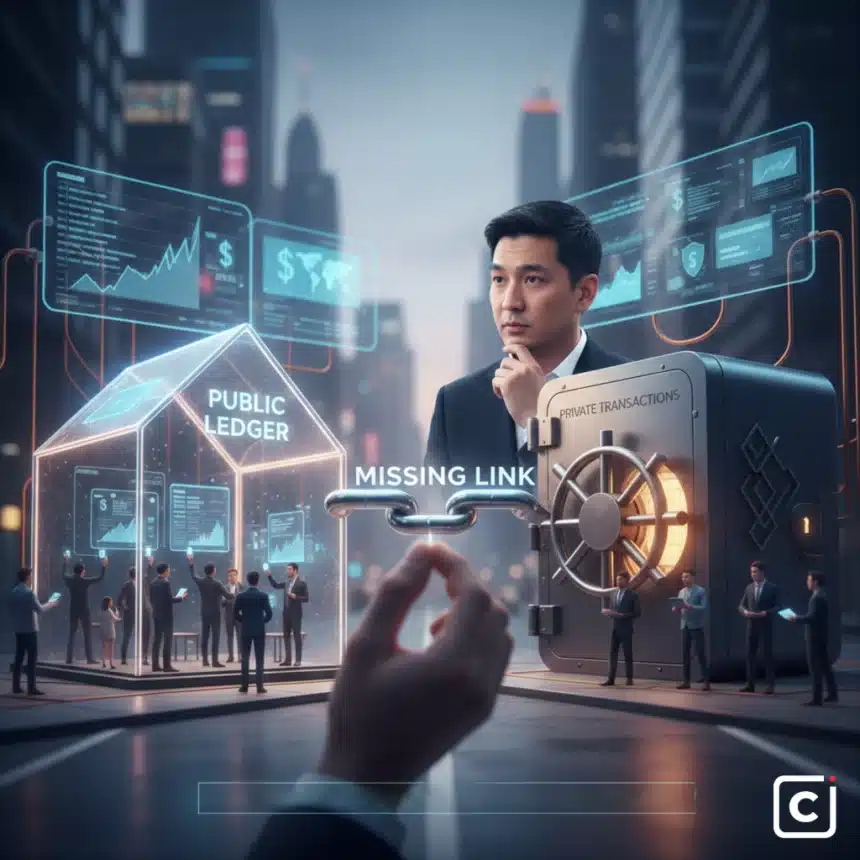
- Public Records: Current digital money systems act like a public glass house where everyone can see your balance. It is lacking privacy.
- Business Risks: Companies won’t use a system that shows their secret deals or employee salaries to competitors.
- CZ’s View: Privacy is a human right and a business necessity, not just a tool for hiding.
- The Consensus: Industry leaders agree that “Privacy as-a Service” will be the big trend of 2026.
Why Privacy Is the “Missing Link” for Crypto Adoption in 2026
The lack of privacy for digital money is the biggest wall standing in the way of people and businesses using it every day.
- Who it affects: Regular people, big companies, and any business paying employees or suppliers.
- Why it matters: Without privacy, your salary and spending habits are visible to anyone with an internet connection.
- What to watch: New technologies like “zero knowledge proofs” that allow for private payments without breaking the law.
The world of digital currency has hit a major roadblock. While millions of people trade these assets, very few use them to buy groceries or pay rent. According to Changpeng Zhao (CZ), the founder of Binance, and a group of experts at the recent Consensus conference, this isn’t because the technology is too slow it’s because it’s too public. This article will explain why privacy is the key to the next wave of growth and how it could change how you get paid.
The “Glass House” Problem in Digital Payments
When you use a credit card or cash, the world doesn’t see your bank balance. However, most popular digital currencies work on a public ledger. If a company pays its workers this way, anyone can see exactly what every person in the office earns just by looking up the company’s digital “address.”
CZ recently highlighted this as the “missing link” for mass adoption. He pointed out that while transparency was the original goal to prevent fraud, it has become a trap for honest users. If your wallet address is linked to your name, your entire financial history becomes an open book.
Why Companies Are Staying Away
For a big business, using public digital money is a competitive nightmare. If a smartphone company pays its parts supplier using a public system, its rivals can see:
- How much they are paying (allowing rivals to outbid them).
- Who they are working with (revealing secret partnerships).
- Their financial health (showing how much cash they have left).
At the Consensus 2024 and 2025 meetings, experts like Sandy Carter of Unstoppable Domains and venture capitalists emphasized that privacy is a “choice.” Businesses need the ability to choose what they show the world. Without this control, most corporations will stick to old fashioned bank transfers.
Is Privacy Legal?
A common concern is that privacy only helps criminals. However, CZ and other leaders argue that privacy is a fundamental human right. Just as you wouldn’t want a stranger reading your private mail or watching you through your living room window, you shouldn’t have to show your spending habits to the public.
The goal for 2026 is a “middle ground.” New tools are being built that keep your transactions private from the public while still allowing the proper authorities to check for illegal activity if a crime is suspected.
| Feature | Current Public Systems | Future Private Systems |
| Visible Balance | Public to everyone | Only visible to you |
| Transaction History | Searchable by anyone | Encrypted and private |
| Business Use | High risk (leaks secrets) | Safe (protects data) |
| Safety | High (prevents fraud) | Balanced (privacy + security) |
What Happens Next?
The push for privacy is already starting to move the needle. In early 2026, we are seeing a surge in “Privacy as-a Service.” This means platforms are building “layers” on top of existing systems to hide sensitive data.
Vitalik Buterin, the creator of Ethereum, has also shifted his focus toward these privacy tools. The industry is moving away from the “wild west” where everything was exposed, and toward a professional era where digital money feels as private as the cash in your wallet.
Frequently Asked Questions (FAQ)
1. Does privacy in crypto make it easier for scammers? Not necessarily. Modern privacy tools use “proofs” that show a transaction is valid without revealing the amount or the sender.
2. Why did CZ wait until now to speak up about this? As the industry matures and more big businesses try to join, the “lack of privacy” has become a bigger problem than it was during the early trading days.
3. Will my current digital wallet become private? Many developers are adding “privacy layers” to existing wallets, so you might not need to switch to a new one.
4. Is this why some countries are banning certain coins? Some governments are worried about coins that are too hidden. The new trend is “regulated privacy,” which protects you from the public but stays legal.
5. When will I be able to pay for things privately? Many companies are testing these systems now. We expect to see more “private” payment options at major retailers by the end of 2026.
The Daily Brief by TCB
Crypto, AI & finance intelligence in 5 minutes. Every weekday morning. Free.