
Last updated: 9 April 2026
Key Takeaways
- Tariff Timeline: A 10% tax starts February 1, 2026, rising to 25% on June 1 if no deal is reached.
- Stock Slump: European markets saw their biggest one day drop since November, led by carmakers like BMW and Volkswagen.
- Safety Search: Investors are fleeing to “safe” assets, pushing gold and silver to record breaking price levels.
- Political Risk: The European Union is considering an “anti coercion” tool to punish the U.S. in return.
Markets Shaken by Trump’s Greenland Tariff Threat
Stocks and government bonds fell sharply today as investors reacted to President Donald Trump’s latest plan to use trade taxes to force the sale of Greenland.
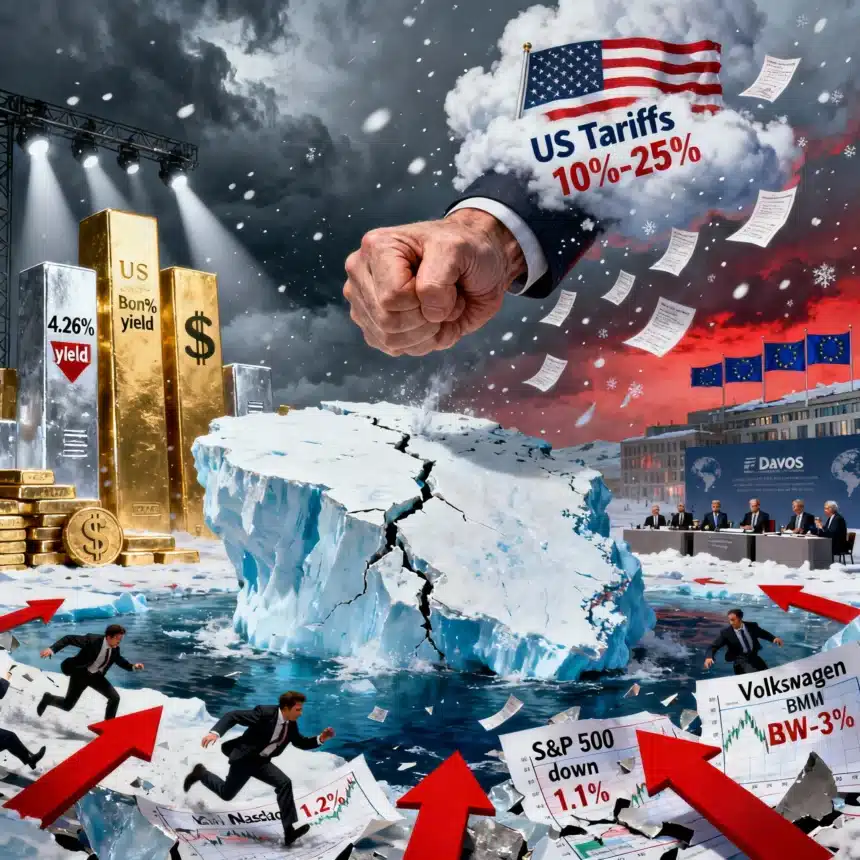
- Market Impact: S&P 500 futures dropped over 1%, while interest rates on 10 year government bonds climbed to 4.26%.
- Who Is Affected: Major European economies including Germany, France, and the UK face a 10% tax on all goods sent to the U.S. starting February 1.
- The Conflict: European leaders have rejected the U.S. bid to buy the territory, calling the move “economic coercion” and threatening to fight back with their own trade taxes.
This article explores why a dispute over a frozen island is causing a global financial chill, how markets are reacting, and what experts expect to happen next as world leaders gather in Davos.
Why Markets Are Falling Over Greenland
The sudden drop in stock prices stems from a weekend announcement by President Trump. He stated that the U.S. would impose a 10% tax on all imports from eight specific countries: Denmark, Norway, Sweden, France, Germany, the UK, the Netherlands, and Finland.
These nations have been vocal in their support for Denmark’s refusal to sell Greenland to the United States. By tying trade taxes to land acquisition, the administration has introduced a level of unpredictability that Wall Street dislikes.
When traders feel uncertain, they often sell “risky” assets like stocks and move money into “safe” spots. This shift caused S&P 500 contracts to slide by 1.1% and the Nasdaq 100 to drop 1.2% in early Tuesday trading.
The Impact on Your Money and Global Trade
For the average person, these market moves suggest that everyday goods could soon become more expensive. If a 10% or 25% tax is placed on European imports, companies often pass those costs on to shoppers.
Winners and Losers in the Current Market
| Asset / Sector | Movement | Reason |
| Gold & Silver | Up | Hit record highs as investors look for safety. |
| European Cars | Down | BMW and Porsche fell over 3% on trade war fears. |
| U.S. Bonds | Down | 10 year yields rose to 4.26%, making borrowing more expensive. |
| US Dollar | Steady | Edged higher as the global reserve currency of choice. |
Strategic experts, such as those at Allianz Global Investors, warn that this could turn into a “full blown trade war.” If the EU retaliates by taxing the $108 billion worth of U.S. goods they currently buy, it could slow down the entire global economy.
What Happens Next?
The world is now looking toward the World Economic Forum in Davos, where President Trump is scheduled to speak this Wednesday. Investors are watching closely to see if he doubles down on the “Greenland or bust” strategy or offers a path to negotiation.
There is also a legal hurdle at home. The U.S. Supreme Court is currently reviewing the President’s authority to use emergency economic powers to set these types of taxes. If the court rules against the administration, the February 1 deadline might never be met.
Watch Items for the Coming Week:
- Davos Speeches: Any sign of softening or escalating rhetoric from the U.S. delegation.
- EU Response: Whether Germany and France can agree on a unified counter tax.
- Bond Auctions: How much interest investors demand to hold U.S. debt during this friction.
”The threat of tariffs against fellow NATO members adds a fresh dose of uncertainty… keeping financial markets off balance,” noted Tim Waterer, chief market analyst at KCM Trade.
FAQ: The Greenland Tariff Crisis
Why does the U.S. want to buy Greenland?
The administration views Greenland as a vital strategic location to counter Russian and Chinese influence in the Arctic and to secure access to valuable natural resources.
Which countries are being targeted?
The initial 10% tariffs targets Denmark, Norway, Sweden, France, Germany, the United Kingdom, the Netherlands, and Finland.
When do the taxes actually start?
The first wave of 10% tariffs is set for February 1, 2026. If no deal is made by June 1, 2026, the rate is scheduled to jump to 25%.
Is this a permanent move?
President Trump has described the taxes as a negotiating tool, saying the U.S. is “immediately open to negotiation” if Denmark agrees to discuss the sale.
How has the stock market responded?
Most major indexes are down. The S&P 500 and Nasdaq are seeing losses of roughly 1%, while European car and luxury goods companies have been hit even harder.
Free Daily Briefing
Get the Daily Briefing
Crypto, AI, and Web3 intelligence. Free, every day.
The Daily Brief by TCB
Crypto, AI & finance intelligence in 5 minutes. Every weekday morning. Free.