
Key Takeaways
- Smart Brains: These robots have tools that help them see even when it is smoky, underwater or completely dark.
- Safety First: The main goal is to keep people from jobs that are boring, dirty and dangerous.
- Human-Led: While the robots do the work they are controlled by people who are experts and they do this from a safe place.
- Efficiency Boost: Machines can work in hot or cold temperatures or in bad air without needing to rest or wear special clothes.
A new partnership between technology companies is going to start using advanced robots that can be controlled from far away to do jobs that are too risky for people.
- Why it matters: This will make it much safer for workers in jobs, like mining, nuclear energy and cleaning up after disasters.
- Who it affects: People who work in factories, emergency responders and companies that work in places.
- What to watch: The first group of these robots will be tested in water and very hot places by the end of the year.
This article explores how these new mechanical helpers work, the specific jobs they will take over, and how this partnership aims to make “impossible” workplaces safe for everyone. By looking at real-world testing and safety data, we will see why the future of hard labor is shifting from human hands to smart machines.
How This Partnership Changes the Game for Safety
For a time some jobs have been really risky. Take fixing a leak in a chemical plant or exploring a mine that has collapsed. The danger to people has always been the problem. A new partnership is now dealing with this directly by combining technology with strong machines.One company is good at making robot bodies that can handle extreme conditions. The other company provides the software that helps the robot understand what’s around it. Together they are making a tool that doesn’t just follow a set path but actually responds to its environment.
This new tool can help make risky jobs safer. The robot can withstand conditions and make decisions on its own. This partnership is a step forward for safety in risky jobs.The companies are working together to make this tool even better. They want to make sure it can handle situations and help people in various industries. With this partnership the future of safety in jobs looks promising.
Why We Need Smart brains (Robots) in These Places
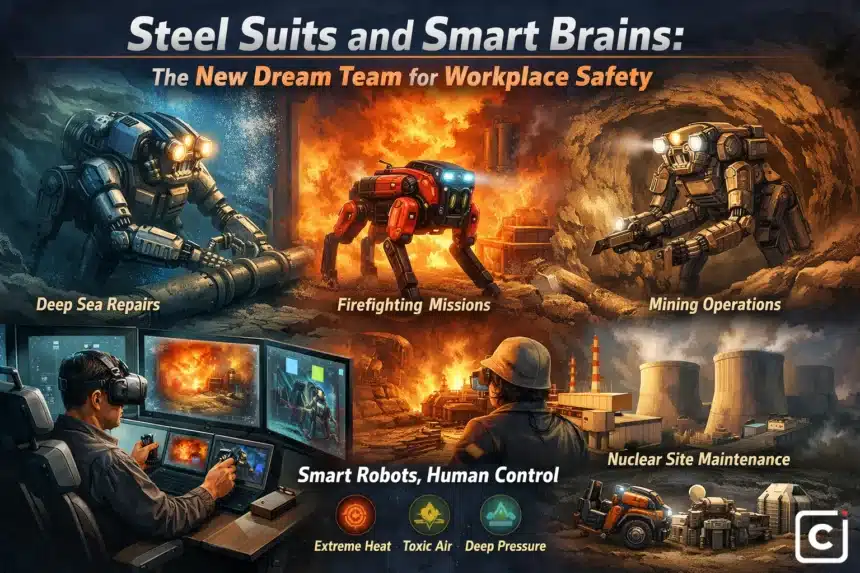
Humans have limits. We need oxygen, we can only stand a certain amount of heat, and our skin is fragile. Robots, however, can be built from materials like titanium or reinforced steel. This partnership focuses on three specific “danger zones”:
- Extreme Heat: Fires or industrial furnaces.
- Toxic Air: Chemical spills or gas leaks where one breath could be fatal.
- High Pressure: Deep underwater repairs on oil rigs or internet cables.
The Technology: Simple Tools for Complex Problems
You might think of a robot as a confusing piece of sci-fi tech, but the way these new machines work is actually quite simple to understand. Think of them as high-tech avatars.
Seeing Through the Impossible
In a house fire or a dusty mine, a human can’t see two inches in front of their face. These robots use “heat vision” and sound waves to map out a room. They send a 3D picture back to a tablet or a headset worn by a human operator. This allows the person in charge to “see” through walls or thick smoke.
The “Touch” Factor
One of the biggest breakthroughs in this partnership is how the robot handles objects. In the past, robots were clumsy. If they tried to pick up a glass vial of chemicals, they might crush it. These new machines use “touch sensors” that tell the operator exactly how much pressure is being applied. This makes them gentle enough to turn a small valve but strong enough to lift a fallen beam.
Where Will These Robots Work First?
The partnership has identified four main areas where these robots will start working immediately. Each of these fields has a high rate of workplace accidents, and the introduction of smart machines could bring those numbers down to nearly zero.
| Industry | High-Risk Task | Robot Solution |
| Nuclear Energy | Cleaning waste or fixing leaks | Lead-shielded robots that ignore radiation |
| Firefighting | Scouting burning buildings | Heat-proof “dogs” that find survivors |
| Mining | Working in unstable tunnels | Machines that drill and scout before humans enter |
| Deep Sea | Repairing underwater pipes | Robots that handle immense water pressure |
Real-World Proof: The Recent Testing Phase
In a recent test conducted by the partnership, a prototype robot was sent into a decommissioned factory filled with smoke. While human firefighters stayed at the entrance, the robot navigated three floors, located a simulated gas leak, and shut off the main valve in under ten minutes. This task would have normally required a team of four humans in heavy gear and took twice as long.
Why This Matters to the Average Worker
There is often a fear that robots will take the jobs of the worker. However this partnership is focusing on the jobs that people do not want to do or should not do because they are too risky for the worker.
A big change is happening here
Of the average worker spending eight hours in a hot and cramped tunnel the average worker will now sit in an air-conditioned office or a mobile command center to control the robot. The average worker will use a joystick or a virtual reality headset to guide the robot. This changes the job of the worker from a physical labor role to a technical role.The average worker will be able to work for a time because the job is not as physically demanding for the average worker.
Lowering Costs for Everyone
When a company has accidents the insurance costs of the company go down. When a robot can fix a problem without a facility needing to shut down for safety checks products become cheaper to make for everyone. In the run these robots help stabilize the prices of energy and raw materials like copper and steel for everyone.
What Is Next for the Partnership?
The next step for this partnership is to make robots. Now these robots are expensive and made one by one for the partnership. Over the two years the partnership aims to move into mass production of the robots.
Training the Next Generation
A major part of this rollout includes training programs for the generation of workers. The companies are working with trade schools to teach workers how to maintain and pilot these machines for the partnership. The goal is to ensure that the people who know the danger zones best. The miners, the divers and the engineers. Are the ones in control of the robots for the partnership.
Improving Battery Life
One of the remaining hurdles is how long these machines can stay awake and working for the partnership. Currently most high-power robots need to be plugged in or have batteries that last a few hours for the partnership .The partnership is working on a type of power cell that could keep a robot running for a full 24-hour shift without needing a charge, for the partnership.
The Road Ahead for Industrial Safety
The partnership between these two tech giants is more than just a business deal; it is a shift in how we view work. For a long time, we accepted that some jobs were just “dangerous” and that accidents were part of the cost of doing business.
With the arrival of smart, tough robots, that era is coming to an end. We are moving toward a world where a “dangerous environment” is just another place where we send a machine to do a job, while the person stays safe, sound, and in control.
Stay Informed
As these machines roll out to more factories and mines, we will see a massive drop in workplace injuries. This partnership is just the beginning of a safer, smarter industrial world.
FAQ
Are these smart brains (robots) able to think for themselves and make their decisions?
No. These robots have features that help them avoid running into things but a person is always in charge and makes the important decisions. The robots are like really cool machines that people use, rather than beings that can think on their own.
Can these robots work underwater?
Yes. One of the things that the people making these robots want to do is create machines that can go really deep into the ocean, where it is hard for people to go because the water is so heavy. Now people need big and expensive submarines to go that deep.
Will robots like this make some jobs go away?
This will change the way people do their jobs. If they have to be in a place that is not safe the person will be able to control the robot from a distance. This is about keeping people safe, not about taking their jobs.
How do robots deal with high temperatures?
The robots are made with systems that keep them cool and have special coverings that reflect the heat so it does not hurt the computers inside them.
What happens if the robot loses its connection with the person controlling it?
The robots are programmed to be safe. If they lose their connection with the person they will automatically stop moving or go back to a place so they do not cause any accidents.
Stay updated, follow us on X for real-time crypto and AI news: