



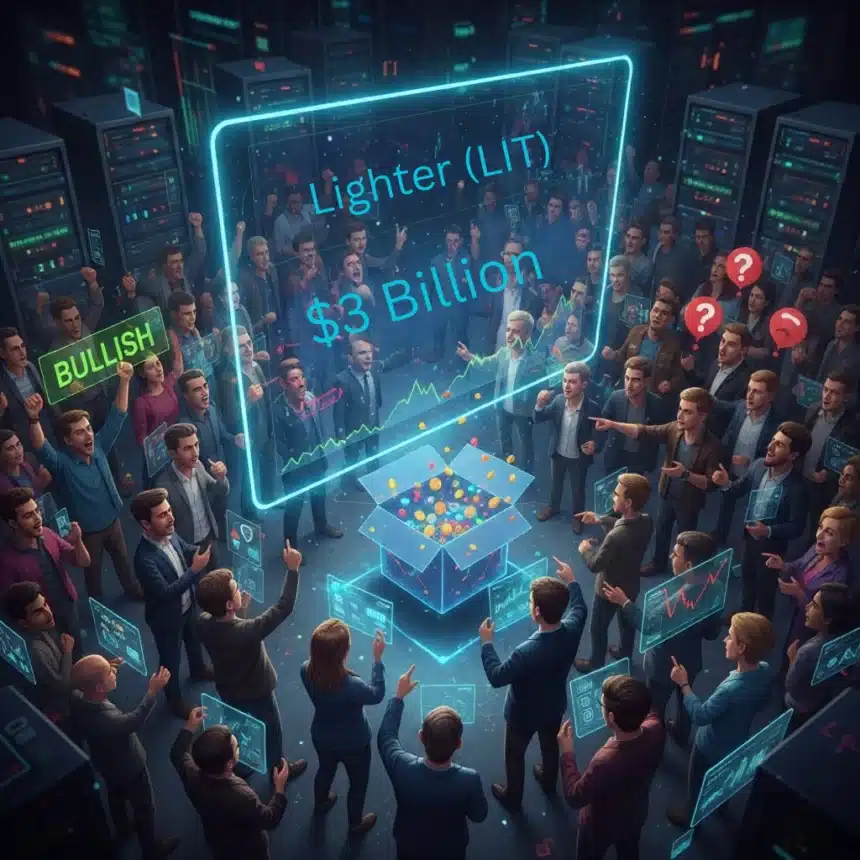
Key Highlights
- Massive Valuation: Lighter launched with a total projected value of $3 billion, placing it among the most valuable projects in the digital trading space.
- Trader Split: The market is divided; supporters point to record-breaking trading volumes, while skeptics fear the price is an incentive-driven bubble.
- High-Stakes Airdrop: The project gave away 25% of its tokens for free to early users, leading to a wave of selling that has caused significant price swings.
- Institutional Backing: With support from major players like Founders Fund and Robinhood, the project is betting its “zero-fee” model will redefine how the world trades.
The launch of the Lighter (LIT) token has become one of the most talked-about events in the digital finance world as 2025 comes to a close. Traders and enthusiasts are currently divided over a big question: is the project actually worth $3 billion?
While some see Lighter as the next big star, others worry that the hype might be larger than the reality. Here is a breakdown of what is happening, why it matters, and why the community can’t seem to agree.
What is Lighter?
At its heart, Lighter is a platform designed for trading. Think of it like a high-speed stock market, but for digital assets, where everything happens transparently on a public ledger.
What makes it special is its attempt to combine two worlds. It wants the speed and ease of a traditional big-bank trading app with the security and honesty of a decentralized system. Most trading platforms today are either fast but “closed” (you have to trust the company), or “open” but slow and clunky. Lighter claims to have solved this puzzle using clever math that keeps things moving at lightning speed while proving every trade is fair.
The $3 Billion Debate
The term “FDV” (Fully Diluted Valuation) is essentially a way of saying, “If every single token that will ever exist for this project were out in the world today at the current price, what would the whole thing be worth?”
For Lighter, that number is hovering around $3 billion. To put that in perspective, that is the size of many well-known global companies.
Why Some Traders are Excited
Many people believe Lighter is easily worth $3 billion or even much more. Their reasons are simple:
- The “Big Names” are Involved: Famous investment firms and even household names like Robinhood have put money into Lighter. When the “smart money” moves in, regular traders often follow.
- Massive Usage: Even before the token launched, the platform was seeing billions of dollars in trading volume every single day. People aren’t just talking about it; they are actually using it.
- The Technology: Because Lighter uses “Zero-Knowledge” technology (a way of proving something is true without revealing all the private data behind it), it is considered the “gold standard” for the future of digital trading.
Why Others are Worried
On the other side of the fence, some traders are nervous. They argue that the $3 billion price tag is a “bubble” waiting to burst for a few reasons:
- The “Airdrop” Effect: Lighter gave away 25% of its tokens for free to early users (an “airdrop”). Often, when people get something for free, they sell it immediately to lock in profit. We have already seen the price dip by about 30% shortly after the launch as people cashed out.
- Artificial Hype: Some critics believe the high trading volume was only high because people were “farming” for rewards. Once the rewards are gone, will the users stay?
- The “VC” Trap: Some worry that the early big investors (Venture Capitalists) will eventually sell their shares to regular people, leaving the “little guy” holding a devaluing asset.
The Market’s “Crystal Ball”
Before the token even officially launched, people were betting on its success on “prediction markets.” These are platforms where people put real money down to guess the outcome of events.
For weeks, these markets showed about a 60% to 70% chance that Lighter would stay above that $3 billion mark. It was a close race, and even now, the betting continues. If Lighter can keep its users and continue to grow its technology, it might join the ranks of the “unicorns” (projects worth over $1 billion). If the excitement fades, it could become a cautionary tale of a project that flew too close to the sun.
What’s Next?
The next few weeks will be the “stress test” for Lighter. The project has set aside half of its tokens to reward people who keep using the platform, which might help keep it stable. Meanwhile, the world is watching to see if Lighter becomes the new standard for how we trade or if the $3 billion dream was a bit too optimistic.