


Key Highlights
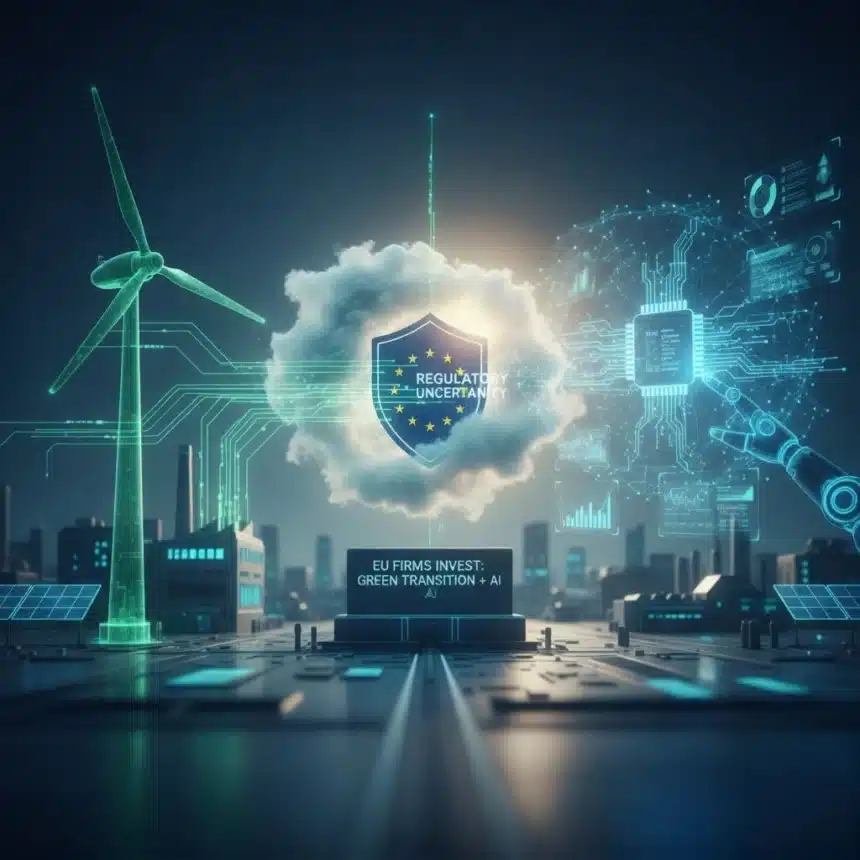
- EU firms are heavily investing in both the green transition and advanced AI to build resilience against global volatility
- While EU firms match the US in initial AI adoption (37% vs. 36%), they lag behind in applying AI across multiple business functions, suggesting they aren’t fully utilizing its potential
- Despite a slowdown and high uncertainty, 86% of EU firms continue to invest, though they are cautious, prioritizing replacement over capacity expansion
- The biggest investment hurdles are uncertainty (83%) and a shortage of skilled labor (79%), with energy costs and growing customs/tariff worries also posing significant challenges
The European Investment Bank (EIB) has just released its latest survey, revealing that businesses across the European Union are actively investing in sustainable practices and digital technologies. This commitment to the green transition and digitalization is a strategic move to build resilience, even as firms grapple with a turbulent global landscape of economic and regulatory uncertainty.
The EIB Investment Survey (EIBIS) spoke with over 12,000 EU firms and more than 800 US companies between April and July 2025. The results show that European businesses are directly allocating resources to cut greenhouse gas emissions while simultaneously adopting advanced Artificial Intelligence (AI) tools.
AI Adoption: European Pace Matches the US, But Application Lags
One of the survey’s standout findings is the comparable adoption rate of advanced AI between the two major economic blocs. About 37% of EU firms are deploying Generative AI, just slightly ahead of the 36% adoption rate in the US. This initial uptake presents a significant opportunity for companies to gain value through AI-powered process automation, supplier risk monitoring, and market intelligence.
However, the survey highlights a divergence in how AI is being used. While initial adoption is similar, European firms appear to be slower at integrating AI across a wide range of business functions. The data shows that 81% of US companies using AI do so in more than two activities (like customer service, HR, and marketing), compared to only 55% of European companies. This suggests that while European firms are willing to invest in the technology, they may not yet be harnessing its full potential across their operations.
Resilience and Strategic Green Commitment
Despite a general slowdown in investment across the Atlantic, EU companies are showing remarkable fortitude, with 86% continuing to invest. This, however, is being done with a measure of caution due to ongoing political, regulatory, and economic uncertainty.
As Debora Revoltella, Chief Economist at the EIB, notes: “While uncertainty weighs heavily on firms, they are so far weathering the shock.” She emphasizes a clear dedication to digitalization and green initiatives, which are vital for remaining competitive. The commitment to sustainability is particularly evident, with a significant share of capital directed toward eco-friendly practices.
Green Transition is a Major Investment Focus
The dedication to environmental goals is substantial: a massive 92% of EU companies report directly investing in resources aimed at reducing greenhouse gas emissions. This strong, dual focus on green and digital investment signals a clear strategic path for many European businesses.
Policy support is also playing a role, with about 16% of investing companies receiving government assistance through grants or favorable financing. Notably, the majority of this EU policy support is highly targeted: 41% is dedicated to green transition initiatives, and 29% is focused on innovation.
Persistent Hurdles and Future Growth Caution
The 2025 EIBIS also reveals that significant investment obstacles remain in Europe. A high percentage of EU businesses cite uncertainty (83%) and a shortage of skilled labor (79%) as their primary barriers. The lack of qualified workers is a critical issue for the technology sector and could impede the broader rollout of AI.
Furthermore, energy costs pose an obstacle for 75% of European businesses, highlighting the urgent need to accelerate renewable energy deployment to boost competitiveness.
These challenges are likely influencing future outlooks. The survey indicates that EU firms will prioritize replacing existing equipment over expanding their capacity. Only 26% are planning to expand operations over the next three years, compared to a much higher 37% of US firms with similar intentions.
Finally, though fewer European firms face financial constraints than in previous years, growing worries about changes to trade taxes and import fees are affecting businesses in both the US and Europe. While this is viewed as a major obstacle by 77% of US firms, it also concerns nearly half (48%) of EU companies.