



Key Highlights
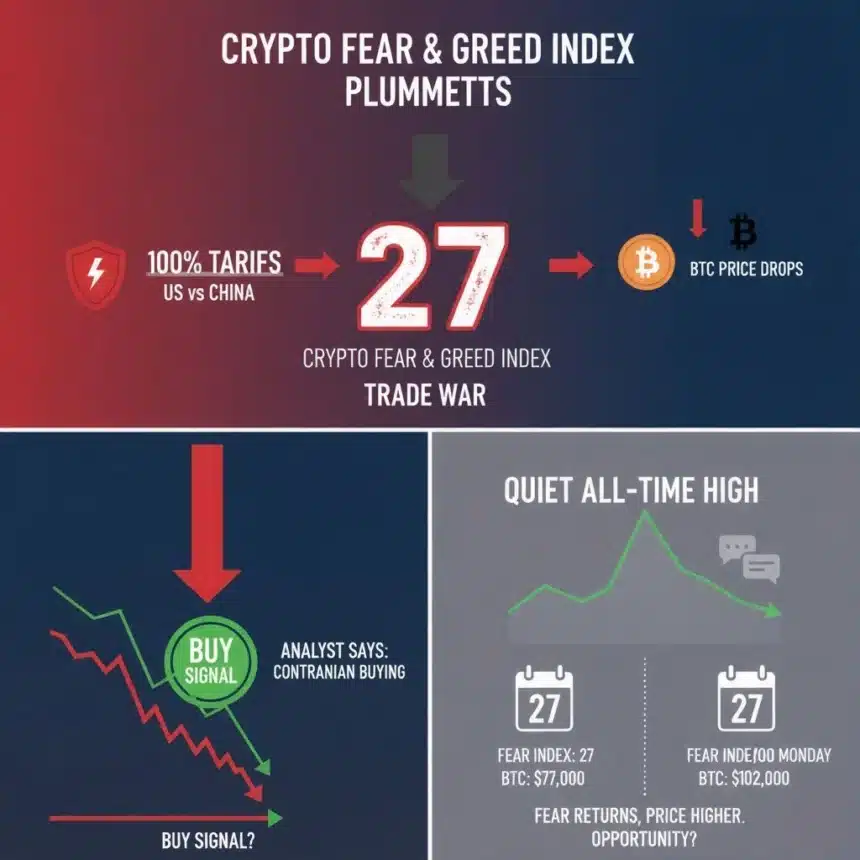
- The Crypto Fear & Greed Index dropped sharply to a “Fear” level of 27—its lowest in almost six months—after US President Donald Trump announced a 100% tariff on China
- Following the announcement, Bitcoin briefly dipped to $102,000
- Andre Dragosch, stated that the company’s Sentiment Index generated a “strong contrarian buying signal” as it hit a severe low of -2.8 standard deviations.
- Bitcoin’s earlier all-time high of $125,100 on Monday did not generate the typical “euphoric” social media reaction observed in previous record highs
The cryptocurrency market has been hit with a sudden wave of fear following US President Donald Trump’s announcement of a 100% tariff on China. This dramatic turn of events has caused the Crypto Fear & Greed Index—a popular gauge of market sentiment—to plummet to its lowest level in almost six months, hitting a “Fear” reading of 27 on Saturday. This is a massive drop from the previous day’s “Greed” reading of 64.
This sudden panic on Saturday mirrored an event that happened just six months earlier. The last time the Fear & Greed Index was at this level, on April 16, Bitcoin was trading around $77,000. Just a week prior to that low point, Bitcoin had been trading as high as $80,000, illustrating how quickly market sentiment can change.
Bitcoin’s Price Reacts to the News
The news of the sweeping tariffs on Friday sent Bitcoin’s (BTC) price briefly dipping to $102,000 on perpetual futures pairs, a significant pullback from its recent highs. Earlier in the week, Bitcoin had been flying high, reaching a new record of $125,100 on Monday, which had kept the Fear & Greed Index in “Greed” territory.
The current atmosphere of fear is a sharp reversal from just days ago. This entire episode highlights the market’s sensitivity to global trade policy and geopolitical uncertainty.
A Contradictory Signal: Strong Buying Recommended
Despite the widespread fear, some analysts see the sharp decline in sentiment as a potential “strong contrarian buying signal.”
Andre Dragosch, Bitwise’s European head of research, shared on social media platform X that the company’s own intraday crypto asset Sentiment Index had generated this optimistic signal on Friday. The index hit an intraday low of -2.8 standard deviations, a level it hasn’t seen since the ‘Yen Carry Trade Unwind’ in the summer of 2024. For seasoned traders, the Fear & Greed Index dropping this low often represents a point where the market is oversold due to panic, making it an opportune time for those betting on a recovery to step in.
A Lack of Euphoria in the Last Rally
Interestingly, before this recent crash, Bitcoin’s ascent to its all-time high of $125,100 on Monday wasn’t accompanied by the usual frenzy of excitement from the crypto community.
An analyst Brian Quinlivan pointed out that the recent all-time high didn’t generate the same level of enthusiasm on social media as previous record-breaking events. In an interview with the Thinking Crypto podcast, Quinlivan described the reaction to the $125,100 price as “a modest, run-of-the-mill reaction from the crypto audience” and noted that it “really wasn’t much of anything.” He concluded it wasn’t “nearly as euphoric as some of these previous ones.”
This lack of “euphoria” during the bull run may have been a subtle indicator that the market wasn’t entirely convinced of the rally’s sustainability, even before the tariff news broke. The quiet nature of the rise suggests the market was more cautious than it has been in past cycles.
Looking Back: The April Precedent
The market’s current volatility echoes the uncertainty experienced in April. The previous low for the Fear & Greed Index (April 16) was set shortly after Bitcoin tumbled to $77,000. That earlier downturn was also driven by escalating trade tensions.
However, just a few days before that low point, on April 9, Trump had announced a 90-day pause on higher reciprocal tariffs, temporarily reverting them to a 10% baseline for many countries. This earlier, smaller trade resolution provided a brief moment of relief, showing how responsive the crypto market is to even temporary shifts in global trade policy.
In sum, the crypto market is currently grappling with a sudden, externally-driven fear spike. While the sentiment index is flashing a strong panic signal, suggesting a potential buying opportunity for contrarian investors, the key factor remains the rapidly shifting landscape of US-China trade relations.