
Last updated: 9 April 2026
Key Highlights
- The cash banks keep at the Federal Reserve is running out fast, hitting a “danger zone.”
- To stop the banking system from crashing, the Fed will soon be forced to create and inject a lot of new money (liquidity) into the economy
- Huge new financial products (like ETFs) are buying up and locking away the limited supply of Bitcoin faster than it can be created
- When the Fed’s new money floods the system and tries to buy the tiny amount of available Bitcoin, the price is expected to shoot up massively.
A potent mix of traditional finance stress and relentless crypto demand is setting the stage for what one prominent market analyst calls the “mother of all liquidity pivots,” a shift that could send Bitcoin soaring. Adam Livingston, a respected figure in macroeconomics and the author of The Kobeissi Letter, has issued a sharp warning that bank cash reserves at the Federal Reserve are rapidly approaching a “danger zone,” an ominous sign for the established financial system, but a potential rocket booster for the world’s leading digital currency.
Livingston’s analysis zeroes in on a critical, yet often overlooked, indicator: the total amount of cash that commercial banks hold on deposit at the Federal Reserve. This cash, known as reserve balances, acts like the oil in the financial machine; it represents the overall liquidity and stability of the banking system. When this number drops too low, it signals that the entire system is becoming brittle and prone to stress.
The $2.93 Trillion Trigger: Approaching the ‘Danger Zone’
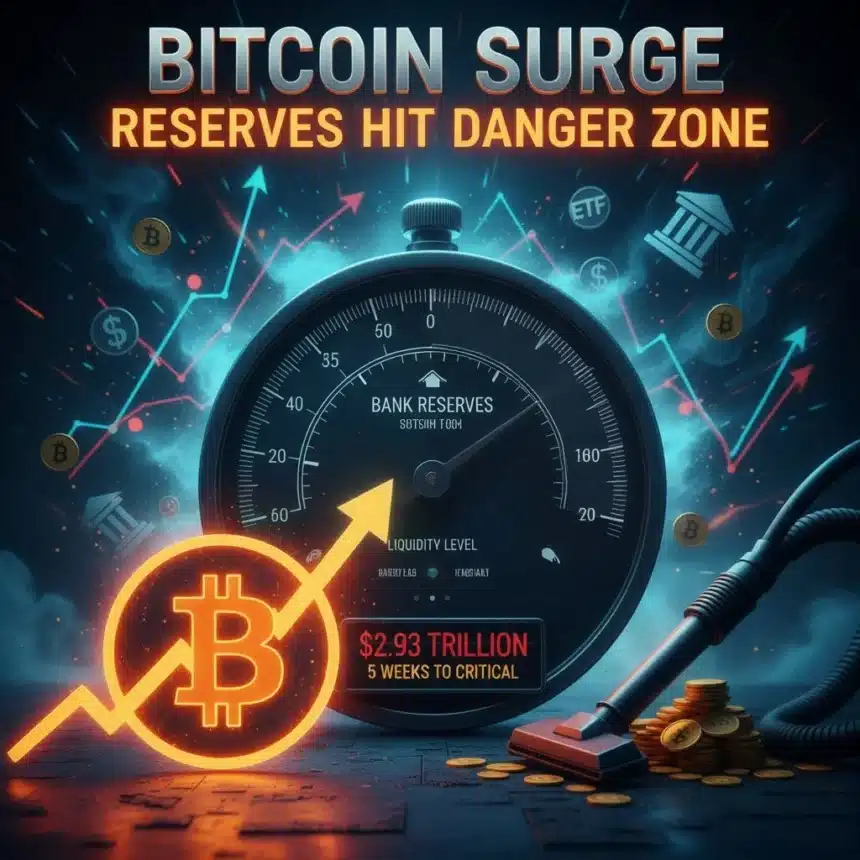
According to reports, bank reserves have recently dipped to approximately $2.93 trillion. While that number sounds enormous, in the context of global finance, it signifies a rapid and concerning decline. Livingston argues that, at the current pace, the reserves are “within five weeks of the danger zone.” He’s not talking about a slow, gentle slowdown; he’s arguing that “liquidity is bleeding” out of the system.
Imagine the bank reserve level as the fuel gauge on a massive airliner. While it might have started full, if the gauge drops into the danger zone, the pilots in this case, the Federal Reserve have no choice but to take immediate, quick action to prevent a crisis. In simple terms, when the traditional banking system’s fuel supply gets dangerously low, the Fed is eventually forced to inject new money, or liquidity, back into the system.
This necessity for a monetary policy reversal is the “liquidity pivot” that Livingston forecasts. Historically, when central banks are compelled to flood the system with new money, risky assets that stand to benefit most from increased capital flow are the first to see dramatic gains. And at the top of that list is Bitcoin. The inflow of fresh capital searches for the highest growth potential, and time and again, that path leads to decentralized, scarce assets.
The Scarcity Squeeze: ETFs are ‘Hoovering Supply’
While the macroeconomic backdrop sets the stage for a grand entrance of new liquidity, the structure of the Bitcoin market itself is adding a powerful, one way pressure on supply. This is the second crucial component of Livingston’s bullish thesis: the effect of Bitcoin Exchange Traded Funds (ETFs).
The introduction of spot Bitcoin ETFs has revolutionized access to the cryptocurrency for institutional investors, major corporations, and wealth managers. These sophisticated entities are now able to buy and hold Bitcoin through a familiar, regulated structure. The result, as Livingston notes, is that ETFs are “hoovering supply.” They are vacuuming up available Bitcoin from the market and locking it away in institutional custody for long term holding.
Bitcoin is inherently scarce, with a fixed supply cap of 21 million coins. When massive, consistent institutional demand meets a limited, shrinking supply of available coins, a powerful supply shock is inevitable. Every day, these ETFs absorb more Bitcoin than the network can mine. This creates a relentless upward pressure on price, as buyers are forced to compete for fewer and fewer publicly available coins.
The Convergence of Two Forces
The genius of Livingston’s analysis lies in connecting these two distinct forces. On one side, you have the macro financial system’s instability, the “danger zone” of bank reserves which will ultimately force the central bank’s hand to inject liquidity. This is the catalyst for a large injection of new money.
On the other side, you have the structural rigidity of the Bitcoin market, the combination of its fixed supply and the sustained institutional buying from ETFs which creates profound scarcity.
When the inevitable macro liquidity pivot occurs, and a wave of new institutional money seeks a home, it will crash directly into a Bitcoin market that has already been emptied of its available supply by the ETFs. This convergence is why Livingston frames the potential rally not just as a surge, but as a looming “mother of all liquidity pivots,” signaling a major repricing event for Bitcoin as the traditional banking system struggles to maintain its footing.
For investors, the convergence of this critical macro signal and the ongoing supply drain creates a rare and powerful setup. Livingston’s timeline suggesting the danger zone is mere weeks away marks this period as a crucial moment for observing a shift that could redefine the landscape of digital assets and traditional finance alike.
Free Daily Briefing
Get the Daily Briefing
Crypto, AI, and Web3 intelligence. Free, every day.
The Daily Brief by TCB
Crypto, AI & finance intelligence in 5 minutes. Every weekday morning. Free.