Key Highlights
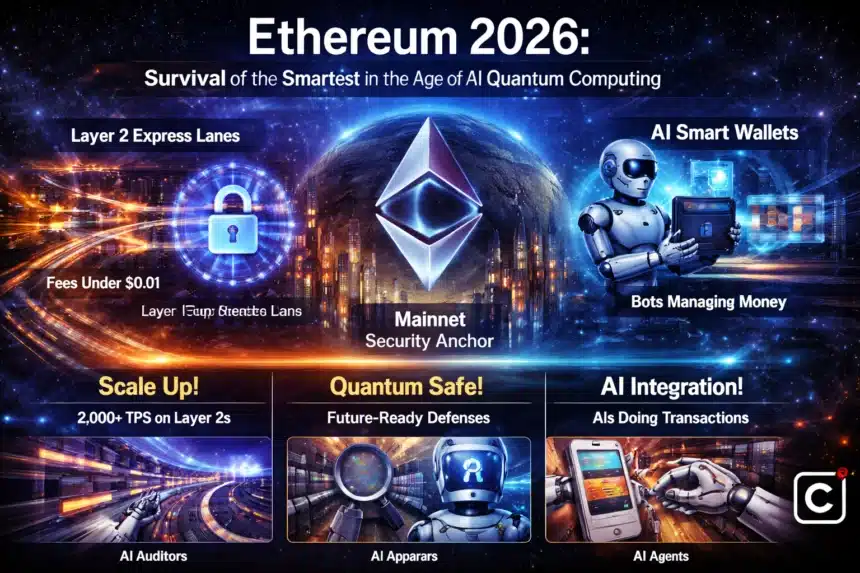
- Scaling Victory: Most users have moved to “Layer 2” networks (like digital express lanes), where fees are now consistently below $0.01.
- Quantum Shield: Ethereum is testing new “digital locks” to protect user funds from future supercomputers that could potentially crack today’s security.
- AI Integration: New tools are being built so AI “bots” can have their own digital wallets to pay for services or manage money automatically.
- Main net Role: The original Ethereum network is becoming a “security guard” that stays in the background while other faster networks do the heavy lifting.
Ethereum is currently the world’s most popular foundation for digital finance, but it is facing a critical turning point. To remain the leader, it must now balance three massive pressures: the need to handle millions of more users, the rising threat of super-fast “quantum” computers, and the sudden explosion of Artificial Intelligence (AI).
How the Ethereum Ecosystem Ranks in 2026
| Network Name | Primary Use Case | Key Benefit | Where to Watch |
| Ethereum (Mainnet) | Security & Settlement | Maximum safety for large funds | Ethereum.org |
| Arbitrum | Institutional Finance | Most money locked in the system | Arbitrum Foundation |
| Base | Everyday Shopping & Social | Built by Coinbase for easy use | Base.org |
| Polygon zkEVM | Business & Enterprise | High security for big companies | Polygon.technology |
The Strategy: Moving People to the “Express Lanes”
For years, using Ethereum was like driving on a one-lane road that was always jammed and expensive. In 2026, that has changed. Ethereum has officially moved most of its traffic to “Layer 2” networks. Think of these as high-speed express lanes built on top of the main road.
The big breakthrough came from a technical update called “Data Blobs.” Instead of recording every tiny detail on the main, expensive network, these express lanes now bundle thousands of transactions together and store them in a temporary, cheap “folder” on Ethereum. This has dropped the cost of sending money or playing games from several dollars to less than a penny.
Why this matters:
- It’s invisible: Most new users don’t even know they are using Ethereum; they just see an app that is fast and free.
- It’s scalable: These lanes can now handle over 2,000 transactions every second, which is close to what major credit card companies handle.
The Quantum Threat: Building a Better Lock
While Ethereum is getting faster, a new “boss level” threat is appearing on the horizon: Quantum Computing. Regular computers today would take trillions of years to guess your private password (your “digital key”). However, a powerful quantum computer could potentially do it in minutes.
Ethereum’s creator, Vitalik Buterin, recently shared a roadmap to make the network “Quantum-Safe.” The plan involves moving away from the mathematical locks we use today and switching to “Hash-based” security. These are new types of digital locks that even the most powerful future computers shouldn’t be able to break.
The Transition Plan:
- Hybrid Security: For a while, Ethereum will use both the old locks and the new ones at the same time.
- Smart Wallets: New “Smart Accounts” are being designed so that if a security threat is detected, you can upgrade your account’s lock without losing your money.
- Efficiency: Because these new locks are “heavy” and take more energy to use, developers are finding ways to bundle them so they don’t make fees expensive again.
The AI Explosion: Giving Robots a Wallet
The most exciting change in 2026 is how Ethereum is teaming up with Artificial Intelligence. In the past, AI was just a brain in a box. Now, AI is becoming an “Agent” , something that can actually go out and do things.
Ethereum is providing the “Bank Account” for these AIs. Imagine an AI agent that notices your favorite shoes are on sale, checks your budget, and buys them for you instantly. To do that, the AI needs a way to hold money and sign contracts without a human having to click “Approve” every five seconds.
Real-world examples of AI on Ethereum:
- Independent Workers: AI programs that can rent out their own computer power and get paid in digital currency.
- Auditors: AI “security guards” that scan the code of new apps 24/7 to make sure they aren’t scams.
- Decision Makers: In large online groups (DAOs), AI is now used to summarize long debates and help members make better choices.
FAQ
1. Is Ethereum still safe to use with all these changes?
Yes. Security remains the number one priority. The changes are being tested on “mock” networks for months before they ever touch real user money.
2. Why is my “gas fee” still high sometimes?
If you are using the original Ethereum “Mainnet,” fees can still be high during busy times. To save money, most experts recommend moving your funds to a Layer 2 network like Base or Arbitrum.
3. When will the Quantum threat actually happen?
Most experts believe powerful enough quantum computers are still years away, but Ethereum is building the “shield” now so that the transition is smooth when the time comes.
4. Can an AI steal my money if it has a wallet?
Only if you give it permission. New “Smart Wallets” allow you to set strict rules, like “this AI can only spend $10 a day” or “it can only buy items from this specific list of stores.”
What’s Next for the “World Computer”?
The goal for the rest of 2026 is to make the entire network feel like one single, unified system. Right now, moving money between different “express lanes” can still feel a bit clunky. Upcoming updates aim to make moving between networks as easy as moving a file from one folder to another on your laptop.
Ethereum isn’t just a currency anymore; it is becoming the invisible “trust layer” of the internet the place where humans, AIs, and businesses can interact safely without needing a middleman to watch over them.