



Key Highlights
- Blockchain technology is a digital record-keeping system that doesn’t rely on a single person or bank to run it. While most people know it because of Bitcoin, it is used to prevent fraud, keep data transparent, and stop any one group from having too much control.
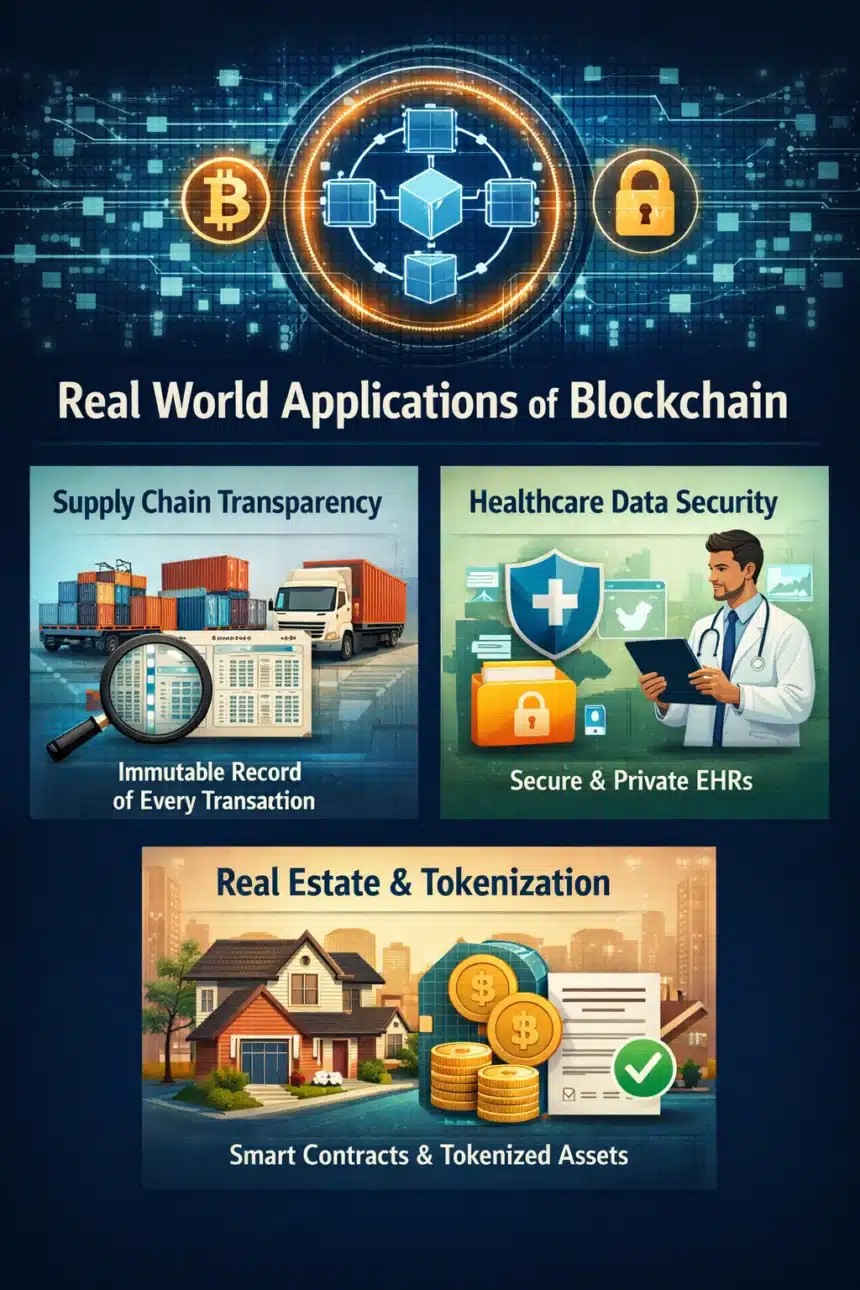
- Supply Chain Transparency can be attained by maintaining an immutable record of every transaction.
- Electronic Health Records (EHRs), a sensitive data in healthcare, are secured by means of blockchain technology, ensuring data can only be accessed by authorised personnel.
- Buying and selling property can be easier and more honest if we use digital “tokens” and automatic payments. This cuts out the middlemen and makes every step of the process clearer for everyone.
When I say the word blockchain, what is the first thing that comes to your mind? I bet you think of cryptocurrency. You will be surprised to know that the potential of Blockchain is not limited to Cryptocurrency. The Real-World Applications of blockchain are beyond cryptocurrency, including healthcare, government services, supply chain management, real estate and many more. Along with the information about Blockchain beyond Cryptocurrency, this article will be an eye-opener on how blockchain is used in real life.
Here, we will start with the basics of Blockchain technology before getting deeper into Blockchain use cases beyond crypto.
What in the world is Blockchain Technology?
An immutable digital ledger which works on decentralised and distributed technology to carry out transactions and data management across various platforms. Its transparent, secure, efficient, and fraud detection features make the real-world applications of blockchain go beyond cryptocurrencies.
Cybersecurity,pharmaceuticals, advertisement industry, banking and unified communications are some of the fields which successfully implemented the potential of Blockchain technology to overcome hurdles like centralisation of power, loss of transparency, fraud and security risks. The impact of blockchain technology in business, such as increased speed, lower costs, and automated efficiency, can be witnessed in our article Blockchain Breakthrough: Figure Technology Files for Public Offering.
Blockchain in supply chain management
Think of blockchain as a shared digital record book that everyone in a supply chain can see but no one can secretly change
Blockchain acts like a permanent, unchangeable GPS for products. It makes sure everyone stays honest, cuts out the paperwork, and proves that what you’re buying isn’t a fake.
Manual record-keeping and staff involvement may cause errors in the traditional supply chain, and the process may be slow. By the automatic updates of records in real time, productivity and reduced delays can be attained through the Blockchain streamlined process.
Blockchain in healthcare
The information in healthcare needs to be safe and secure since it deals with a lot of information. New technology like blockchain in healthcare is a safer and better option. As we are aware, the information stored in Blockchain cannot be changed, the electronic health records are protected from people who want to hack into them or steal the information. Since these records are immutable and locked with a code, only authorised people are able to see the information and get to it, say, the patient’s doctor.
Blockchain in the healthcare industry is a big deal, as it is used to keep information safe and secure. Blockchain also improves interoperability by allowing hospitals and healthcare providers to securely share up-to-date patient data, leading to better treatment decisions.
“The tamper-proof ledger system inherent to blockchain provides a fortified vault for patient data, effectively neutralizing the threat of systemic hacks or illicit data exposure.”
Blockchain in real estate
You cannot skip real estate while speaking about non-cryptocurrency blockchain applications. Since Blockchain technology plays a significant role in transparency, enhanced security, fraud reduction and removes the requirement of intermediaries, the future of Blockchain technology in the real estate field is unavoidable.
Whether you are purchasing a property, selling or leasing, Blockchain technology enables you to make smart decisions. Wonder how? The streamlined process, more transparency, smart contracts, Programmable payments, and tokenised assets benefit not only to increase efficiency but also enhance transparency and liquidity.
Conclusion
Blockchain technology applications are not limited only to cryptocurrencies. This decentralised ledger technology use cases extended to many fields. The role of blockchain in government service, a fairer and more trustworthy real-world application in voting systems, and Intellectual Property Protection are some of the blockchain use cases beyond crypto.
To gain knowledge of AI, Crypto, Blockchain, and the digital economy, The Central Bulletin breaks complex topics into easy-to-understand ones. Our team helps you to stay informed, from basic definitions to deep knowledge, to make investment decisions in the digital economy.