


Key Highlights
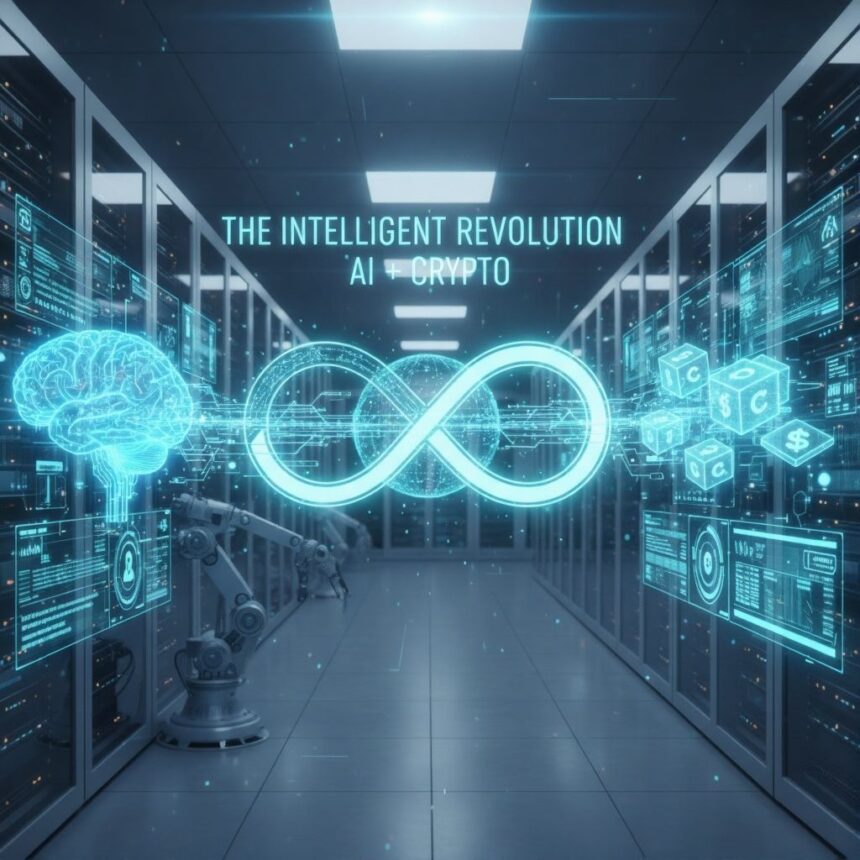
- The fusion of AI’s intelligence (analysis/prediction) and Crypto’s trust (decentralization/immutability) is the next major technological paradigm shift
- Blockchain provides trustworthy data for AI training, eliminating manipulation. AI creates smarter, dynamic smart contracts for advanced DeFi applications
- This convergence is driving Decentralized AI (DeAI) and AI-powered DAOs, distributing computational power and making governance automated, efficient, and secure
- Major hurdles include scaling blockchain for AI’s massive data, navigating complex regulation, and establishing robust ethical oversight for autonomous AI agents
The parallel rise of Artificial Intelligence (AI) and Cryptocurrency (powered by blockchain) has long been fascinating. For years, they’ve been hailed as the great technological disruptors of our time, evolving on separate but equally fast tracks. Today, that narrative is shifting. We are no longer watching two distinct evolutions; we are witnessing a powerful and unavoidable convergence a fusion that is set to redefine not just finance and technology, but the very infrastructure of global data, trust, and decision-making.
This editorial argues that the synergy between AI’s processing power and crypto’s decentralized trust layer represents the most significant technological paradigm shift of the coming decade.
A Partnership Built on Complementary Strengths
At their core, AI and blockchain/crypto solve different, yet complementary, problems.
- AI’s greatest asset is intelligence: the ability to analyze massive datasets, identify complex patterns, and make instantaneous, predictive decisions.
- Crypto’s greatest asset is trust: the ability to create immutable, transparent, and decentralized ledgers for transactions and data without needing a central authority.
When combined, they address each other’s most pressing limitations:
- Trustworthy Data for AI: AI models are only as good as the data they consume “garbage in, garbage out.” Blockchain provides a solution by creating verifiable,
tamper-proof provenance for the data used to train AI models. This ensures the data is clean, authentic, and free from manipulation, leading to more robust and ethical AI systems.
- Smarter, Autonomous Crypto: Traditional smart contracts are limited by pre-defined logic. Integrating AI allows for “smarter” smart contracts that can dynamically adapt their terms based on real-time external data (fed by decentralized oracles) or market
conditions. This enhances the complexity and utility of Decentralized Finance (DeFi) platforms, from dynamic interest rates to autonomous risk management.
The Rise of Decentralized Intelligence
The most transformative outcome is the emergence of Decentralized AI (DeAI) and
AI-powered Decentralized Autonomous Organizations (DAOs).
In a DeAI ecosystem, the control over AI models, datasets, and computational power is distributed, rather than being concentrated in the hands of a few tech giants. Crypto tokens serve as the economic incentive layer, rewarding individuals for contributing their computing resources (like unused GPUs, often dubbed the “AirBnB for graphics cards”) or high-quality data.
Furthermore, AI is beginning to be integrated into DAO governance itself. Imagine an AI agent acting as an auditor, scanning proposals for malicious code, or even voting on behalf of a DAO’s treasury to maximize yield based on complex market analysis. This promises to solve the common DAO pitfalls of low voter turnout and slow, uninformed decision-making, leading to truly efficient, automated, and secure decentralized governance.
Navigating the Challenges
As with any seismic technological shift, significant hurdles remain.
- Scalability and Data Storage: Blockchain networks are not natively designed for the petabytes of data required by large AI models. Solutions must be found in more efficient Layer 2 protocols and off-chain storage that maintains the cryptographic integrity required for AI training.
- Regulatory Fragmentation: The regulatory landscapes for both AI and crypto are nascent and often conflicting. Policymakers must move quickly to create cohesive, global frameworks that protect consumers and prevent illicit activity without stifling innovation at this critical intersection.
- Ethical Oversight: Granting powerful AI agents the autonomy enabled by smart contracts demands rigorous ethical and security standards. We must ensure mechanisms for oversight and reversal are built in, lest we create an unstoppable, buggy, or biased automated financial system.
The Path Forward
The convergence of AI and Crypto is more than a fleeting trend; it’s a foundational restructuring of how we compute, transact, and organize. For innovators in this space, the message is clear: focus on integrating the best of both worlds. Use blockchain to enforce trust and ownership, and use AI to provide the intelligence and automation needed to scale.
The intelligent, decentralized future is here. Those who embrace this powerful synergy responsibly will be the architects of the next digital era.