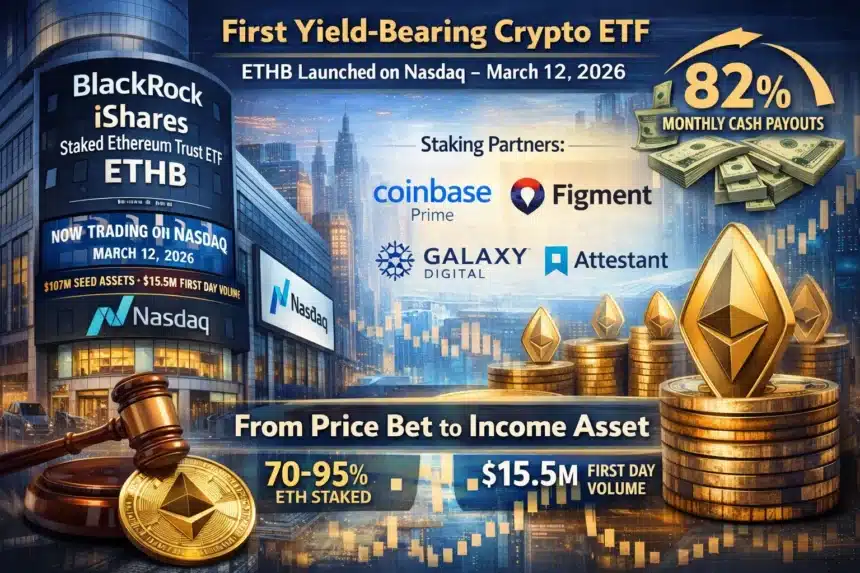
On March 12, 2026, BlackRock listed the iShares Staked Ethereum Trust ETF (ticker: ETHB) on Nasdaq. It debuted with $107 million in seed assets and drew $15.5 million in trading volume on its first day. It is not just another crypto ETF. It is the first major fund product to pass staking yield directly to retail investors as monthly cash distributions.
Key Highlights
- BlackRock’s ETHB listed on Nasdaq on March 12, 2026, with $107 million in seed assets and $15.5 million in first-day trading volume
- Between 70% and 95% of held ETH is staked through four operators: Coinbase Prime, Figment, Galaxy Digital, and Attestant
- Investors receive approximately 82% of gross staking rewards as monthly cash payouts — BlackRock and Coinbase retain the remaining 18%
- Current annualized staking yields on Ethereum sit at approximately 3.2%, making this a yield-bearing digital commodity for the first time
- The SEC approval sets precedent for staked ETF products on Solana, Avalanche, Cosmos, and other proof-of-stake networks
- Fidelity, Franklin Templeton, and VanEck each filed staked ETH applications in Q4 2025 — ETHB gives them the template they were waiting for
How ETHB Works
ETHB holds spot ETH and stakes between 70% and 95% of those holdings through four validator operators: Coinbase Prime, Figment, Galaxy Digital, and Attestant. Investors receive approximately 82% of gross staking rewards as monthly cash payouts. BlackRock and Coinbase retain the remaining 18% as a staking service fee.
The fee structure starts at 0.12% on the first $2.5 billion for the first 12 months, waived as part of a promotional launch discount. After that, the standard rate is 0.25%. Both figures are below the category average for commodity ETFs.
Why This Is Different From the Bitcoin ETF
The Bitcoin ETF (IBIT) was a passive hold. Buy ETH, put it in a wrapper, charge a fee. ETHB has an active yield component: the fund generates income from the Ethereum proof-of-stake protocol and distributes it monthly. That transforms the product from a price-exposure vehicle into something that resembles a yield-bearing asset.
For institutional allocators, that distinction matters. Fixed income desks, not just equity or alternatives desks, can now evaluate ETHB as a potential portfolio component. A yield-bearing digital commodity is a different asset class conversation than a speculative commodity.
For retail investors, it means that holding ETHB generates a return even in flat or sideways ETH markets, as long as staking rewards continue. Current annualized staking yields on Ethereum sit at approximately 3.2%.
What It Opens Up
The SEC approval of a staked ETF sets precedent. Every major proof-of-stake network, including Solana, Avalanche, and Cosmos, now has a clearer regulatory path to staked ETF products.
Fidelity, Franklin Templeton, and VanEck each filed staked ETH applications in Q4 2025. Those filings were pending ETHB approval. They are no longer pending a template. They have one.
The broader implication is that ETF wrappers around crypto can now be income products, not just price products. The first stablecoin yield ETF application is already in review at the SEC. Structured yield on RWA tokens is the logical next step.
The First Day in Context
$15.5 million in first-day volume is modest compared to IBIT’s $1 billion debut in January 2024. But the comparison misses the context. IBIT launched into years of pent-up institutional demand for a Bitcoin wrapper that simply did not exist. ETHB launches into a market where spot ETH ETFs have existed since mid-2024 and have already normalized institutional ETH exposure.
ETHB is not capturing new demand for ETH. It is upgrading what investors can do with the ETH exposure they already have.
The regulatory groundwork mattered here. The SEC and CFTC classified Ethereum as a commodity earlier this year, which cleared the path for a staked product that pays yield through a regulated wrapper.
The 3.2% annualized yield ETHB distributes is tied to Ethereum’s proof-of-stake rewards. Those rewards are sensitive to network activity. The Glamsterdam upgrade targets 10,000 TPS on the base layer, which could increase transaction volume and affect staking economics.
The TCB View
ETHB is the product the crypto industry has been asking institutional finance to build for three years. Now that it exists, the test is whether fixed income desks actually allocate to it. A 3.2% annualized yield on a digital commodity is not compelling compared to high-grade bonds in most interest rate environments. What makes ETHB structurally interesting is not the yield level — it is the asset class framing.
A regulated, yielding wrapper around the second-largest proof-of-stake network is a new category, not just a new product. If the structure works and attracts genuine institutional allocation, it templates every other major proof-of-stake asset. Solana, Avalanche, and Cosmos all follow. The first staked ETF is not the end of the story. It is the prototype for what comes next.
The modest first-day volume does not concern us. Structural products build slowly. IBIT’s first-day billion was an anomaly driven by years of pent-up demand. ETHB is building a new demand category from scratch. That takes longer — and it is worth watching more carefully than the day-one numbers suggest.