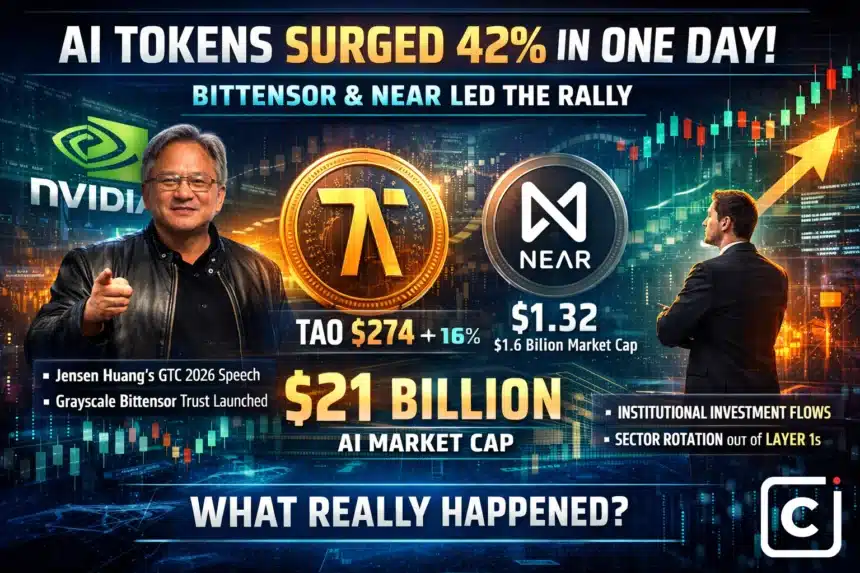
The AI crypto sector jumped over 42% in a single 24-hour window on March 21, 2026, pushing the combined market cap of AI-focused tokens to $21 billion. Bittensor (TAO) led the move, climbing 16% in seven days to reach $274 and a $2.6 billion market cap. NEAR Protocol followed, crossing $1.6 billion in market value. The catalyst was not a product launch. It was a combination of Jensen Huang, institutional access, and a sector rotation out of Layer 1 tokens.
Key Highlights
- AI crypto sector market cap: $21 billion after 42% single-day surge on March 21, 2026
- Bittensor (TAO): $274, up 16% in seven days, $2.6 billion market cap
- NEAR Protocol: $1.32, $1.6 billion market cap, up on the AI infrastructure narrative
- Grayscale Bittensor Trust launched, opening institutional access to TAO
- Jensen Huang’s GTC 2026 remarks cited as the direct catalyst for the rally
- AI tokens outperformed every other crypto sector on the day
What Triggered the Move
Three things hit simultaneously. Nvidia’s Jensen Huang used his GTC 2026 keynote to describe decentralized AI infrastructure as “the missing compute layer” for the next generation of AI deployment. He did not name any crypto projects specifically, but the framing directly validated Bittensor’s thesis. Markets moved before he finished speaking.
The same day, Grayscale confirmed the launch of its Bittensor Trust product, giving registered investment advisors and institutional allocators regulated access to TAO exposure without holding the token directly. The Grayscale wrapper has historically acted as a sentiment amplifier for assets it covers, regardless of immediate AUM size.
Finally, a broader sector rotation was already underway. Bitcoin ETF inflows had absorbed significant institutional capital over Q1, but some portfolio managers were looking for higher beta AI exposure. The AI token sector, which had lagged behind Bitcoin and Ethereum year to date, offered that leverage at a time when the macro narrative favored it.
Bittensor: Why It Led
Bittensor is not a standard Layer 1. It operates as a decentralized marketplace for machine intelligence, where validators compete to produce the best AI models and are rewarded in TAO. The token is designed to function like Bitcoin in structure, with a fixed supply of 21 million and an emission schedule based on mining, but the work being done is AI training rather than hash computation.
The appeal in March 2026 is specific. As centralized AI labs face increasing regulatory scrutiny over data and model transparency, Bittensor’s permissionless open model marketplace is positioned as the alternative. That narrative is resonating with developers and now, clearly, with traders.
The Upbit listing in South Korea earlier in March expanded TAO’s retail liquidity significantly. South Korean crypto volume is historically outsized relative to the country’s market share, and the Upbit listing created a new buyer pool that was primed for the Huang catalyst.
NEAR’s Role in the AI Infrastructure Story
NEAR Protocol has been quietly repositioning itself as the AI layer for Web3 since late 2025. Co-founder Illia Polosukhin’s repeated public statements that AI will be the primary interface layer for everything online, including crypto, have given NEAR a narrative edge that most Layer 1 projects lack.
The March 21 rally pushed NEAR from a position of relative underperformance to market-leading gains in the AI sector, suggesting that some capital was rotating specifically into Layer 1 projects with an AI positioning rather than tokens focused purely on AI.
What the Surge Does Not Prove
A 42% single-day move in a sector worth $21 billion is a momentum trade, not a fundamental rerating. Most AI crypto tokens still have limited on chain revenue, unclear token utility beyond speculation, and founder teams that have pivoted to the AI narrative within the past 12 months. The Bittensor and NEAR exception is that they have actual infrastructure with measurable usage. Many of the tokens that participated in the March 21 move do not.
Pullbacks in AI token rallies have historically been sharp. The May 2025 AI token surge of 38% gave back 60% of its gains within three weeks.
The TCB View
The Bittensor story is real and worth following. A decentralized marketplace for AI models that is structured like Bitcoin is a genuinely novel idea with plausible long term value. But the 42% sector-wide rally swept up dozens of tokens that have no substantive connection to AI infrastructure, only the word “AI” in their marketing. When institutional money enters this sector seriously, it will concentrate in Bittensor, NEAR, and a small number of verifiably functional AI protocols. Everything else is noise.