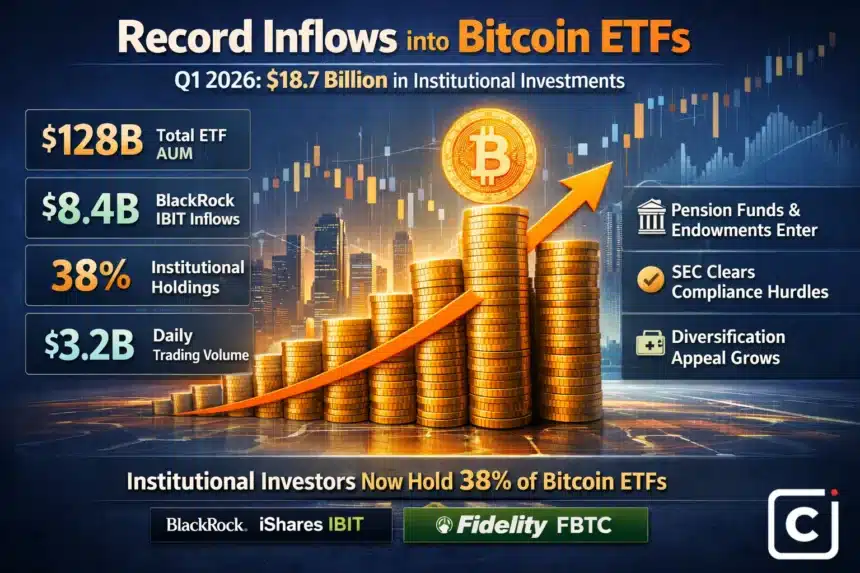
Bitcoin exchange-traded funds just posted the strongest quarter in their short history. U.S. spot Bitcoin ETFs absorbed $18.7 billion in net inflows during Q1 2026, pushing total assets under management past $128 billion. BlackRock’s iShares Bitcoin Trust (IBIT) alone captured $8.4 billion of that. This is not a spike driven by retail. Institutional allocators now account for 38% of total spot Bitcoin ETF holdings.
Key Highlights
- U.S. spot Bitcoin ETFs: $18.7 billion net inflows in Q1 2026
- Total ETF AUM crosses $128 billion for the first time
- BlackRock IBIT leads with $8.4 billion. Fidelity FBTC is second at $4.1 billion
- Institutional allocators now hold 38% of all spot Bitcoin ETF assets
- IBIT average daily trading volume: $3.2 billion, most liquid Bitcoin ETF by far
- Four consecutive weeks of positive inflows heading into March 22
The Numbers Behind the Record
The Q1 2026 inflow figure of $18.7 billion surpasses the previous quarterly record set in Q4 2024, when the post-election rally drew the first major wave of institutional capital. The difference this time is the composition of who is buying.
In 2024, inflows were driven largely by retail investors and crypto native funds rotating from self-custody into regulated wrappers. In 2026, pension funds, endowments, and registered investment advisors have entered. The 38% institutional share is a structural shift, not a speculative trade.
BlackRock’s IBIT has cemented itself as the dominant product. Its $3.2 billion average daily trading volume makes it more liquid than many large-cap U.S. equity ETFs. Fidelity’s FBTC, second at $4.1 billion in Q1 inflows, is the only other fund capturing meaningful market share. The remaining ten or so spot Bitcoin ETFs collectively account for less than 15% of inflows.
Why Institutions Are Moving Now
The timing is not accidental. Three factors converged in early 2026 that made institutional allocation significantly easier than it was even 18 months ago.
First, the SEC’s guidance clarifying that spot Bitcoin ETFs qualify as eligible investments under most institutional investment policy statements removed a key compliance barrier. Many pension funds and endowments had Bitcoin ETF exposure on their watchlist for months but could not act without that clarification.
Second, Bitcoin’s price correlation with traditional risk assets has declined meaningfully. A portfolio allocation analysis published by BlackRock’s research team in February 2026 showed Bitcoin’s 12 month rolling correlation with the S&P 500 dropped to 0.31, the lowest since 2020. For institutional portfolio constructors, lower correlation means genuine diversification value.
Third, custody and reporting infrastructure has matured. Third-party custody, real time NAV reporting, and clean tax treatment through the ETF wrapper have removed the last operational objections most institutions cited.
What the Inflows Are Not Saying
$18.7 billion flowing into Bitcoin ETFs does not mean $18.7 billion of new demand for Bitcoin at the spot level. ETF flows represent capital moving into regulated vehicles, some of which is rotation from existing crypto holdings rather than entirely fresh money entering the ecosystem.
It also does not signal that Bitcoin’s price will necessarily follow inflows upward in the short term. Q1 2026 inflows came while Bitcoin ranged between $82,000 and $92,000, a relatively tight band suggesting that selling pressure from holders who have owned Bitcoin long term has partially offset institutional buying.
The more useful signal is the four consecutive weeks of positive inflows heading into March 22. Extended inflow streaks historically precede rather than accompany price moves. The capital is being positioned, not reacting.
The TCB View
The Q1 2026 ETF data marks a line in the sand. Bitcoin is no longer an asset class institutions are considering. It is one they are actively allocating to at scale. The 38% institutional ownership figure is the number that matters most. Once that crosses 50%, the dynamics of who sets Bitcoin’s price at the margin will have fundamentally changed. At that point, Bitcoin’s price behavior will begin to look more like gold and less like a speculative tech asset. That transition has a date now. We are watching it happen in real time.