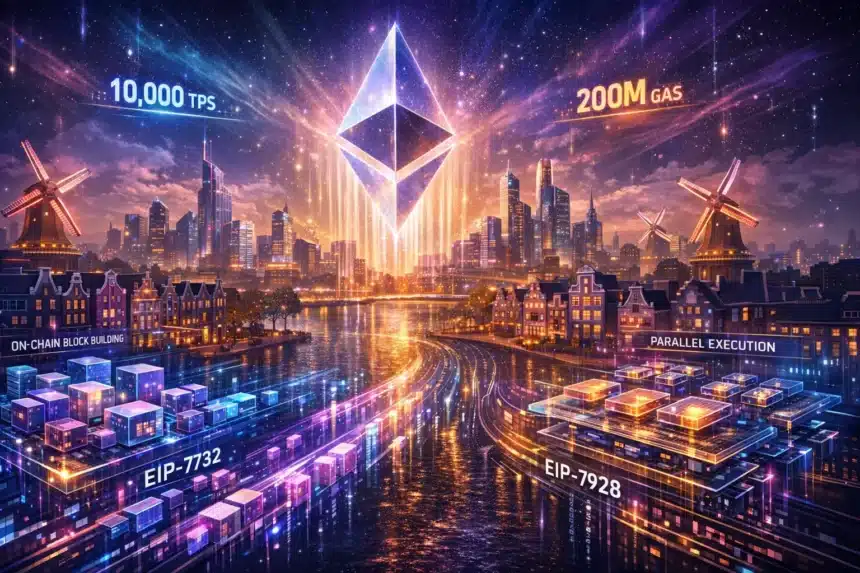
Glamsterdam is Ethereum’s next hard fork, targeted for H1 2026 with a tentative June date that could slip to Q3 or Q4. The two confirmed headline EIPs are EIP-7732 (Enshrined Proposer-Builder Separation) and EIP-7928 (Block Level Access Lists). Together with a gas limit increase from 60 million to 200 million per block, the upgrade targets approximately 10,000 transactions per second on the base layer, up from roughly 1,000 today.
This is an L1 upgrade, not an L2 one. And that distinction matters more than most coverage suggests.
Key Highlights
- EIP-7732 moves proposer-builder separation into the Ethereum protocol, removing a centralisation risk that has existed offchain since 2021
- EIP-7928 introduces Block Level Access Lists, enabling parallel transaction execution for the first time on Ethereum
- The gas limit is targeted to increase from 60 million to 200 million per block, aiming for approximately 10,000 TPS
- The 10,000 TPS headline is a theoretical ceiling. Real-world throughput post-upgrade will be materially lower during the adoption phase
- Glamsterdam does not touch sharding or data availability. That is scoped for the Hegota fork later in 2026 or 2027
What EIP-7732 Actually Does
Proposer-builder separation (PBS) describes the division between the validator that proposes a block and the specialized actor that assembles its transaction contents for maximum extractable value. Since 2021, this separation has existed as an offchain arrangement: MEV-boost, run by Flashbots, handles the builder market outside the Ethereum protocol itself.
EIP-7732 moves PBS into the protocol. Builders no longer rely on third-party relay infrastructure that Ethereum cannot audit, slash, or govern. The protocol validates builder commitments directly, which removes a trust assumption that has been a quiet systemic risk in Ethereum’s block production since the Merge.
The practical change for users is less dramatic: lower MEV exposure, more predictable transaction inclusion, and reduced gas fee volatility during high-traffic periods. For protocol security researchers, it is significant. The largest operator of MEV-boost relays today processes over 90% of Ethereum blocks. Enshrining PBS removes that concentration risk.
What EIP-7928 Actually Does
Block Level Access Lists specify in advance which accounts and storage slots a block’s transactions will read or write during execution. This is the precondition for parallel transaction processing.
Currently, the Ethereum EVM executes transactions sequentially. Each transaction might touch any state slot, so the EVM cannot safely run two transactions simultaneously without knowing in advance that they do not share state. BALs solve this: if a transaction declares its state access upfront, the EVM knows which transactions can run in parallel without conflicts.
The gas limit increase from 60 to 200 million only delivers its capacity if execution can keep pace. EIP-7928 is what makes that throughput realizable rather than theoretical. Without it, tripling the gas limit would triple the validation burden without tripling actual throughput.
The Gas Limit Change: Context Matters
The Ethereum gas limit is not set by the protocol. It is a parameter validators adjust block-by-block within a range. The current de facto limit of 60 million was reached through a series of validator votes in late 2024 and early 2025.
The Glamsterdam upgrade does not hard-code 200 million. It raises the ceiling toward and beyond 100 million as an immediate target, with 200 million as a medium-term objective as BAL adoption by block builders matures. This means the upgrade arrives in phases driven by validator coordination rather than a single switch. Users should not expect 200 million gas blocks on activation day.
What Glamsterdam Does Not Change
Glamsterdam does not touch sharding or data availability in any meaningful way. Danksharding, which will dramatically expand blob throughput for L2s, is scoped for the Hegota fork later in 2026 or 2027. The two upgrades address different parts of the stack.
Glamsterdam also does not solve MEV at the application layer. EIP-7732 removes the relay trust assumption, but the economic incentive to front-run and reorder transactions remains. MEV will continue as long as profitable ordering exists.
The 10,000 TPS target is a theoretical ceiling under optimal conditions. Real-world throughput after Glamsterdam, with typical transaction mixes and BAL adoption curves, will be materially lower.
The L1 upgrade also arrives into an L2 consolidation already underway. Of the 50 rollups that launched in 2023 and 2024, most are inactive. Glamsterdam’s throughput improvements will reshape the economics for the survivors.
Ethereum’s protocol health is now a yield variable. BlackRock’s staked ETH product pays monthly distributions tied to staking rewards. How Glamsterdam affects network activity and validator economics will flow directly into that yield.
The TCB View
Glamsterdam is one of the most technically consequential Ethereum upgrades since the Merge, and it is receiving a fraction of the coverage. EIP-7732 addresses a centralisation risk that has been openly discussed among protocol researchers for three years. Moving PBS onchain is not optional infrastructure hygiene. It is a prerequisite for Ethereum’s credible neutrality claim at scale.
The gas limit increase gets the headlines. BALs and ePBS are what matter. The upgrade timeline slipping from June to Q3 or Q4 is not a failure. It reflects how seriously Ethereum’s core developers treat activation risk on a $300 billion network. Slow and correct beats fast and wrong, every time.
If Glamsterdam ships cleanly, it establishes the execution environment that Danksharding’s data layer will build on. These two upgrades together represent the most significant L1 scaling leap since Ethereum’s inception. The industry should be paying more attention.