Key Highlights
- Privacy coins are like the money in your wallet. Instead of using cash you use them online. This means you can keep the things you buy, how much money you have and how much you earn privately so nobody can see what you are doing.
- While coins like Monero and Zcash use math to make transactions hard to understand, they are really just trying to keep people safe from bad guys who want to steal their money or identity or companies that want to charge them more for things.
- In the year 2026 there is an argument going on. Governments want to control Privacy coins because they think some people are using them to do things.. Regular people are using Privacy coins because they want to be free and keep their personal lives private.
- The future of Privacy coins is about finding a way to let people keep their daily lives private while still being able to share information with the government when they need to. This way Privacy coins can help people have private security, which is very important, for Privacy coins.
The story of money is changing fast. For a time if you had a paper bill in your pocket that money belonged to you and only you. When you gave it to a shopkeeper to buy a loaf of bread nobody else knew about that transaction. There was no list somewhere that had your name, the date, the time and the exact amount of change you got. This was the way things were with physical cash.
As we get deeper into 2026 this way of doing things is going away. Most of the money we use now like credit cards, banking apps or even famous digital currencies like Bitcoin is really out in the open. Imagine if every time you swiped your card a message was sent to a public board that anyone could see. That is what is happening in the digital world.
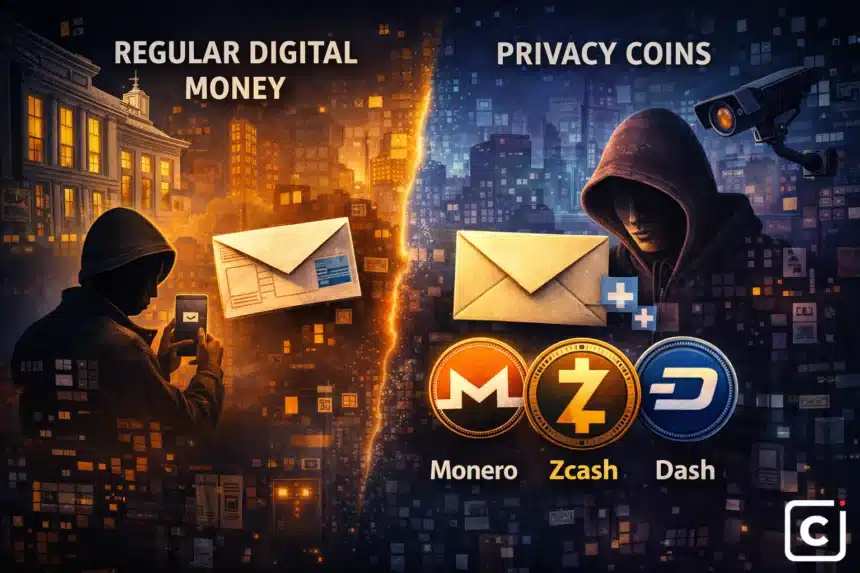
This is where something called privacy coins comes in. They are a kind of digital money that is made to bring back the feeling of using cash. You know, like when you put a letter in an envelope and nobody can see what is inside. In this article we are going to talk about why privacy coins are important, how they work in a way that is easy to understand and why they are a big part of a global discussion, about our right to keep our lives private.
Why Does Privacy Even Matter?
You might hear people say, “If you have nothing to hide, you have nothing to fear.” But think about your daily life. You pull the curtains when you change clothes. You put a password on your email. You don’t tell every stranger on the street how much money is in your savings account.
Privacy is not about being “bad.” It is about having a choice.
The Danger of a “Glass” Economy
In a world where all money is tracked, your data becomes a product. Companies can see that you just bought a certain type of medicine and start sending you targeted ads. Worse, if a criminal finds out your digital “address” and sees that you have a lot of money, you become a target for kidnapping or digital theft.
Privacy coins act as a shield. They allow you to participate in the digital economy without leaving a trail of “digital breadcrumbs” that lead right back to your front door.
The Role of Freedom
In many parts of the world, people live under governments that might freeze their bank accounts for supporting the “wrong” political party or participating in a protest. In 2026, we are seeing more and more people turn to private digital money as a way to ensure they can always feed their families, no matter what is happening in the world of politics.
How Do These Coins Actually Work? (The Simple Version)
To understand privacy coins, we first need to look at how a “normal” digital currency works. Think of a normal one like a public ledger a giant notebook at the library that everyone can read. It says:
- Person A sent 5 coins to Person B.
You don’t see their names, but you see their “account numbers.” If you follow those numbers long enough, you can figure out who they are.
Privacy coins use three main tricks to “blur” this notebook so it can’t be read by nosy neighbors.
1. The Mask (Hiding the Receiver)
When you send money using a privacy coin, the system creates a “fake” address that only exists for that one transaction. It’s like sending a letter to a PO Box that disappears as soon as the letter is picked up. No one can look at the receiver and see a history of all the other money they’ve ever gotten.
2. The Crowd (Hiding the Sender)
Imagine you want to give a friend a twenty dollar bill. You do not want anyone to see you do it. You and ten other people all walk into a room at the same time. You all throw a twenty dollar bill into a hat. Then your friend reaches in and grabs one.Because everyone moved once someone watching outside the room has no idea whose specific twenty dollar bill ended up with your friend.Privacy coins do this instantly with digital code so it is like throwing all the twenty dollar bills into a hat. Your friend gets one but it happens really fast with digital code.
Privacy coins are like this: they help keep things, like the twenty dollar bill your friend got.
3. The Fog (Hiding the Amount)
Some coins go a step further and hide the number itself. The system uses a special kind of math to prove that you have enough money to pay for your coffee, without actually telling the network if you are spending $5 or $5,000. It’s like a vending machine that confirms your coin is real but doesn’t tell the owner how much change is left in your pocket.
Meeting the Main Players of 2026
There are many different types of these coins, but three of them have become the “celebrities” of the privacy world. Each one has a different personality.
Monero: The “No Exceptions” Coin
Monero is the most famous privacy coin because it doesn’t give you a choice. Every single transaction is private by default. You can’t “turn off” privacy.
- Who uses it? People who want the highest level of protection possible.
- The Catch: Because it is so private, many big banks and governments are afraid of it. In 2026, it can be harder to buy Monero through a standard bank app than other coins.
Zcash: The “Choice” Coin
Zcash is like a house with both a front porch and a private backyard. You can choose to make a transaction “public” (transparent) or “private” (shielded).
- Who uses it? People who want to be private but also want to be able to show their records to an accountant or a tax office if asked.
- The Catch: Most people forget to turn on the “private” setting, meaning they aren’t as protected as they think they are.
Dash: The “Everyday” Coin
Dash was built to be fast. It’s great for buying a sandwich or a movie ticket. It has an optional “PrivateSend” button that mixes your money with others.
- Who uses it? Regular shoppers who want a little more privacy than a credit card but don’t need to be a “digital ghost.”
- The Catch: Its privacy isn’t quite as strong as the others, so it’s more for casual use than for high-stakes protection.
The Great Global Debate (The “Bad Guy” Problem)
We have to be honest: if you can hide money, bad people will try to hide money. This is the main argument governments use to try and ban these coins. They worry about money being used for things that hurt society.
Is the Criticism Fair?
While it is true that criminals use privacy coins, it is also true that criminals use $100 bills and regular bank accounts. In fact, most experts agree that the vast majority of “dirty money” still moves through traditional banks, not digital coins.
In 2026, the debate has shifted. Instead of trying to ban the coins entirely, many countries are trying to find a middle ground. They are asking: “How can we let citizens have privacy while still catching the big criminals?”
The “Travel Rule”
You might hear about something called the “Travel Rule.” This is a regulation being pushed in 2026 that requires digital money companies to share information about who is sending money. Privacy coins make this very difficult, which is why there is so much friction between the tech world and the law-making world right now.
Why Privacy is a Human Right in 2026
As our lives become 100% digital, the line between our “money” and our “identity” is blurring. If someone knows what you buy, they know who you are.
Protecting the Vulnerable
Consider a woman trying to leave an abusive relationship. If her partner can track every cent she spends via a shared bank account or a public digital ledger, she can never truly escape. Privacy coins give her a way to save money for a bus ticket or a new apartment in total secrecy. This is a “humane” use of technology that often gets lost in the headlines about hackers and millionaires.
Fighting “Price Discrimination”
Have you ever noticed that a flight or a hotel room might cost more if you search for it on a fancy computer versus an old one? Companies use your data to figure out how much they can squeeze out of you. If you pay with a private coin, the company doesn’t know who you are or what your balance looks like. They have to give you the same fair price they give everyone else.
What Does the Future Look Like?
Where is all of this going? If we look toward the end of 2026 and beyond, we can see three major trends.
1. Privacy Becomes “Invisible”
In the early days of the internet, you had to be a genius to send an encrypted email. Today, apps like WhatsApp and iMessage do it automatically. We are moving toward a world where your digital wallet will handle privacy for you. You won’t have to “learn” how to be private; the coins will just work that way in the background.
2. The Rise of “Audit-Friendly” Privacy
We will likely see more coins like Zcash that allow “Selective Disclosure.” This means you can keep your money hidden from the world, but if the government asks for a tax audit, you can click a button and show them only what they need to see. This balance of “Privacy for the public, accountability for the law” is where the world is headed.
3. The Battle of the “Digital Dollar”
Many countries are now creating their own “Official” digital currencies (often called CBDCs). These are the opposite of privacy coins. They are designed to give the government more sight into where money goes. This will create a clear choice for citizens: Do you want the convenience of the government’s official coin, or the freedom of a private one?
How to Stay Safe in the World of Privacy Coins
If you are thinking about exploring this world, it is important to remember that with great freedom comes great responsibility.
- You are your own bank: There is no “Forgot Password” button in the world of privacy coins. If you lose your digital keys, your money is gone forever.
- Watch out for fakes: Because these coins are popular, many scammers create fake versions. Always make sure you are using official apps and trusted sources.
- Stay Legal: Always check the rules in your specific country. While the technology is amazing, you don’t want to accidentally break a local law regarding how you report your taxes.
Summary: A World Worth Protecting
Privacy coins are often misunderstood. They are painted as tools for shadows and secrets, but at their heart, they are tools for light and safety. They are the digital version of the “Keep Out” sign on a bedroom door or the “Private” stamp on a personal letter.
In 2026, as every part of our lives moves onto a screen, the ability to keep some things to ourselves is becoming one of the most valuable things we own. Whether you use them or not, the existence of privacy coins ensures that we still have the option to be private. And in a world that is always watching, that option is priceless.
| Comparison At A Glance | Regular Digital Money | Privacy Coins |
| Privacy Level | Like a postcard (anyone can read it) | Like a sealed envelope |
| Who Controls It? | Banks or public networks | You (and the code) |
| Ease of Use | Very easy, accepted everywhere | Getting easier, but still a bit specialized |
| Main Risk | Data leaks and tracking | Losing your password/keys |
A Final Thought
The best privacy coin is not the one with math. It’s the one that makes you feel secure. As we move forward in 2026 watch how these tools develop. They are not about money; they are about our right to live privately without being tracked. Privacy coins are key to that.They help keep our transactions safe. That is what matters most.
FAQ:
1. Is using a privacy coin the same as money laundering?
No. Using a privacy coin to buy a coffee or support a charity is just like using cash. It only becomes “laundering” if you are intentionally trying to hide money earned from a crime. Most users are just regular people who don’t want their data sold.
2. Why do some coins get “delisted” from shops?
Governments often tell digital “shops” (exchanges) that they aren’t allowed to sell privacy coins because the government can’t track the users. To keep their business licenses, the shops stop selling those coins.
3. Can I turn Bitcoin into a privacy coin?
There are tools that try to “mix” Bitcoin to make it private, but it’s like trying to put a mask on a person who is already famous. It’s much harder and less effective than using a coin that was built to be private from day one.
4. What happens if I lose my “keys”?
In the world of privacy coins, your “key” is a long string of words. If you lose those words, there is no help desk to call. The money is locked in a digital vault forever. This is why being your own bank requires being very organized!
5. Are privacy coins faster than regular ones?
Sometimes! Because they don’t always have to announce every detail to the whole world in the same way, some privacy coins like Dash can be much faster than older coins like Bitcoin.