Key Highlights
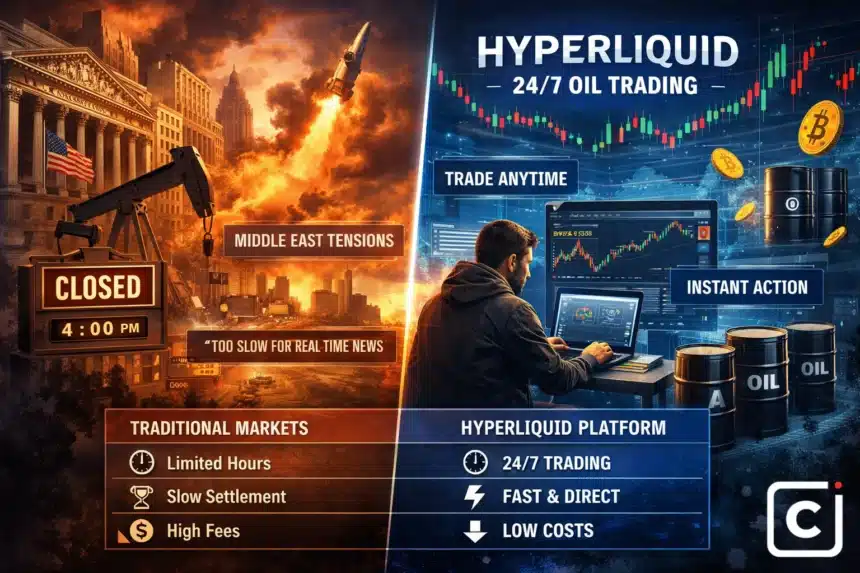
- 24/7 Access: Unlike the New York Stock Exchange, Hyperliquid allows users to trade oil every single second of the day, including weekends.
- Geopolitical Impact: The threat of conflict in the Middle East, particularly involving Iran, makes oil prices move fast; traders need a platform that moves just as fast.
- JPMorgan’s Warning: The bank highlighted that traditional markets are too slow for the “real-time” nature of modern war news.
- Beyond Crypto: While Hyperliquid uses blockchain technology, it is being used by “real-world” investors to trade “real-world” commodities like oil.
In a world that never sleeps, the traditional financial markets are starting to look like relics of a bygone era. According to a groundbreaking report from JPMorgan, one of the largest and most respected banks in the world, a significant shift is happening in how people trade oil. Because of the ongoing tensions and the threat of war involving Iran, investors are moving away from old-school stock exchanges and flocking to a digital platform called Hyperliquid.
This isn’t just a story for tech experts or “crypto fans.” This is a story about how everyday people and major investors are changing the way they protect their money during times of global crisis. When the world feels unstable, the “gaps” in our old systems become obvious, and new technology steps in to fill them.
Understanding the “Iran Factor” in Oil Prices
To understand why a trading boom is happening, we first have to understand why oil prices are so sensitive. Iran is a major player in the global energy market. It sits next to the Strait of Hormuz, a narrow stretch of water through which about 20% of the world’s total oil consumption passes every single day.
When there is talk of war, or when tensions between Iran and its neighbors escalate, traders get nervous. They worry that the flow of oil will be blocked. If the supply of oil goes down, the price goes up. This is basic “supply and demand.”
However, “news” doesn’t wait for the markets to open. A geopolitical event like a missile strike or a failed peace talk can happen at 3:00 PM on a Saturday. In the traditional world, if you own oil and you see bad news on Saturday, you have to wait until Monday morning to sell or change your position. By the time Monday rolls around, you might have already lost a fortune.
What is Hyperliquid and Why is it Different?
Hyperliquid is what experts call a “decentralized exchange.” For the average person, think of it as a digital marketplace that is run by code rather than by a big building in New York.
The Problem with Traditional Markets
Traditional markets, like the New York Mercantile Exchange (NYMEX), have been the gold standard for decades. But they have rules that are starting to feel outdated:
- Market Hours: They close on weekends and holidays.
- Middlemen: You usually need a broker or a bank to help you trade.
- Slow Settlement: It can take days for your money to actually move from one place to another.
The Hyperliquid Solution
Hyperliquid uses blockchain technology to solve these problems. It doesn’t have a CEO who decides when the market opens or closes. The “code” keeps the market running forever.
- No Closing Bell: You can trade on Christmas Day, at midnight on a Sunday, or during a Tuesday morning commute.
- Direct Access: You don’t need a fancy suit or a bank account at a major firm. You just need a digital wallet.
- Instant Reaction: As soon as a news alert hits your phone about Iran, you can click “buy” or “sell” and the trade happens in less than a second.
Why JPMorgan is Paying Attention
When a bank like JPMorgan writes a report about a digital platform, it’s a big deal. Usually, big banks are skeptical of “crypto-related” things. However, their analysts noticed something undeniable: The volume of oil being traded on Hyperliquid is exploding.
The bank pointed out that “geopolitical shocks” which is just a fancy way of saying “scary world events” expose the flaws in our current financial system. They noted that during recent moments of high tension in the Middle East, the activity on Hyperliquid spiked.
This tells us that investors aren’t just using these platforms to buy “magic internet money.” They are using them to manage the risk of their real-world businesses. If you run a shipping company or a trucking fleet, the price of oil matters to your survival. If the traditional markets are closed, you go where the lights are still on.
How “Synthetic” Oil Trading Works (Simply Explained)
You might be asking: “How can a computer program trade oil? Is there a giant warehouse of oil barrels somewhere?”
The answer is no. Hyperliquid uses something called Perpetual Contracts (Perps).
What is a Perp?
Imagine you and a friend make a bet. You think the price of oil will go up, and your friend thinks it will go down. You both put $10 on the table. You check the official price of oil on a trusted news site. If the price goes up, you take some of your friend’s money. If it goes down, your friend takes some of yours.
A “Perp” is just a high-tech version of that bet. You aren’t buying the physical oil; you are “contracting” to pay or receive the difference in its price.
- The Price Feed: Hyperliquid uses “Oracles.” These are super-fast data connections that pull the price of oil from the real world and “feed” it into the digital platform.
- The Collateral: Instead of cash, people use “Stablecoins.” These are digital tokens that are always worth $1.00.
The Benefits of Trading in the “New Way”
Beyond just being open 24/7, platforms like Hyperliquid offer several advantages that are drawing in a “boom” of new users.
1. Transparency
In a traditional bank, you don’t always know what is happening behind the scenes. On a blockchain-based platform, every single trade is recorded on a public ledger. While you don’t necessarily know who is trading (it’s anonymous), you can see exactly how much oil is being traded and at what price. This prevents big banks from manipulating the market in secret.
2. Lower Costs
Banks and brokers charge “fees.” They charge you to open an account, they charge you to make a trade, and they take a cut of your profits. Because Hyperliquid is run by software, the fees are much, much lower. This makes it easier for smaller investors to participate.
3. “Permissionless” Finance
In many parts of the world, it is very hard to get access to global oil markets. If you live in a country with a weak banking system, you might be locked out of the world economy. With digital platforms, all you need is an internet connection. This is “democratizing” finance giving everyone the same tools that the big Wall Street traders have.
The Risks: What You Need to Know
While the JPMorgan report is exciting, it is important to be realistic. Trading oil during a war is “volatile.” Volatility means the price can go up 10% and down 10% in the same hour.
1. No “Safety Nets”
In the traditional stock market, if a price drops too fast, the exchange will “pause” trading for 15 minutes to let everyone calm down. This is called a Circuit Breaker. Digital platforms like Hyperliquid don’t usually have these. If the price crashes, it crashes all the way.
2. Leverage is a Double-Edged Sword
Many traders on these platforms use “leverage.” This means they borrow money to make a bigger bet.
- The Good Side: If you bet $100 with 10x leverage, you are effectively betting $1,000. If the price goes up, you make 10 times the profit.
- The Bad Side: If the price goes down just a little bit, you lose your entire $100 instantly. This is called “liquidation.”
3. Smart Contract Risk
Since the platform is run by code, there is always a tiny chance the code has a “bug.” While Hyperliquid has a strong track record, the world of digital finance is still relatively new compared to the 100-year-old New York Stock Exchange.
Who is Moving to Hyper liquid?
Originally, these platforms were only for “crypto enthusiasts” people who loved Bitcoin and technology. But the JPMorgan report shows that the demographic is changing.
- Hedge Funds: Professional money managers who need to protect their clients’ wealth over the weekend.
- Commodity Traders: People who have spent their lives trading oil but are frustrated by the slow speed of old banks.
- Global Investors: People in Europe, Asia, and the Middle East who want to trade based on local news without waiting for New York to wake up.
A Comparison: Old vs. New
To make it easy to see why this “boom” is happening, let’s look at a simple comparison table.
| Feature | Traditional Oil Trading (Banks) | Hyperliquid (Digital Platform) |
| Opening Hours | 9:30 AM – 4:00 PM (usually) | 24 hours / 7 days a week |
| Weekend Trading | No | Yes |
| Who can join? | Must have a broker/bank account | Anyone with a digital wallet |
| Speed | Can take minutes or hours | Happens in milliseconds |
| Fees | High (commissions, bank fees) | Very low (code-based fees) |
| Safety | High (Government regulated) | Moderate (Code-regulated) |
The Future: Is This the “New Normal”?
The fact that war volatility in Iran is driving this boom suggests that we are at a “tipping point.” People used to think of crypto and “real” commodities (like oil) as two different worlds. Now, those worlds are merging.
JPMorgan’s report isn’t just a comment on oil; it’s a prediction for the future of all trading. In five or ten years, we might look back and think it was “crazy” that we used to close the markets on Saturdays. Why should the world’s economy pause just because it’s the weekend?
As long as there is tension in the world whether it’s in the Middle East or elsewhere prices will change rapidly. And as long as prices change rapidly, traders will seek out the fastest, most accessible tools to manage their money. Right now, that tool is Hyperliquid.
FAQ:
1. Why is Iran specifically mentioned in the oil boom?
Iran is a key member of OPEC (the group of countries that produce much of the world’s oil) and is located in a very sensitive geographical area. Any threat of war involving Iran suggests a high risk that oil supplies will be cut off, causing prices to jump.
2. Can I lose money on Hyperliquid?
Yes. Just like any form of trading, if you bet that the price of oil will go up and it actually goes down, you will lose money. Because it moves 24/7, the market can change while you are asleep.
3. Is Hyperliquid a “crypto” thing?
It is built on blockchain technology (the same tech behind Bitcoin), but it allows you to trade things that aren’t crypto, like oil, gold, and stock indices. Think of it as a “crypto-powered” version of a regular stock market.
4. Why did JPMorgan call it a “boom”?
They used this word because the amount of money flowing into these oil contracts on Hyperliquid has grown faster than almost any other sector of the digital market recently.
5. Do I need a lot of money to start?
No. Traditional oil trading often requires “lots” (large minimum amounts). On digital platforms, you can often start with very small amounts of money, sometimes as little as $10 or $20.
Final Thoughts: The World is Getting Faster
The “Oil Trading Boom” on Hyperliquid is a sign of the times. We live in a world of instant information. When we hear about a conflict in Iran, we see it on Twitter or news apps instantly. It only makes sense that the way we trade should be just as fast.
While there are risks to moving away from the “safety” of traditional banks, many investors feel that the biggest risk of all is being “stuck” in a closed market while the world is changing. As JPMorgan noted, the “gaps” are being exposed, and for now, the digital world is winning the race to fill them.